Spectroscopic Ellipsometry for Two-Dimensional Materials: Methods, Optical Modeling, and Emerging Phenomena
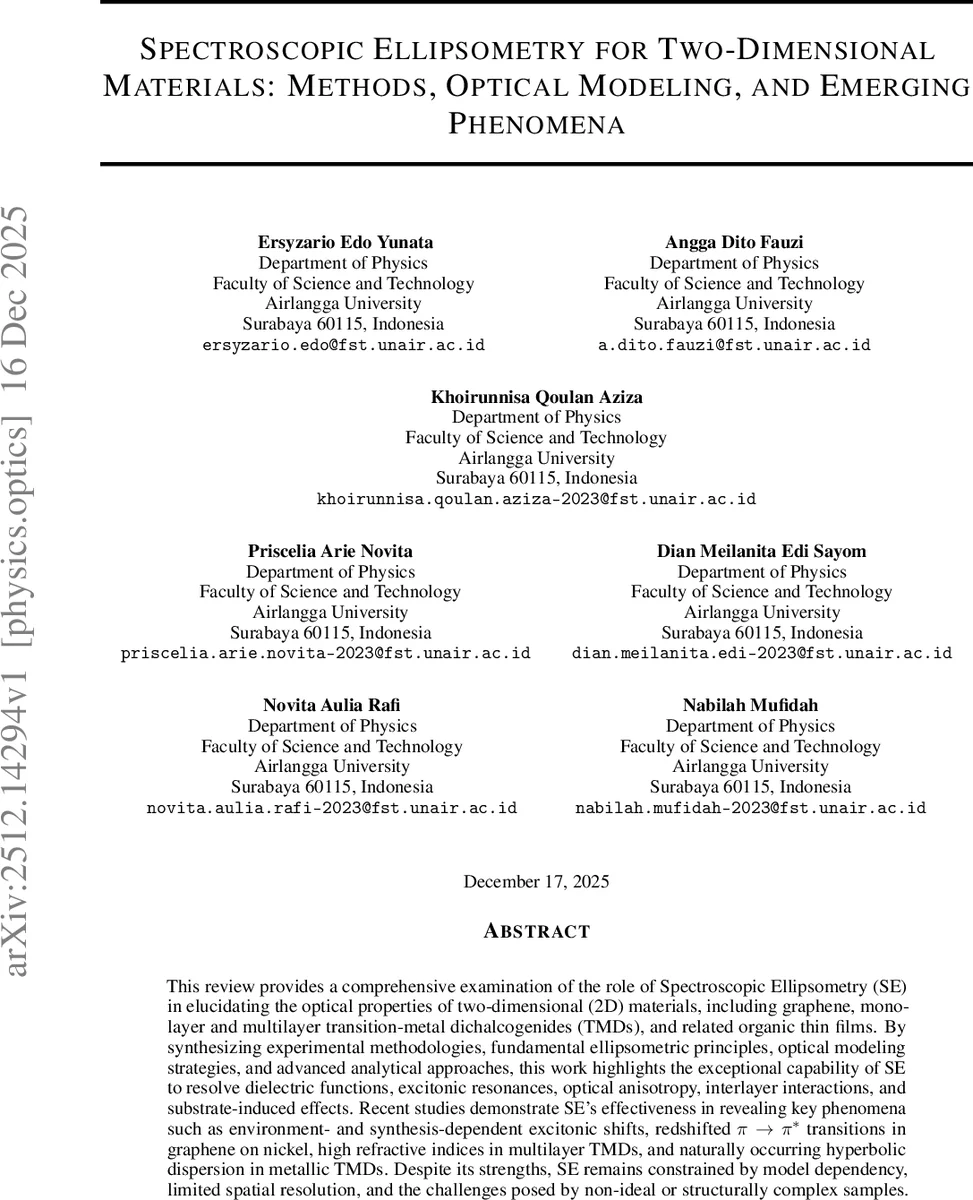
Spectroscopic ellipsometry (SE) has emerged as a powerful and non-destructive optical characterization technique for probing the complex dielectric properties of two-dimensional (2D) materials. This review provides a comprehensive overview of ellipsometric methods applied to atomically thin and multilayer van der Waals materials, including graphene, transition metal dichalcogenides, and other emerging 2D systems. We discuss experimental configurations, optical modeling strategies, and challenges associated with reduced dimensionality, anisotropy, and substrate effects. Advanced techniques such as Mueller matrix ellipsometry are highlighted for their capability to resolve in-plane and out-of-plane dielectric tensor components in anisotropic and low-symmetry materials. Furthermore, we review recent discoveries enabled by ellipsometry, including extreme optical anisotropy, hyperbolic dispersion, and tunable plasmonic responses in multilayer 2D materials. These findings establish spectroscopic ellipsometry as an essential tool for both fundamental studies and photonic device engineering based on two-dimensional materials.
💡 Research Summary
Spectroscopic ellipsometry (SE) has become an indispensable, non‑destructive tool for probing the complex dielectric response of atomically thin and multilayer van‑der‑Waals materials. This review first outlines the fundamental principle of SE—measurement of the amplitude ratio (Ψ) and phase difference (Δ) between p‑ and s‑polarized reflected light, which together form the complex ellipsometric ratio ρ = tan Ψ e^{iΔ} = r_p/r_s. By operating at oblique incidence (45°–80°) and acquiring data at several angles, SE achieves sub‑nanometer thickness sensitivity and high accuracy for optical constants (n, k).
Two modeling strategies are highlighted for 2D systems. The three‑dimensional slab model treats the material as a thin film of finite thickness d with a bulk‑like dielectric function ε(ω). The two‑dimensional sheet model, in contrast, represents the layer as an infinitesimally thin sheet characterized by a sheet conductivity σ, avoiding explicit thickness assignment. Both approaches require a stratified optical stack that includes the substrate, possible surface roughness, and interfacial mixing layers. Roughness and interfacial inhomogeneity are commonly described using the Bruggeman effective‑medium approximation (EMA).
Anisotropy is a central issue for many transition‑metal dichalcogenides (TMDs). Uniaxial TMDs demand separate in‑plane (ε∥) and out‑of‑plane (ε⊥) components, while low‑symmetry crystals such as ReS₂ require a full biaxial tensor (ε_xx ≠ ε_yy ≠ ε_zz). The review details the dispersion models employed to enforce Kramers‑Kronig causality: Lorentz oscillators for bound excitonic transitions, Drude terms for free‑carrier response, Drude‑Lorentz hybrids for graphene on metals, Tauc‑Lorentz for amorphous semiconductors, and Gaussian oscillators for complex organic films.
Advanced analysis techniques are discussed. Point‑by‑point extraction retrieves ε₁(ω) and ε₂(ω) without a predefined model, useful for tracking subtle temperature‑dependent exciton shifts. Critical‑point analysis (second derivative of ε) resolves overlapping A and B excitons in monolayer TMDs. When both thickness and dielectric function are unknown, simultaneous multi‑angle fitting provides a self‑consistent solution. The authors also highlight emerging machine‑learning approaches—deep neural networks trained on synthetic Ψ/Δ data can directly infer optical constants, dramatically reducing analysis time and model bias.
Experimental case studies illustrate the power of SE. For multilayer graphene grown on nickel, a Drude‑Lorentz fit reveals a pronounced red‑shift of the π → π* interband transition from the free‑standing value of ~4.6 eV to 4.38 eV, a 220 meV shift attributed to charge transfer and hybridization with Ni d‑bands. This spectral signature provides a quantitative metric of graphene‑substrate coupling, crucial for designing graphene electrodes and heterostructures.
Monolayer TMDs (MoS₂, MoSe₂, WS₂, WSe₂) exhibit two sharp excitonic peaks (A and B) arising from spin‑orbit‑split valence bands at the K point. SE measurements show that these atomically thin layers can absorb more than 15 % of incident light at the A‑exciton resonance, confirming their exceptionally large oscillator strength. Temperature‑dependent SE (300 K → 68 K) demonstrates a blue‑shift and a dramatic narrowing of the exciton linewidth, reflecting reduced exciton‑phonon scattering. The technique also captures doping‑induced shifts, strain effects, and dielectric‑screening variations, enabling non‑invasive monitoring of device‑relevant perturbations.
For multilayer and metallic TMDs, the review reports extreme optical anisotropy: ε⊥ differs from ε∥ by factors of 2–5, and in metallic TMDs such as WTe₂ the product ε∥·ε⊥ becomes negative, giving rise to natural hyperbolic dispersion in the mid‑infrared. This intrinsic hyperbolicity opens pathways to ultra‑compact waveguides, hyperlenses, and broadband spontaneous‑emission control without the need for artificial metamaterial structuring.
The authors acknowledge current limitations of SE: strong model dependence, sensitivity to sample non‑uniformity, and spatial resolution limited to the micrometer scale. To overcome these challenges, they advocate the use of Mueller matrix ellipsometry for full polarization tensor retrieval, high‑angle multi‑incidence measurements, integration with complementary probes (Raman, photoluminescence, SEM‑EDX), and AI‑driven automated model selection.
In summary, the review consolidates recent advances in spectroscopic ellipsometry applied to 2D materials, demonstrates how sophisticated optical modeling can extract dielectric tensors, excitonic parameters, and interfacial physics, and outlines future directions that will make SE an even more powerful platform for fundamental studies and the engineering of next‑generation photonic and optoelectronic devices based on atomically thin crystals.
Comments & Academic Discussion
Loading comments...
Leave a Comment