DTRec: Learning Dynamic Reasoning Trajectories for Sequential Recommendation
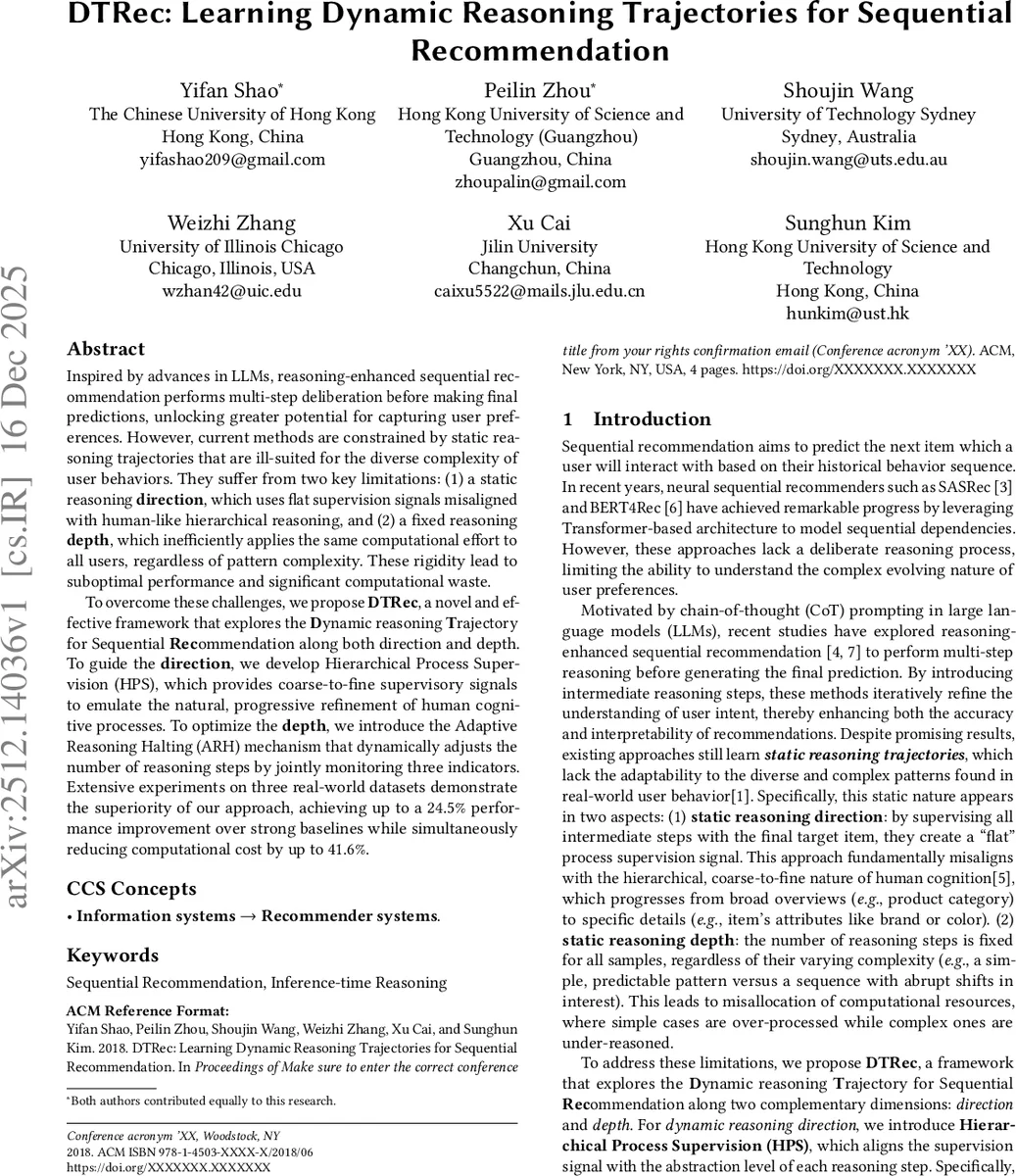
Inspired by advances in LLMs, reasoning-enhanced sequential recommendation performs multi-step deliberation before making final predictions, unlocking greater potential for capturing user preferences. However, current methods are constrained by static reasoning trajectories that are ill-suited for the diverse complexity of user behaviors. They suffer from two key limitations: (1) a static reasoning direction, which uses flat supervision signals misaligned with human-like hierarchical reasoning, and (2) a fixed reasoning depth, which inefficiently applies the same computational effort to all users, regardless of pattern complexity. These rigidity lead to suboptimal performance and significant computational waste. To overcome these challenges, we propose DTRec, a novel and effective framework that explores the Dynamic reasoning Trajectory for Sequential Recommendation along both direction and depth. To guide the direction, we develop Hierarchical Process Supervision (HPS), which provides coarse-to-fine supervisory signals to emulate the natural, progressive refinement of human cognitive processes. To optimize the depth, we introduce the Adaptive Reasoning Halting (ARH) mechanism that dynamically adjusts the number of reasoning steps by jointly monitoring three indicators. Extensive experiments on three real-world datasets demonstrate the superiority of our approach, achieving up to a 24.5% performance improvement over strong baselines while simultaneously reducing computational cost by up to 41.6%.
💡 Research Summary
The paper “DTRec: Learning Dynamic Reasoning Trajectories for Sequential Recommendation” proposes a novel framework that introduces dynamic, adaptive reasoning into sequential recommendation systems, inspired by the Chain-of-Thought (CoT) capabilities of Large Language Models (LLMs). It identifies and addresses critical limitations in existing reasoning-enhanced recommendation methods, which rely on static reasoning trajectories ill-suited for the diverse complexity of real-world user behavior.
The core problem is twofold. First, static reasoning direction: Methods like ReaRec supervise all intermediate reasoning steps directly with the final target item, creating a “flat” supervision signal. This contradicts the hierarchical, coarse-to-fine nature of human reasoning (e.g., from “electronics” to “smartphones” to a specific “iPhone model”). Second, static reasoning depth: Using a fixed number of reasoning steps for all user sequences leads to computational inefficiency—over-processing simple patterns and under-reasoning complex ones.
To overcome these limitations, DTRec introduces two innovative components that enable dynamic adaptation along both the direction and depth of reasoning:
-
Hierarchical Process Supervision (HPS): This component dynamically guides the reasoning direction. It extracts semantic prototypes by applying K-means clustering to the item embedding space. Crucially, the number of clusters (i.e., the granularity of the prototypes) increases progressively with each reasoning step according to an exponential schedule. Early reasoning steps are supervised towards coarse-grained prototypes (representing broad categories), while later steps are guided towards finer-grained ones (representing specific attributes). This aligns the learning signal with a natural, human-like progressive refinement process, preventing the reasoning state from being trapped near the final target from the beginning.
-
Adaptive Reasoning Halting (ARH): This mechanism dynamically optimizes reasoning depth. At each step, it computes three complementary indicators: prediction entropy (uncertainty), KL-divergence between consecutive step predictions (consistency), and the L2-norm change in the reasoning state representation (stability). These indicators are fused via a lightweight MLP to produce a halting probability. During training, a soft halting scheme ensures differentiability. During inference, reasoning stops at the first step where this probability exceeds a threshold. This allows DTRec to allocate more computational steps to complex user sequences and fewer to simple ones, significantly improving efficiency.
Extensive experiments were conducted on three real-world datasets (Sports, Beauty, Yelp) using strong backbone models (SASRec, GRU4Rec, BERT4Rec). DTRec consistently and significantly outperformed all baselines, including state-of-the-art reasoning-enhanced models like ReaRec and LARES, achieving performance improvements of up to 24.5% in metrics like Recall@10 and NDCG@10. Simultaneously, thanks to ARH, it reduced the average number of reasoning steps by up to 41.6%, demonstrating substantial computational savings without compromising accuracy. Ablation studies confirmed the necessity of both the hierarchical aspect of HPS and the multi-indicator design of ARH. Visualizations of reasoning trajectories using t-SNE provided intuitive evidence that DTRec’s states move progressively toward the target, unlike ReaRec’s static cluster of states.
In conclusion, DTRec successfully translates the CoT reasoning paradigm from LLMs to the sequential recommendation domain while innovatively solving its domain-specific challenges. By making reasoning trajectories dynamic—both in their hierarchical direction and adaptive depth—it achieves a superior balance between recommendation accuracy and computational efficiency, paving the way for more intelligent and scalable reasoning-based recommenders.
Comments & Academic Discussion
Loading comments...
Leave a Comment