Love First, Know Later: Persona-Based Romantic Compatibility Through LLM Text World Engines
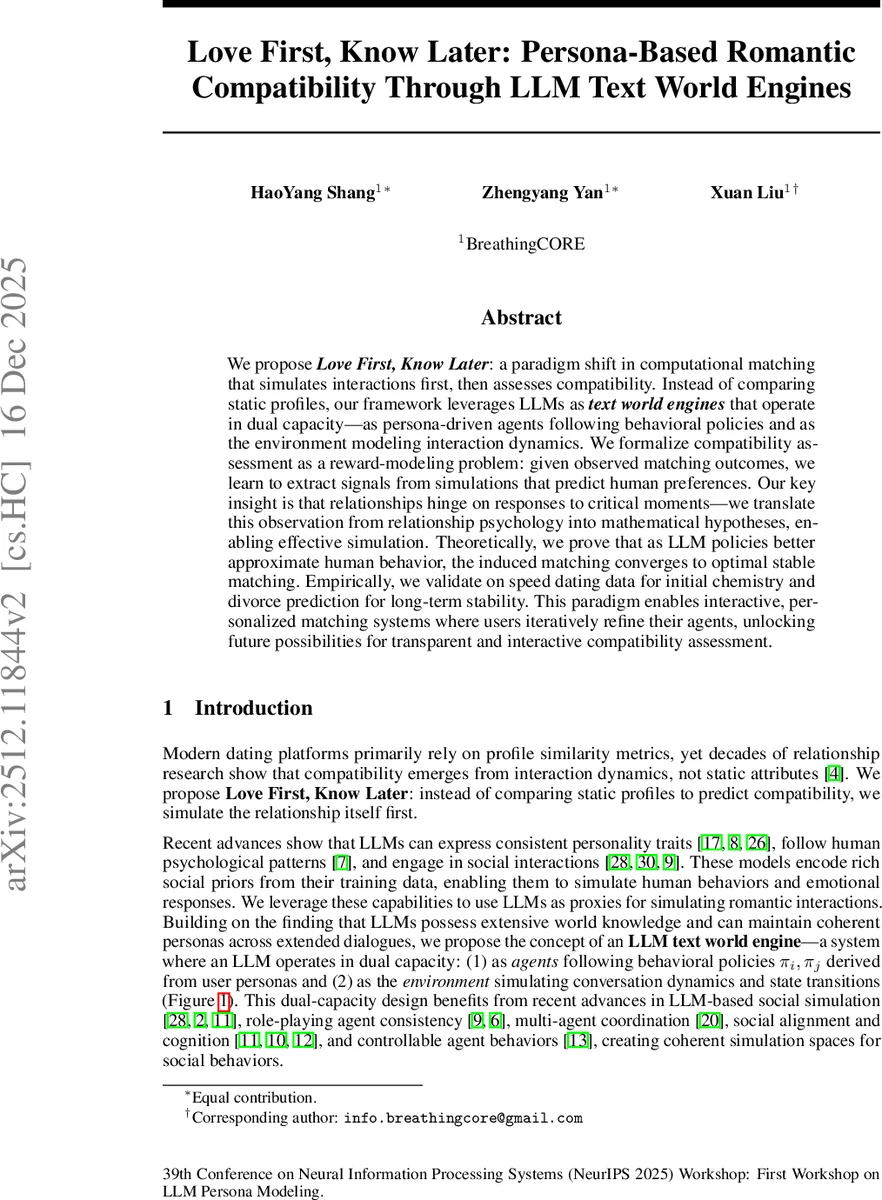
We propose Love First, Know Later: a paradigm shift in computational matching that simulates interactions first, then assesses compatibility. Instead of comparing static profiles, our framework leverages LLMs as text world engines that operate in dual capacity-as persona-driven agents following behavioral policies and as the environment modeling interaction dynamics. We formalize compatibility assessment as a reward-modeling problem: given observed matching outcomes, we learn to extract signals from simulations that predict human preferences. Our key insight is that relationships hinge on responses to critical moments-we translate this observation from relationship psychology into mathematical hypotheses, enabling effective simulation. Theoretically, we prove that as LLM policies better approximate human behavior, the induced matching converges to optimal stable matching. Empirically, we validate on speed dating data for initial chemistry and divorce prediction for long-term stability. This paradigm enables interactive, personalized matching systems where users iteratively refine their agents, unlocking future possibilities for transparent and interactive compatibility assessment.
💡 Research Summary
The paper “Love First, Know Later” introduces a groundbreaking paradigm shift in computational matching, moving away from the traditional method of comparing static user profiles toward a dynamic, simulation-based approach. The authors propose using Large Language Models (LLMs) not merely as conversational agents, but as “Text World Engines” capable of simulating complex, high-stakes interpersonal interactions.
The core innovation lies in the dual-role deployment of LLMs. Within this framework, LLMs function simultaneously as persona-driven agents, which follow specific behavioral policies derived from user characteristics, and as the environment itself, which models the evolving dynamics of the interaction. By leveraging the LLM’s ability to generate nuanced text, the researchers can simulate “critical moments”—pivotal interaction points that, according to relationship psychology, are the true determinants of long-term compatibility and relationship stability.
Technically, the paper formalizes the compatibility assessment as a reward-modeling problem. The goal is to learn a model that can extract predictive signals from these simulated interactions to accurately reflect human preferences. A significant theoretical contribution of this work is the mathematical proof that as the LLM’s behavioral policies become more accurate representations of human behavior, the resulting matching process converges to an optimal stable matching. This provides a rigorous mathematical foundation for the reliability of the simulation.
The empirical validity of this approach is demonstrated through two distinct lenses: short-term chemistry and long-term stability. Using speed dating datasets, the authors show the model’s ability to predict initial attraction and “chemistry.” Furthermore, by utilizing divorce prediction data, they demonstrate the framework’s capacity to assess long-term relationship durability and stability.
Ultimately, this research paves the way for a new generation of interactive and personalized matching systems. In such systems, users could iteratively refine their digital personas, essentially “testing” potential relationships in a controlled, simulated environment. This leads to a more transparent, interactive, and scientifically grounded approach to human connection, transforming matching from a simple data-comparison task into a sophisticated simulation of human social dynamics.
Comments & Academic Discussion
Loading comments...
Leave a Comment