Completeness of reparametrization-invariant Sobolev metrics on the space of surfaces
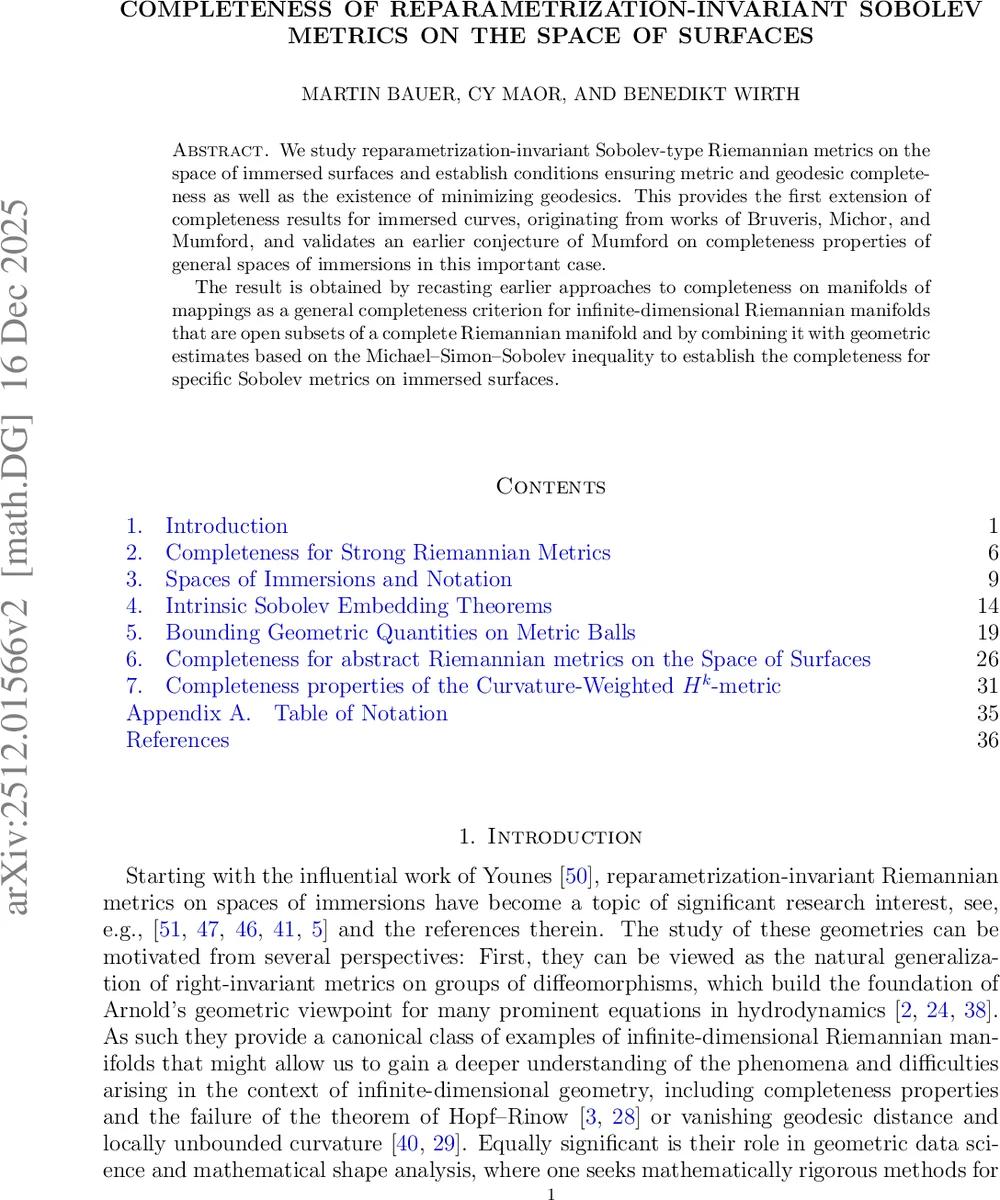
We study reparametrization-invariant Sobolev-type Riemannian metrics on the space of immersed surfaces and establish conditions ensuring metric and geodesic completeness as well as the existence of minimizing geodesics. This provides the first extension of completeness results for immersed curves, originating from works of Bruveris, Michor, and Mumford, and validates an earlier conjecture of Mumford on completeness properties of general spaces of immersions in this important case. The result is obtained by recasting earlier approaches to completeness on manifolds of mappings as a general completeness criterion for infinite-dimensional Riemannian manifolds that are open subsets of a complete Riemannian manifold and by combining it with geometric estimates based on the Michael–Simon–Sobolev inequality to establish the completeness for specific Sobolev metrics on immersed surfaces.
💡 Research Summary
The paper addresses a fundamental problem in infinite‑dimensional Riemannian geometry: the completeness of reparametrization‑invariant Sobolev metrics on spaces of immersed surfaces. Let M be a closed oriented two‑dimensional manifold and consider the Hilbert manifold Imm ℓ(M,ℝᵈ) of H^ℓ‑immersions into Euclidean space ℝᵈ with d ≥ 3 and ℓ ≥ 3. For an integer order k with 3 ≤ k ≤ ℓ the authors define a curvature‑weighted Sobolev metric Gₖ of the form
Gₖ_f(h₁,h₂)=∫_M ⟨h₁,h₂⟩ + |H|⁴⟨∇h₁,∇h₂⟩ + ⟨∇²h₁,∇²h₂⟩ + ⟨∇^k h₁,∇^k h₂⟩ vol_f,
where H denotes the mean curvature of the immersed surface f and ∇ the covariant derivative induced by f. Because Gₖ is invariant under the right action of the Sobolev diffeomorphism group Diff^ℓ(M), it descends to a metric on the shape space Sₖ = Imm _k/Diff^k(M).
The central methodological contribution is a general completeness criterion (Theorem 2.1). The authors view Imm ℓ as an open subset of the complete Hilbert space H^ℓ(M,ℝᵈ). They prove that if a Riemannian metric on such an open subset satisfies suitable L^p‑bounds on geometric quantities (metric, mean curvature, and their derivatives) on every metric ball, then the open subset inherits metric completeness, geodesic completeness, and the existence of minimizing geodesics from the ambient complete space. This abstract result extends the strategy previously used for curves to the surface case.
To verify the required L^p‑bounds, the paper employs Michael–Simon–Sobolev inequalities. Sections 4 and 5 develop intrinsic Sobolev embedding theorems and derive uniform estimates for the mean curvature, its gradient, and higher‑order derivatives on Gₖ‑metric balls. The curvature weight |H|⁴ is crucial: it prevents curvature blow‑up and guarantees that the Sobolev terms control the geometry strongly enough for k ≥ 3. Consequently, metric balls are bounded in the H^ℓ‑norm, which yields C¹‑compactness and allows the passage to limits.
With these estimates in hand, Section 6 applies the abstract criterion to prove the main theorem (Theorem 1.1). The authors establish:
(a) Metric completeness of (Imm _k, Gₖ);
(b) Geodesic completeness of (Imm _l, Gₖ) for any l ≥ k (including the smooth case l = ∞);
(c) Existence of a minimizing Gₖ‑geodesic between any two immersions in the same connected component of Imm _k;
(d) Metric completeness of the shape space Sₖ;
(e) Existence of an optimal reparametrization attaining the infimum in the quotient distance; and
(f) That Sₖ is a geodesic length space, i.e., any two points can be joined by a minimizing geodesic in the metric sense.
The paper also discusses broader implications. The completeness criterion is applicable to other open subsets of Hilbert spaces, such as spaces of H^k‑probability densities or H^k‑Riemannian metrics. The authors formulate a conjecture extending their results to immersions of arbitrary dimension m into a d‑dimensional Riemannian manifold with bounded geometry, and they outline challenges for non‑integer Sobolev orders and for weighted versus unweighted metrics.
Finally, the authors note that while metric completeness follows from the abstract theorem, the existence of minimizing geodesics does not automatically follow from Hopf–Rinow in infinite dimensions; they provide a separate variational argument to guarantee minimizers. The work thus fills a long‑standing gap in the theory of shape spaces, providing the first rigorous proof that high‑order Sobolev metrics on immersed surfaces are both metrically and geodesically complete, and laying a solid foundation for future research in geometric analysis, statistical shape theory, and numerical algorithms for surface matching.
Comments & Academic Discussion
Loading comments...
Leave a Comment