Character Theory for Semilinear Representations
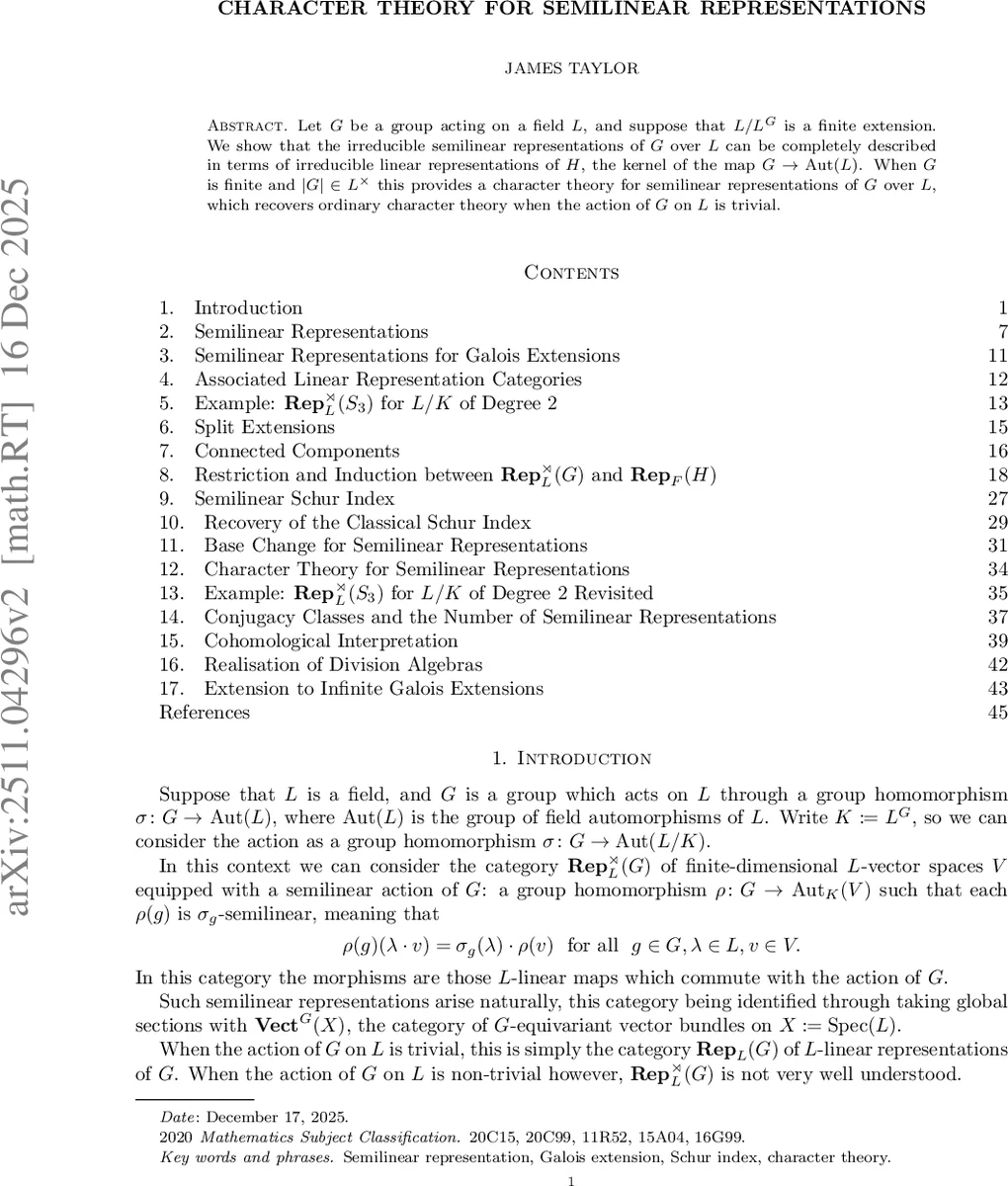
Let $G$ be a group acting on a field $L$, and suppose that $L /L^G$ is a finite extension. We show that the irreducible semilinear representations of $G$ over $L$ can be completely described in terms of irreducible linear representations of $H$, the kernel of the map $G \rightarrow \mathrm{Aut}(L)$. When $G$ is finite and $|G| \in L^{\times}$ this provides a character theory for semilinear representations of $G$ over $L$, which recovers ordinary character theory when the action of $G$ on $L$ is trivial.
💡 Research Summary
The paper “Character Theory for Semilinear Representations” addresses a fundamental challenge in representation theory: how to extend the classical tools of character theory to the realm of semilinear representations. In a standard linear representation, the group action commutes with scalar multiplication. However, in a semilinear representation, the group $G$ acts on the underlying field $L$ via an automorphism $\sigma$. This introduces a “twisting” effect where $g(cv) = \sigma_g(c)g(v)$, leading to a non-linear matrix relation $A_{g_1g_2} = A_{g_1} \cdot g_1(A_{g_2})$. This structure makes traditional linear algebraic methods, such as trace-based character analysis, difficult to apply directly.
The author’s primary innovation lies in the strategic use of the kernel $H = \ker(G \to \text{Aut}(L))$. Since $H$ acts trivially on $L$, any semilinear representation of $G$, when restricted to $H$, becomes a standard linear representation. This allows the complex problem of analyzing $G$-semilinear representations to be reframed as an “extension problem”: determining which irreducible linear representations of $H$ can be extended to semilinear representations of $G$, and determining the uniqueness and multiplicity of such extensions.
A pivotal result presented in the paper is Theorem A, which establishes the uniqueness of these extensions. The theorem proves that two semilinear representations are isomorphic if and only if their restrictions to $H$ are isomorphic. Furthermore, the paper provides a precise description of the $\text{Hom}$ space between such representations, linking the semilinear structure back to the linear structure over $L$.
The paper concludes that when $G$ is finite and the order of $G$ is invertible in $L$, a complete character theory for semilinear representations can be constructed. This theory is a profound generalization of ordinary character theory; when the action of $G$ on $L$ is trivial, the results collapse back to the classical case. By providing a systematic way to handle non-trivial field automorphisms, this work offers a powerful framework for studying group actions in algebraic settings where the field itself is not fixed.
Comments & Academic Discussion
Loading comments...
Leave a Comment