Itinerant Magnetism in Twisted Bilayer WSe$_2$ and MoTe$_2$
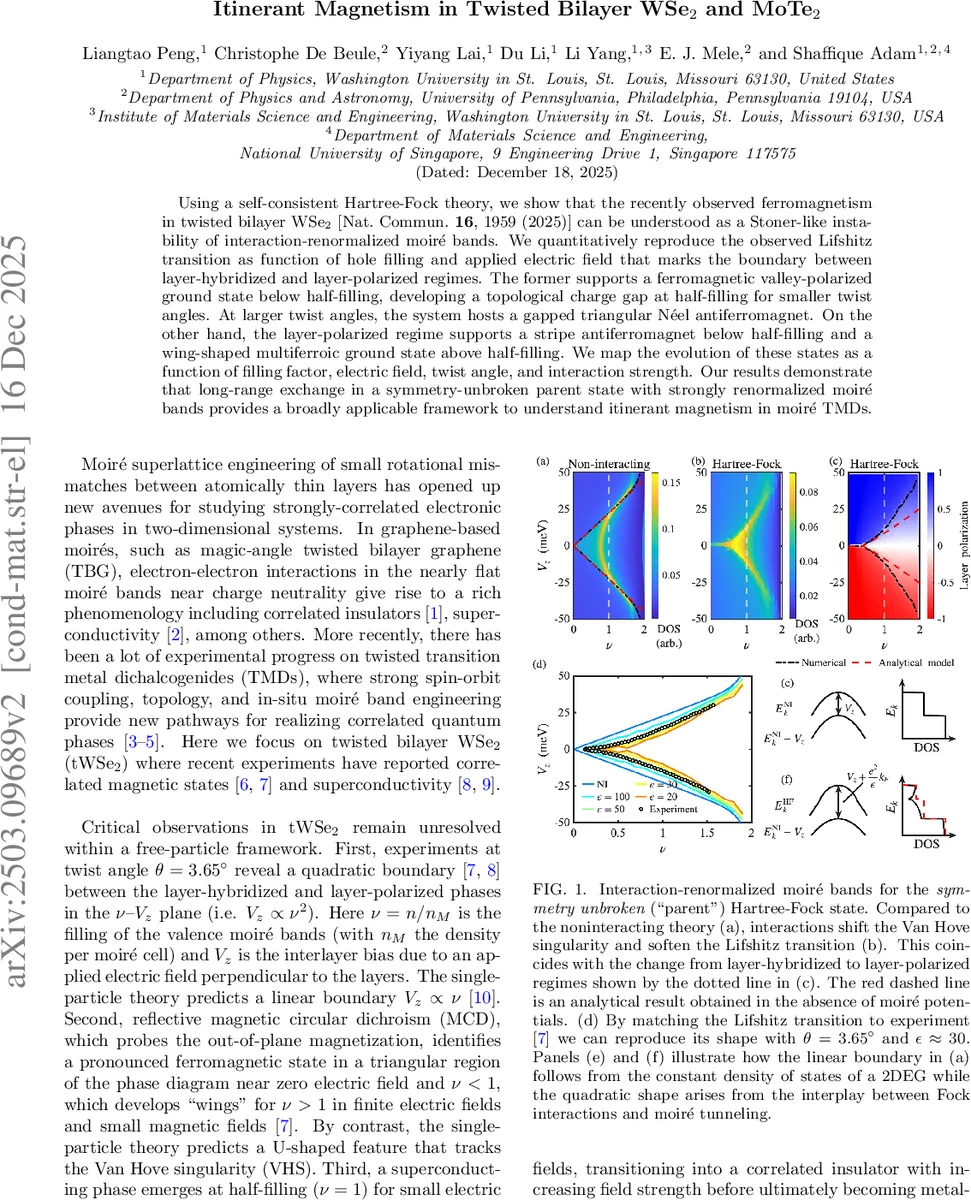
Using a self-consistent Hartree-Fock theory, we show that the recently observed ferromagnetism in twisted bilayer WSe$_2$ [Nat. Commun. 16, 1959 (2025)] can be understood as a Stoner-like instability of interaction-renormalized moiré bands. We quantitatively reproduce the observed Lifshitz transition as function of hole filling and applied electric field that marks the boundary between layer-hybridized and layer-polarized regimes. The former supports a ferromagnetic valley-polarized ground state below half-filling, developing a topological charge gap at half-filling for smaller twist angles. At larger twist angles, the system hosts a gapped triangular Néel antiferromagnet. On the other hand, the layer-polarized regime supports a stripe antiferromagnet below half-filling and a wing-shaped multiferroic ground state above half-filling. We map the evolution of these states as a function of filling factor, electric field, twist angle, and interaction strength. Our results demonstrate that long-range exchange in a symmetry-unbroken parent state with strongly renormalized moiré bands provides a broadly applicable framework to understand itinerant magnetism in moiré TMDs.
💡 Research Summary
This research provides a profound theoretical explanation for the itinerant magnetism observed in twisted bilayer transition metal dichalcogenides (TMDs), specifically focusing on WSe$_2$ and MoTe$_2$. Utilizing a self-consistent Hartree-Fock theory, the authors demonstrate that the ferromagnetism recently reported in twisted bilayer WSe$_2$ originates from a Stoner-like instability within interaction-renormalized moiré bands. The study moves beyond simple localized spin models to show how electron-electron interactions fundamentally reshape the band structure, driving the system toward various magnetic ground states.
A pivotal contribution of this work is the identification of a Lifshitz transition, which acts as a boundary between two distinct physical regimes: the layer-hybridized regime and the layer-polarized regime. This transition is controlled by two primary external parameters: the hole filling factor and the applied perpendicular electric field. By mapping these parameters, the researchers have successfully reproduced the experimental observations of magnetic phase transitions.
In the layer-hybridized regime, the system exhibits a ferromagnetic valley-polarized ground state at low hole fillings. At half-filling, for smaller twist angles, the system develops a topological charge gap, whereas at larger twist angles, it transitions into a gapped triangular Néel antiferromagnet. This demonstrates how the interplay between twist angle and interaction strength dictates the magnetic topology.
Conversely, the layer-polarized regime presents a different set of complex phases. Below half-filling, the system hosts a stripe antiferromagnetic state, while above half-filling, it enters a unique, wing-shaped multiferroic ground state. This discovery of a multiferroic phase highlights the potential for controlling both electric and magnetic orders simultaneously in moiré heterostructures.
Ultimately, the paper establishes a comprehensive and broadly applicable framework for understanding itinerant magnetism in moiré TMDs. The findings suggest that long-range exchange interactions in a symmetry-unbroken parent state, characterized by strongly renormalized moiré bands, are the fundamental drivers of the rich magnetic landscape in these materials. This theoretical breakthrough is essential for the future development of advanced spintronic and valleytronic applications based on 2D moiré superlattices.
Comments & Academic Discussion
Loading comments...
Leave a Comment