Monotonicity, Topology, and Convexity of Recurrence in Random Walks
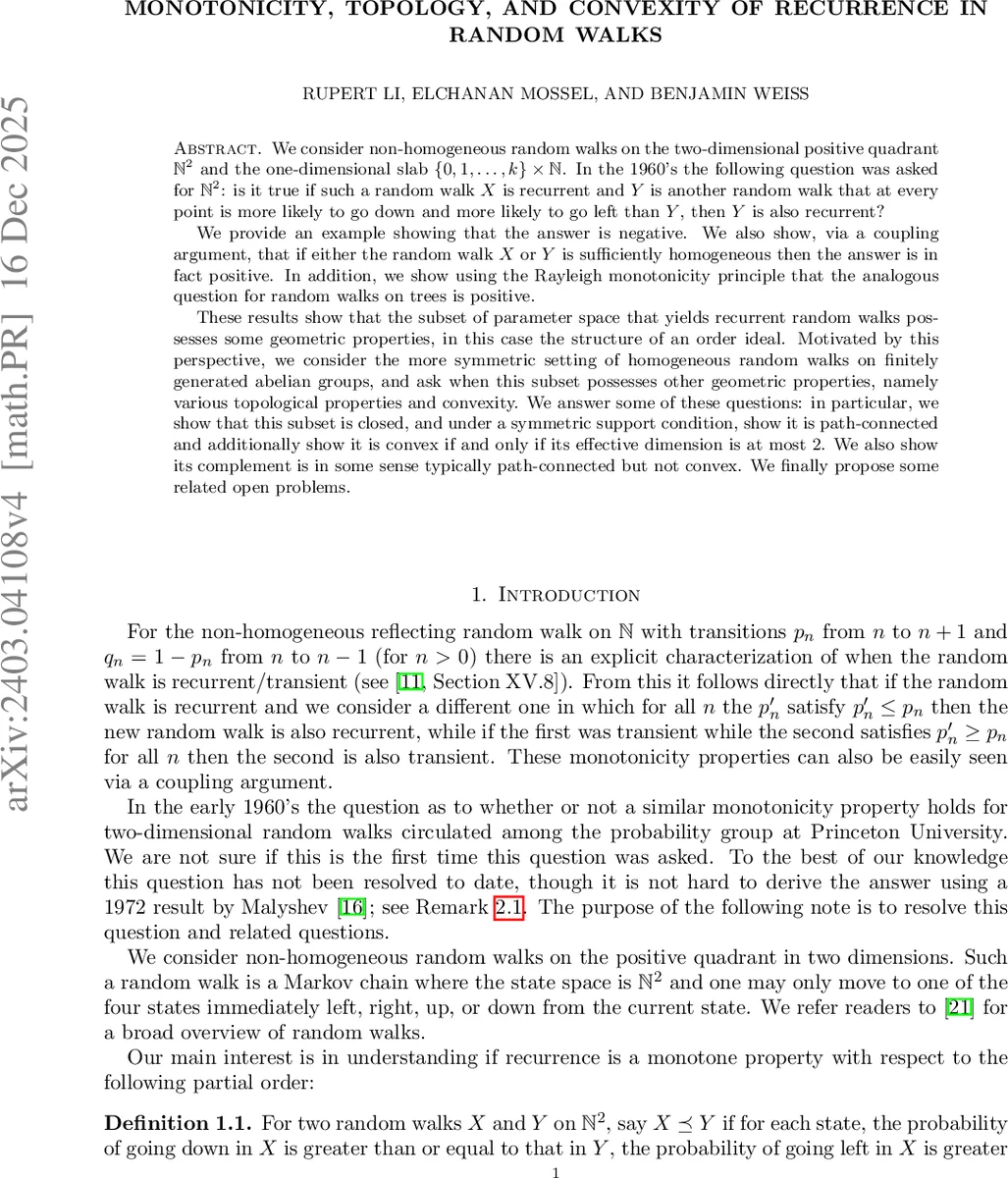
We consider non-homogeneous random walks on the two-dimensional positive quadrant $\mathbb{N}^2$ and the one-dimensional slab ${0,1,\dots,k}\times\mathbb{N}$. In the 1960’s the following question was asked for $\mathbb{N}^2$: is it true if such a random walk $X$ is recurrent and $Y$ is another random walk that at every point is more likely to go down and more likely to go left than $Y$, then $Y$ is also recurrent? We provide an example showing that the answer is negative. We also show, via a coupling argument, that if either the random walk $X$ or $Y$ is sufficiently homogeneous then the answer is in fact positive. In addition, we show using the Rayleigh monotonicity principle that the analogous question for random walks on trees is positive. These results show that the subset of parameter space that yields recurrent random walks possesses some geometric properties, in this case the structure of an order ideal. Motivated by this perspective, we consider the more symmetric setting of homogeneous random walks on finitely generated abelian groups, and ask when this subset possesses other geometric properties, namely various topological properties and convexity. We answer some of these questions: in particular, we show that this subset is closed, and under a symmetric support condition, show it is path-connected and additionally show it is convex if and only if its effective dimension is at most 2. We also show its complement is in some sense typically path-connected but not convex. We finally propose some related open problems.
💡 Research Summary
This paper presents a rigorous mathematical investigation into the stability, monotonicity, and geometric properties of recurrence in random walks. The research focuses on non-homogeneous random walks within the two-dimensional positive quadrant ($\mathbb{N}^2$) and one-dimensional slabs, addressing a long-standing conjecture from the 1960s. The central question asks whether a random walk $Y$, which possesses a stronger drift toward the origin (more likely to move left and down) than a known recurrent walk $X$, must also be recurrent.
The authors begin by providing a definitive counterexample to this conjecture in the context of non-homogeneous walks on $\mathbb{N}^2$, demonstrating that the inherent irregularity of non-homogeneous transitions can break the expected monotonicity of recurrence. However, the paper subsequently recovers the positive result by introducing a degree of homogeneity. Through the application of a coupling argument, the authors prove that if either the reference walk $X$ or the perturbed walk $Y$ is sufficiently homogeneous, the recurrence property is indeed preserved. Furthermore, the study extends to random walks on trees, where the authors utilize the Rayleigh monotonicity principle to confirm that the property holds true in such structures.
A significant portion of the paper is dedicated to characterizing the geometric and topological nature of the parameter space that yields recurrent walks. The authors identify that this subset of the parameter space possesses the structure of an “order ideal.” Expanding the scope to the more symmetric setting of homogeneous random walks on finitely generated abelian groups, the paper delves into advanced topological properties. The authors prove that the set of recurrent parameters is a closed set and, under a symmetric support condition, is path-connected.
One of the most profound findings of the research is the relationship between the convexity of the recurrence set and the dimensionality of the space. The authors demonstrate that the subset of recurrent parameters is convex if and only if the effective dimension of the group is at most 2. This indicates a fundamental phase transition in the geometric complexity of the recurrence region as the dimension increases. Additionally, the paper analyzes the complement of this set (the transient region), noting that while it is typically path-connected, it lacks convexity. By bridging probability theory with topological and geometric analysis, this paper provides a comprehensive framework for understanding how the stability of stochastic processes is shaped by the underlying geometry and dimensionality of the space.
Comments & Academic Discussion
Loading comments...
Leave a Comment