A Maximum Linear Arrangement Problem on Directed Graphs
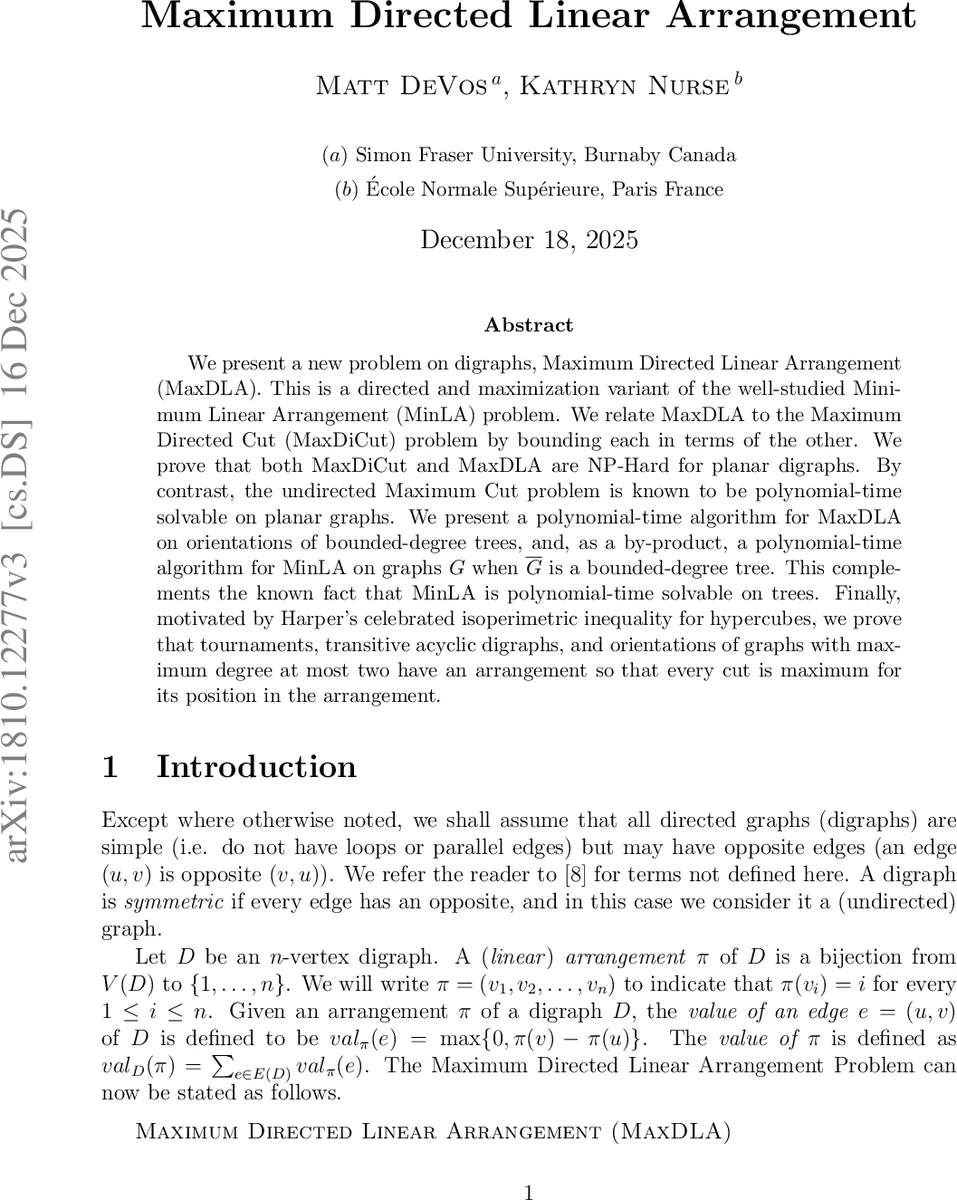
We propose a new arrangement problem on directed graphs, Maximum Directed Linear Arrangement (MaxDLA). This is a directed variant of a similar problem for undirected graphs, in which however one seeks maximum and not minimum; this problem known as the Minimum Linear Arrangement Problem (MinLA) has been much studied in the literature. We establish a number of theorems illustrating the behavior and complexity of MaxDLA. First, we relate MaxDLA to Maximum Directed Cut (MaxDiCut) by proving that every simple digraph $D$ on $n$ vertices satisfies $\frac{n}{2}$$maxDiCut(D) \leq MaxDLA(D) \leq (n-1)MaxDiCut(D)$. Next, we prove that MaxDiCut is NP-Hard for planar digraphs (even with the added restriction of maximum degree 15); it follows from the above bounds that MaxDLA is also NP-Hard for planar digraphs. In contrast, Hadlock (1975) and Dorfman and Orlova (1972) showed that the undirected Maximum Cut problem is solvable in polynomial time on planar graphs. On the positive side, we present a polynomial-time algorithm for solving MaxDLA on orientations of trees with degree bounded by a constant, which translates to a polynomial-time algorithm for solving MinLA on the complements of those trees. This pairs with results by Goldberg and Klipker (1976), Shiloach (1979) and Chung (1984) solving MinLA in polynomial time on trees. Finally, analogues of Harper’s famous isoperimetric inequality for the hypercube, in the setting of MaxDLA, are shown for tournaments, orientations of graphs with degree at most two, and transitive acyclic digraphs.
💡 Research Summary
**
The paper introduces a new combinatorial optimization problem on directed graphs called the Maximum Directed Linear Arrangement (MaxDLA). In a MaxDLA, an arrangement π of the n vertices of a digraph D assigns each vertex a distinct position 1,…,n. The value of a directed edge e = (u,v) under π is defined as max{0, π(v) − π(u)}; the total value of π is the sum of these edge values. Equivalently, π induces n − 1 forward cuts C₁,…,C_{n‑1}, where C_i separates the first i vertices from the remaining n − i vertices, and the total value of π equals the sum of the sizes of these cuts. This observation allows the authors to relate MaxDLA directly to the well‑studied Maximum Directed Cut (MaxDiCut) problem.
The first major theoretical contribution is a tight bound linking the optimum values of the two problems. For any digraph D with n vertices and maximum directed cut size t = maxDiCut(D), the authors prove
(n/2)·t ≤ maxDLA(D) ≤ (n − 1)·t.
The upper bound follows from the fact that any arrangement contains exactly n − 1 cuts, each of which cannot exceed t. The lower bound is constructive: take a maximum cut (X,Y), order the vertices of X in non‑increasing out‑degree and the vertices of Y in non‑decreasing in‑degree, and concatenate the two orders. This arrangement guarantees at least half of the edges of the maximum cut appear as forward edges, yielding the (n/2) factor. The bounds are shown to be best possible; equality holds for complete symmetric digraphs.
Having established this relationship, the authors turn to computational complexity. They prove that MaxDiCut remains NP‑complete even when restricted to planar digraphs of maximum degree 14. The reduction starts from planar Max‑2SAT, a known NP‑complete problem, and builds a planar gadget for each clause. Each gadget contributes either two forward edges (if the clause is satisfied) or none (if it is not). Consequently, a truth assignment satisfying k clauses yields a directed cut of size at least 2k, and conversely any cut of size ≥ 2k can be decoded into a satisfying assignment for at least k clauses. By preserving planarity and bounding vertex degree, the reduction shows planar MaxDiCut with Δ ≤ 14 is NP‑hard.
Because MaxDLA and MaxDiCut differ by at most a factor of (n − 1) and at least a factor of n/2, the NP‑hardness of MaxDiCut immediately transfers to MaxDLA. The paper therefore concludes that MaxDLA is NP‑complete on planar digraphs of bounded degree, and also establishes NP‑completeness for directed split graphs, which in turn implies NP‑completeness of the Minimum Linear Arrangement (MinLA) problem on split graphs.
On the algorithmic side, the authors present a polynomial‑time algorithm for MaxDLA on orientations of trees whose underlying undirected graph has bounded maximum degree d. The key insight is to use vertex “levels”, defined as the out‑degree of a vertex minus the number of its neighbors already placed to the left in the arrangement. Levels can be computed using only out‑degrees, and an optimal arrangement can be obtained by sorting vertices in non‑increasing order of level while respecting the tree structure. By dynamic programming over the tree, the algorithm runs in O(n⁴·d) time, where n is the number of vertices. As a corollary, MinLA can be solved in the same time bound for graphs whose complements are bounded‑degree trees, extending earlier results that MinLA is polynomial on trees themselves.
The final section draws an analogy with Harper’s isoperimetric inequality for the hypercube. Harper showed that there exists an ordering of hypercube vertices such that each cut of size k is minimal among all cuts separating k vertices from the rest. The authors prove a “maximum” analogue for three classes of digraphs: tournaments, orientations of graphs with maximum degree two, and transitive acyclic digraphs. For each class they construct an ordering (often simply the topological order or degree‑based order) such that every cut induced by the ordering is a maximum directed cut among all cuts separating the same number of vertices. This result highlights a structural property of these digraph families: they admit arrangements that simultaneously maximize every possible forward cut size.
In summary, the paper makes several contributions: (1) it defines MaxDLA and establishes tight bounds with MaxDiCut; (2) it proves NP‑hardness of MaxDiCut and MaxDLA on planar bounded‑degree digraphs; (3) it provides a polynomial‑time algorithm for MaxDLA on bounded‑degree tree orientations, yielding a new polynomial algorithm for MinLA on complements of such trees; and (4) it identifies classes of digraphs that admit “max‑cut‑optimal” linear arrangements, mirroring classic isoperimetric results. The work opens several avenues for future research, including approximation algorithms for MaxDLA, extensions to broader graph families (e.g., bounded treewidth), and deeper exploration of the interplay between linear arrangements and cut‑based graph parameters.
Comments & Academic Discussion
Loading comments...
Leave a Comment