AtLAST -- Cosmology with submillimetre galaxies magnification bias
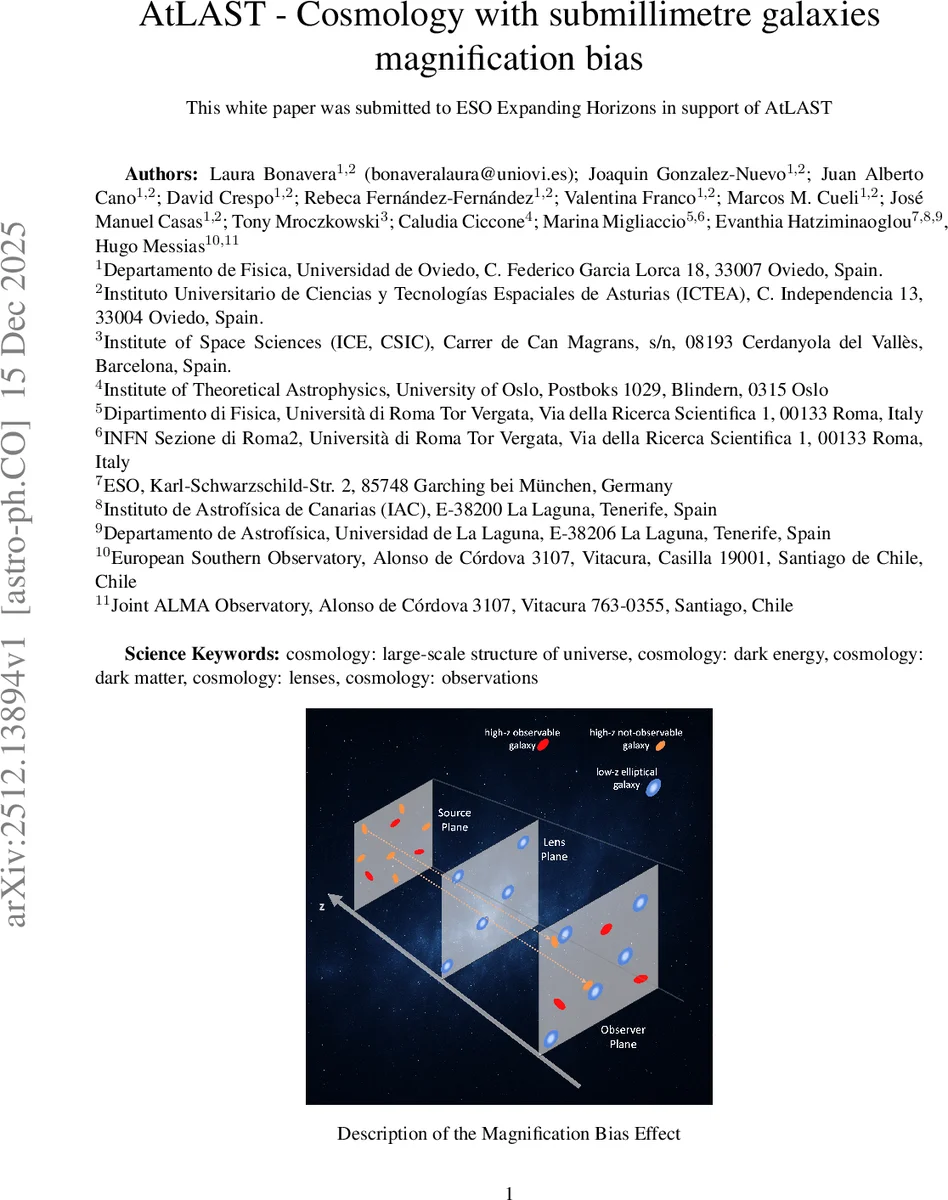
Magnification bias offers a uniquely powerful and independent route to cosmological information. As a gravitational-lensing observable, it probes galaxy-matter correlations without relying on galaxy shapes, PSF modelling, or intrinsic-alignment corrections. Its sensitivity spans both geometry and growth: magnification bias simultaneously responds to the matter density, the amplitude of structure, and the redshift evolution of dark energy (DE) below $z \leq 1$. Importantly, its parameter degeneracy directions differ from those of shear, Baryon Acoustic Oscillations (BAO), and Cosmic Microwave Background (CMB) data, making it a complementary and consistency-check probe with substantial diagnostic value for the next decade of precision cosmology. However, the current potential of magnification bias is restricted by limited sky coverage, catalogue inhomogeneities, and insufficiently precise redshift or number-count characterisation. A next-generation wide-field submillimetre facility like AtLAST – capable of uniform, deep surveys and spectroscopic mapping – would overcome these limitations and transform magnification bias into a competitive, high-precision cosmological tool.
💡 Research Summary
The white paper presents a compelling case for using magnification bias of high‑redshift sub‑millimetre galaxies (SMGs) as an independent cosmological probe and argues that the forthcoming Atacama Large Aperture Submillimetre Telescope (AtLAST) will transform this technique from a niche method into a cornerstone of precision cosmology. Magnification bias arises from weak gravitational lensing: foreground mass concentrations increase the observed flux of background sources (flux boosting) while simultaneously diluting their surface density (solid‑angle dilation). The net effect depends on the logarithmic slope β of the source number counts; for SMGs β > 1, flux boosting dominates, producing an excess of background galaxies around massive foreground structures. By measuring foreground–background cross‑correlations (cosmic magnification) one directly probes the galaxy–matter cross‑correlation without requiring resolved shapes, PSF modelling, or intrinsic‑alignment corrections.
Existing studies that combine Herschel‑H‑ATLAS SMGs with optical foreground samples such as GAMA have yielded constraints of Ωₘ ≈ 0.27 ± 0.03 and σ₈ ≈ 0.72 ± 0.04, and have begun to explore dark‑energy parameters w₀ and wₐ, albeit with large uncertainties. However, these results are limited by three main factors: (1) a small overlapping sky area (~200 deg²) leading to large sample variance; (2) catalogue inhomogeneities and insufficient depth, which force analysts to impose strong priors on β; and (3) Herschel’s modest angular resolution (~18″) that generates significant confusion noise and restricts access to large‑scale modes (ℓ ≲ 100) that carry most of the cosmological information.
AtLAST is designed precisely to overcome these bottlenecks. It will be a 50‑meter single‑dish telescope located at ~5 km altitude near ALMA, operating from 30 to 950 GHz. Its diffraction‑limited beam of ~1.5″ at the highest frequency eliminates confusion noise, enabling direct measurement of β from deep, uniform continuum maps. An instantaneous 2‑degree field of view, coupled with up to 10⁶ detector elements, provides mapping speeds three orders of magnitude faster than ALMA while retaining comparable continuum sensitivity. Crucially, AtLAST will host spectroscopic capabilities that deliver redshifts for millions of SMGs, allowing tomographic foreground‑background analyses across multiple redshift bins.
With an order‑of‑magnitude increase in sky coverage (several thousand deg²) and a factor of 5–10 boost in background source density, the projected constraints tighten dramatically: σ(Ωₘ) and σ(σ₈) can reach sub‑5 % levels, σ(w₀) ≈ 0.1, and σ(wₐ) ≈ 0.3–0.5, providing a powerful, orthogonal check on results from shear, BAO, and CMB experiments. The enhanced statistical power also translates into a 5–10× improvement on the sum of neutrino masses, potentially pushing limits well below the current cosmological bound of Σ m_ν < 0.064 eV.
Technically, AtLAST’s high‑altitude site ensures excellent atmospheric transmission, while its renewable‑energy‑only power system (solar, wind, hybrid battery‑hydrogen storage) guarantees 24‑hour operation. The combination of large collecting area, wide field, high resolution, and simultaneous spectroscopic/continuum capability is unique among planned facilities; neither ALMA (high resolution, narrow field) nor upcoming wide‑field, low‑resolution instruments (e.g., SPT‑3G, SO, FYST) can deliver the required SMG dataset.
In summary, the paper argues that magnification bias, when measured with AtLAST’s unprecedented data set, will deliver independent, high‑precision constraints on matter density, structure growth, dark‑energy evolution, and neutrino mass, while also shedding light on galaxy–halo connections at high redshift. This makes AtLAST not just a new telescope but a transformative platform that will elevate sub‑millimetre magnification bias to a central pillar of 2030‑era cosmology.
Comments & Academic Discussion
Loading comments...
Leave a Comment