The molecular diversity of the ISM in galaxies across cosmic time
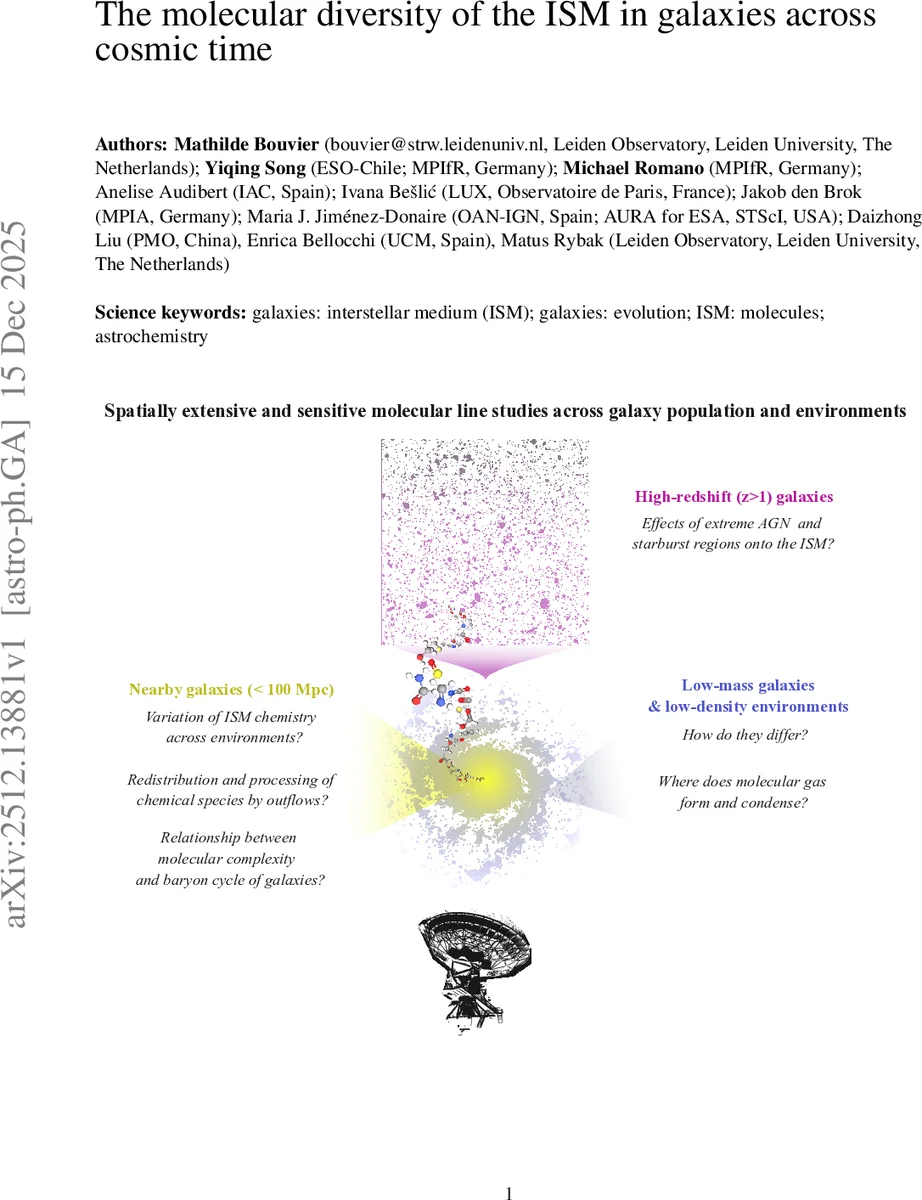
Submillimetre molecular lines (e.g., CO, HCN, SiO) provide a uniquely powerful view of the physical and chemical processes that govern star formation (SF) and galaxy evolution. Yet, our current picture of the molecular universe beyond the Milky Way remains strikingly incomplete: broad chemical inventories exist for only a handful of galaxies, typically more extreme than the Milky Way, constrained by sensitivity limits and narrow survey strategies. In the 2040s, surveying galaxies with multi-species, multi-transitions observations across diverse galactic environments will be crucial to establish effective chemical diagnostics of the various ISM processes from the early universe to $z=0$. Extragalactic astrochemistry provides a uniquely sensitive probe of the physical processes shaping galaxies, allowing us to understand, species by species, how gas responds to its local environment and how galaxies grow, transform, and recycle matter over cosmic time.
💡 Research Summary
This white paper presents a compelling case for a transformative leap in extragalactic astrochemistry, arguing that comprehensive studies of molecular diversity in the interstellar medium (ISM) are crucial for understanding galaxy evolution. It outlines the current limitations, key scientific questions, and the technical specifications required for future facilities to address them.
The paper begins by establishing the scientific context. Galaxy evolution is driven by physical processes within the ISM, where feedback from star formation and active galactic nuclei (AGN) imprints distinctive chemical signatures onto the gas. Molecular spectroscopy is thus a powerful diagnostic tool. While over 70 molecules have been detected in external galaxies since the first extragalactic CO detection in the 1970s, our view remains strikingly incomplete. Most data come from single-pointing observations toward the central regions of only a handful of nearby, often extreme galaxies (e.g., intense starbursts), limited by sensitivity, mapping speed, and spectral coverage. Consequently, we lack wide-field “chemical maps” showing how molecular composition varies from galactic centers to outer disks across diverse environments.
The core of the paper delineates two primary, interconnected science cases. First, it emphasizes the need to expand molecular inventories across cosmic time. Simultaneous observation of multiple species and transitions allows the use of specific molecules as diagnostic tools for particular ISM environments (e.g., CH3OH and SiO for large-scale shocks, HCN/HNC ratios for cosmic-ray ionization rates). However, unbiased spectral line surveys like the ALCHEMI project in NGC 253 are exceedingly rare. For high-redshift (z > 1) galaxies, where SF and AGN activity were more intense, detecting faint dense-gas tracers (e.g., HCN) and complex molecules is key to probing the most extreme ISM conditions and the chemical enrichment history of the early universe.
Second, the paper stresses the importance of probing the full molecular gas budget across the galaxy population. Understanding galaxy evolution requires tracing not only dense gas in star-forming cores but also the extended, diffuse, low-density molecular gas in galactic outskirts. This gas resides in the atomic-to-molecular transition zone and is shaped by large-scale dynamical processes like mergers and outflows. Sensitive, wide-field mapping of low-J CO transitions is essential to recover this faint emission. Furthermore, in low-metallicity galaxies prevalent in the early universe, CO is easily photodissociated, creating “CO-dark” gas. Alternative tracers like
Comments & Academic Discussion
Loading comments...
Leave a Comment