On a generating function of Niebur-Poincaré series
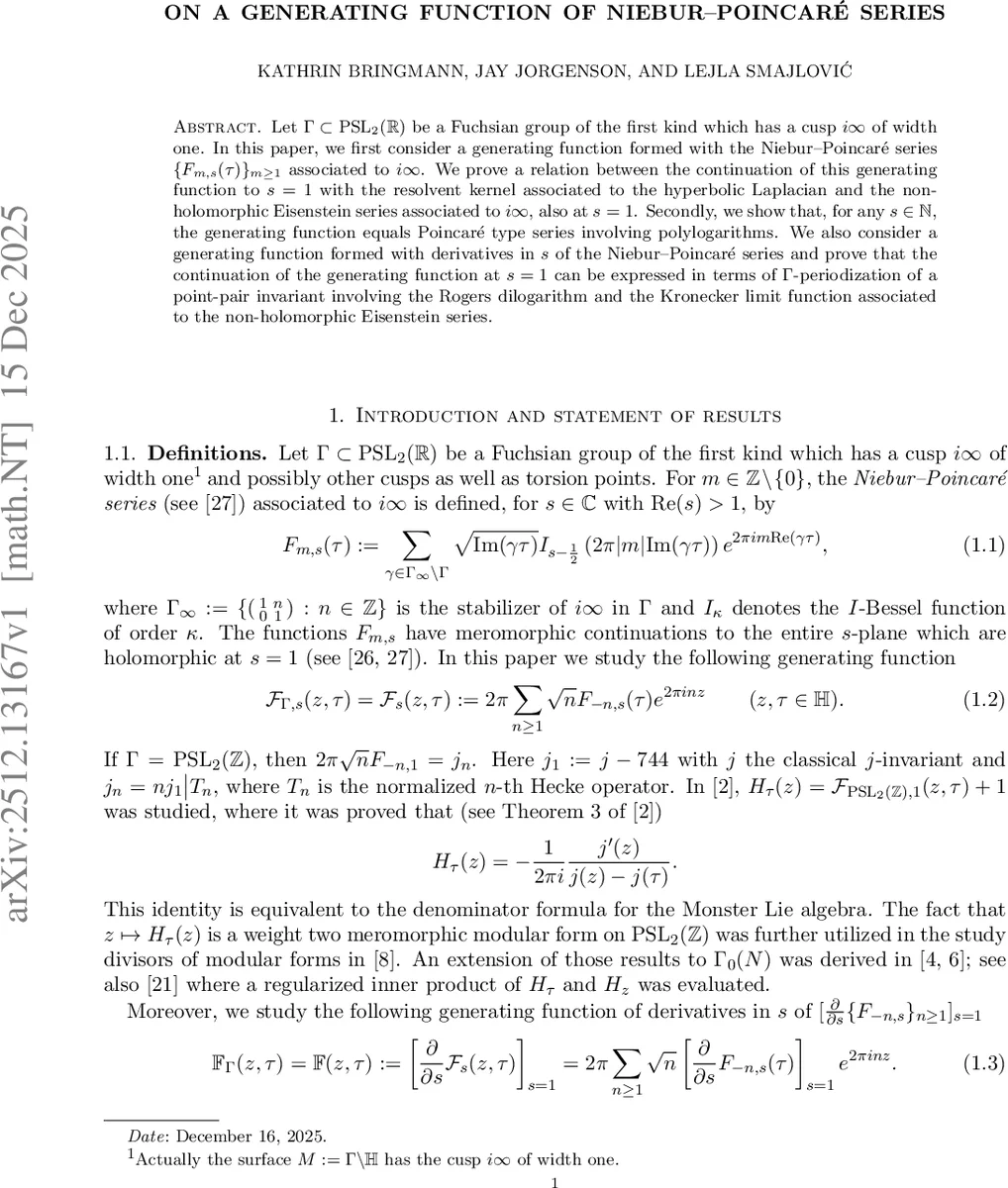
Let $Γ\subset PSL_2(\mathbb{R})$ be a Fuchsian group of the first kind which has a cusp $i\infty$ of width one. In this paper, we first consider a generating function formed with the Niebur–Poincaré series ${F_{m,s}(τ)}_{m\ge 1}$ associated to $i\infty$. We prove a relation between the continuation of this generating function to $s=1$ with the resolvent kernel associated to the hyperbolic Laplacian and the non-holomorphic Eisenstein series associated to $i\infty$, also at $s=1$. Secondly, we show that, for any $s\in \mathbb{N}$, the generating function equals Poincaré type series involving polylogarithms. We also consider a generating function formed with derivatives in $s$ of the Niebur–Poincaré series and prove that the continuation of the generating function at $s=1$ can be expressed in terms of $Γ$-periodization of a point-pair invariant involving the Rogers dilogarithm and the Kronecker limit function associated to the non-holomorphic Eisenstein series.
💡 Research Summary
This paper conducts a deep investigation into generating functions constructed from Niebur–Poincaré series associated with a Fuchsian group Γ of the first kind, assumed to have a cusp at i∞ of width one. The authors study two primary objects: the generating function F_s(z, τ) formed by summing Niebur–Poincaré series F_{-n,s}(τ) with exponential weights in z, and its derivative in s evaluated at s=1, denoted F(z, τ).
The first major achievement (Theorem 1.1) establishes fundamental properties of F(z, τ). The authors prove that a suitably normalized version, bF(z, τ), equals the raising operator applied to the automorphic Green’s function G(z, τ). Furthermore, they show that F(z, τ) is a weight 0 polar harmonic Maass form in τ, while bF(z, τ) is a weight 2 polar harmonic Maass form in z with its only pole in the fundamental domain at z=τ. The order of this pole is inversely proportional to the size of the stabilizer of τ in Γ. This theorem significantly generalizes prior results known primarily for congruence subgroups like Γ₀(N) to arbitrary Fuchsian groups, leveraging spectral theoretic methods for the proof.
A key application (Corollary 1.2) links these generating functions to the divisor theory of modular forms. For a weight k meromorphic modular form f on Γ, a divisor polar harmonic Maass form f_div constructed using bF(z, τ) is shown to be congruent modulo the space of cusp forms S₂(Γ) to the logarithmic derivative Θ(f)/f. This provides a powerful tool for studying divisors, especially for genus zero groups.
The second line of results (Theorems 1.3 and 1.4) provides alternative, geometric representations of the generating function F_s(z, τ). For any natural number s, F_s(z, τ) is shown to equal a Poincaré-type series over the coset space Γ∞\Γ involving polylogarithms Li_s. Explicit formulas are given for s=2 (involving logarithms) and s=1, where the generating function is expressed as a conditionally convergent limit of a series involving simple rational expressions.
The final main result (Theorem 1.5) offers an explicit representation for the derivative generating function F(z, τ). It expresses F(z, τ) in terms of the raising operator applied to an automorphic kernel K(z, τ). This kernel is defined as the Γ-periodization of a point-pair invariant built from the Rogers dilogarithm L(x) and involves the Kronecker limit function P(τ) associated with the non-holomorphic Eisenstein series. Specifically, F(z, τ) = -R₀(K(z, τ)) + β/z₂ - P(τ)/(vol(Γ\H) z₂), where β is a constant depending on Γ. This connects the analytic object F(z, τ) to classical special functions and geometric invariants of the hyperbolic surface Γ\H.
Overall, the paper successfully bridges several areas: the analytic theory of Niebur–Poincaré series and resolvent kernels, the geometry of Fuchsian groups, the theory of harmonic Maass forms, and the combinatorics of polylogarithms. By extending results to general Fuchsian groups and providing novel explicit formulas, it opens avenues for further research in the arithmetic properties of automorphic forms on non-arithmetic groups and in divisor problems on general Riemann surfaces.
Comments & Academic Discussion
Loading comments...
Leave a Comment