Cas d'existence de solutions d'EDP
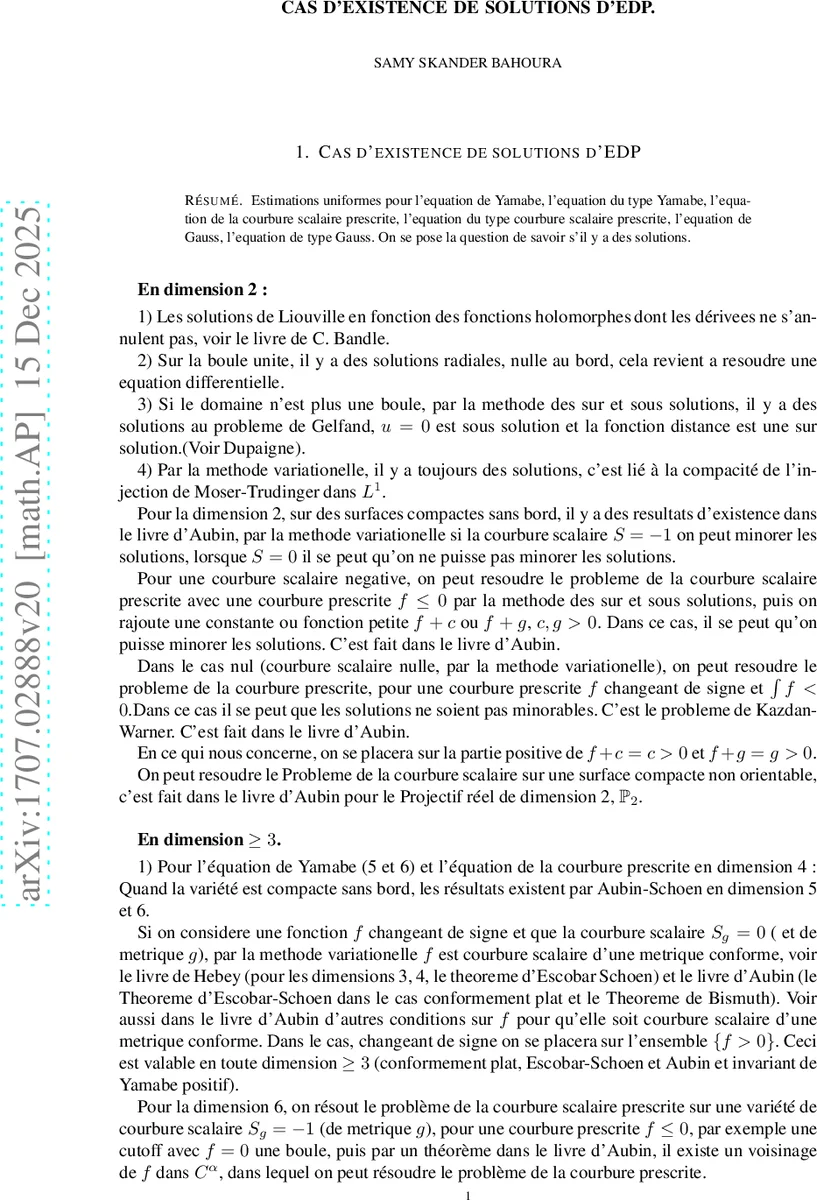
We give some examples of the existence of solutions of geometric PDEs (Yamabe equation, Prescribed Scalar Curvature Equation, Gaussian curvature). We also give some remarks on second order PDE and Green functions and on the maximum principles. And on Harnack type inequalities and Sobolev and interpolation inequality and Moser-Trudinger inequality. And some remarks on the equations.
💡 Research Summary
**
The paper surveys existence results for several fundamental geometric partial differential equations (PDEs), namely the Yamabe equation, the prescribed scalar curvature equation, and the Gaussian curvature equation, across dimensions two through six. It gathers a wide variety of techniques—variational methods, sub‑ and supersolution constructions, topological degree arguments, and a priori estimates—to demonstrate when solutions exist, how they can be bounded, and under what geometric conditions they arise.
In dimension two, the author recalls Liouville-type results based on holomorphic functions, radial solutions on the unit ball with zero boundary data, and the Gelfand problem solved via sub‑ and supersolutions (with the zero function as a subsolution and the distance function as a supersolution). Variational arguments are also invoked, relying on the compact embedding of the Moser–Trudinger inequality into (L^{1}) to guarantee existence. For compact surfaces without boundary, Aubin’s variational framework yields solutions when the scalar curvature (S=-1); the case (S=0) is more delicate and may lack a lower bound, while for (S<0) one can solve the prescribed curvature problem for non‑positive functions (f\le0) by a sub‑supersolution scheme, then perturbing with a small positive constant to obtain a strictly positive prescribed curvature (f+c>0). The Kazdan–Warner obstruction is mentioned for the sign‑changing case.
The discussion then moves to higher dimensions ((n\ge3)). For the Yamabe equation and the prescribed scalar curvature equation in dimensions five and six, the classical Aubin–Schoen results guarantee existence on compact manifolds without boundary. When the prescribed function (f) changes sign, the analysis is confined to the region ({f>0}); a small positive constant (c) is added to ensure (f+c>0), allowing the construction of a lower bound for the solution. Explicit lower bounds are exhibited in dimension six, e.g. (m=1/(1-c)) when (0\ge f\ge -1). The paper also treats manifolds with boundary, citing works of Han, Li, and others that provide positive operators of the form (\Delta + a) (with (a<R)) for dimensions five and above, thereby extending existence results to bounded domains.
Substantial emphasis is placed on the sub‑supersolution method and variational techniques. The former is applied to Gelfand-type problems, to prescribed curvature equations with cut‑off functions, and to situations where the nonlinearity is subcritical. The latter leverages compact Sobolev embeddings, the Moser–Trudinger inequality, and the Brezis–Nirenberg framework to handle critical Sobolev exponents. Radial solutions are illustrated via Chen–Lin’s work, where prescribed curvature of the form (V=1-Kr^{\rho}) yields explicit solutions. The paper also references Druet’s results on compact manifolds with positive potentials and subcritical perturbations, showing how these fit into the broader existence theory.
A significant portion of the manuscript is devoted to a priori estimates. Harnack inequalities, Sobolev inequalities, and Green’s function asymptotics are employed to control blow‑up phenomena. The author argues that, in dimensions three and higher, isolated simple blow‑up points can be ruled out by combining Pohozaev identities with the positivity of the “mass” in the Green function expansion. Consequently, solutions remain bounded in (C^{2}), and topological degree arguments (Leray–Schauder) guarantee non‑trivial solutions. The paper also discusses the compactness of solution families via Cheeger–Gromov convergence, Ascoli-type theorems, and weak compactness in (L^{p}) or (H^{1}).
Finally, the author presents a rich collection of concrete examples on non‑conformally flat manifolds: products of spheres, tori, hyperbolic spaces, complex projective spaces, K3 surfaces, and (S^{2}\times S^{2}). By adjusting sectional curvature (−1, 0, 1) through connected sums or product constructions, the paper demonstrates how the previously discussed existence results apply to these geometries. In particular, it shows that on manifolds such as (S^{1}\times P^{2}(\mathbb{C})) or (S^{1}\times S^{2}\times S), one can prescribe scalar curvature functions that change sign, add a small positive perturbation, and obtain solutions without a priori lower bound, illustrating the sharpness of the theoretical framework.
Overall, the manuscript provides a comprehensive, dimension‑by‑dimension synthesis of existence theorems for geometric PDEs, unifying classical results with newer techniques, and offering explicit constructions and estimates that may serve as a reference for researchers working at the intersection of differential geometry, analysis, and mathematical physics.
Comments & Academic Discussion
Loading comments...
Leave a Comment