A third-order conservation law for the Kirchhoff-Pokhozhaev equation
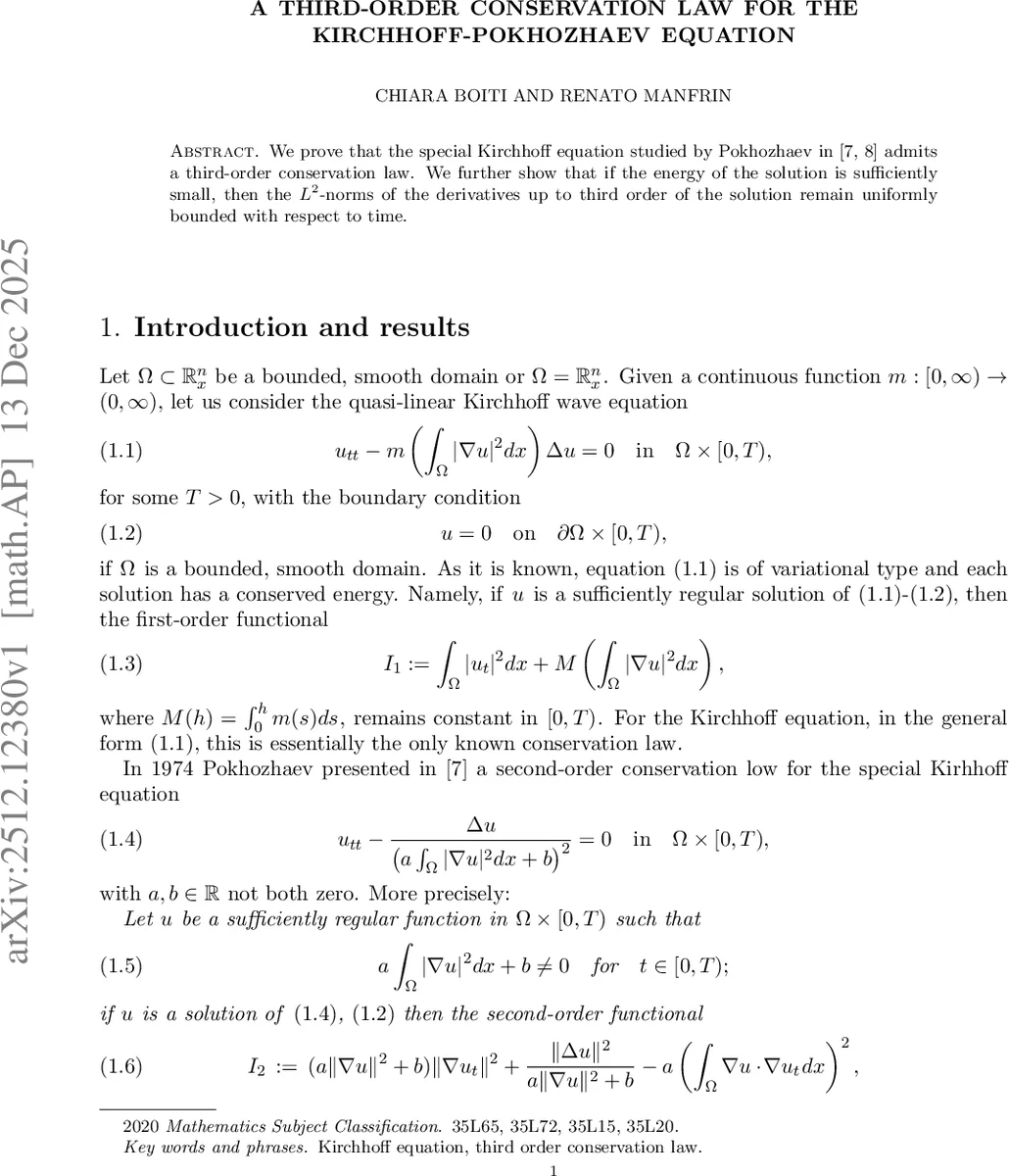
We prove that the special Kirchhoff equation studied by Pokhozhaev admits a third-order conservation law. We further show that if the energy of the solution is sufficiently small, then the $L^2$-norms of the derivatives up to third order of the solution remain uniformly bounded with respect to time.
💡 Research Summary
The paper investigates a special Kirchhoff equation introduced by Pokhozhaev, namely
u_{tt} – Δu + a (∫_{ℝⁿ}|∇u|² dx) + b = 0,
with constants a, b ≠ 0. For this equation the classical first‑order energy
I₁ = ∫|u_t|² dx + M(∫|∇u|² dx), M′(s)=m(s),
is conserved for any smooth solution. Pokhozhaev previously discovered a second‑order conserved functional I₂, which exists only when the coefficient function m(s) takes the specific form m(s)=1/(as+b)². This second‑order law is crucial because it yields a priori bounds for the quantity d/dt‖∇u‖², and under suitable sign conditions on a and b it leads to global existence results.
The main contribution of the present work is the construction of a third‑order conserved functional I₃. The authors start by applying the spatial Fourier transform to u, obtaining for each frequency ξ a Liouville‑type ordinary differential equation
w_{tt} + |ξ|²/q(t)² w = 0, q(t)=a‖∇u‖²+b,
where w(ξ,t) is the Fourier transform of u and q(t) never vanishes under the assumptions. They then introduce a quadratic form
E(ξ,t)=α₀|ξ|⁴|w_t|² + (1/q²)|ξ|²|w|² + β₀|ξ|⁴Re(w w_t) + γ₀|ξ|²|w_t|²,
with time‑dependent coefficients α₀, β₀, γ₀ to be chosen. By differentiating E with respect to t and using the ODE for w, they derive a system of linear equations for the coefficients that forces dE/dt to be proportional to |ξ|²Re(w w_t). Solving this system yields
α₀ = C₀/q, β₀ = –C₀ q′, γ₀ = –C₀² q″/q²,
and, after a second level of adjustment,
α₁ = C₀⁴(q q″+2q′²)/4 + C₁ q, β₁ = … (an explicit expression involving q, q′, q″).
Here C₀ and C₁ are arbitrary constants. Integrating E(ξ,t) over ξ defines a global functional E(t). The time derivative of E(t) reduces to (1/2)β₁′ s′, where s(t)=‖∇u‖² and s′=2∫∇u·∇u_t dx. Consequently, the quantity
I₃ = q‖Δu_t‖² + ‖∇Δu‖² q – q′∫Δu Δu_t dx
+ (1/8)q′²( q‖u_t‖² + ‖Δu‖² q ) – (a/16)a² s′⁴/(as+b)⁴ + q² s″²
is constant in time. This is the desired third‑order conservation law (Theorem 1.1).
Having a third‑order invariant is not sufficient by itself; one must guarantee its positivity to obtain useful a‑priori estimates. The authors therefore impose a small‑energy condition on the first‑order functional:
I₁ ≤ (1/6)|a| b.
Under this hypothesis Lemma 1.3 shows that q stays in the interval
Comments & Academic Discussion
Loading comments...
Leave a Comment