Barium Autoionization for Efficient Ion Trap Loading
We report a theoretical and experimental investigation of autoionizing resonances from the $5d6p,{}^3\mathrm{D}_1^o$ manifold in neutral barium for efficient loading of ion traps. Our calculations predict large resonant cross sections for many narrow autoionizing resonances, but we find experimentally that for most of these, Doppler broadening during trap loading depresses the effective cross sections that can be achieved in practice. We identify and demonstrate a strong, broad transition at $531,\mathrm{nm}$, and show that it furnishes an order-of-magnitude increase in trap loading efficiency compared to other demonstrated resonances.
💡 Research Summary
This paper presents a comprehensive theoretical and experimental investigation into enhancing ion trap loading efficiency for barium through two-step photoionization via autoionizing resonances. Barium ions are promising qubit candidates due to their visible-wavelength transitions and long-lived metastable states, but efficient loading, especially for scarce radioactive isotopes like 133Ba+, remains a challenge.
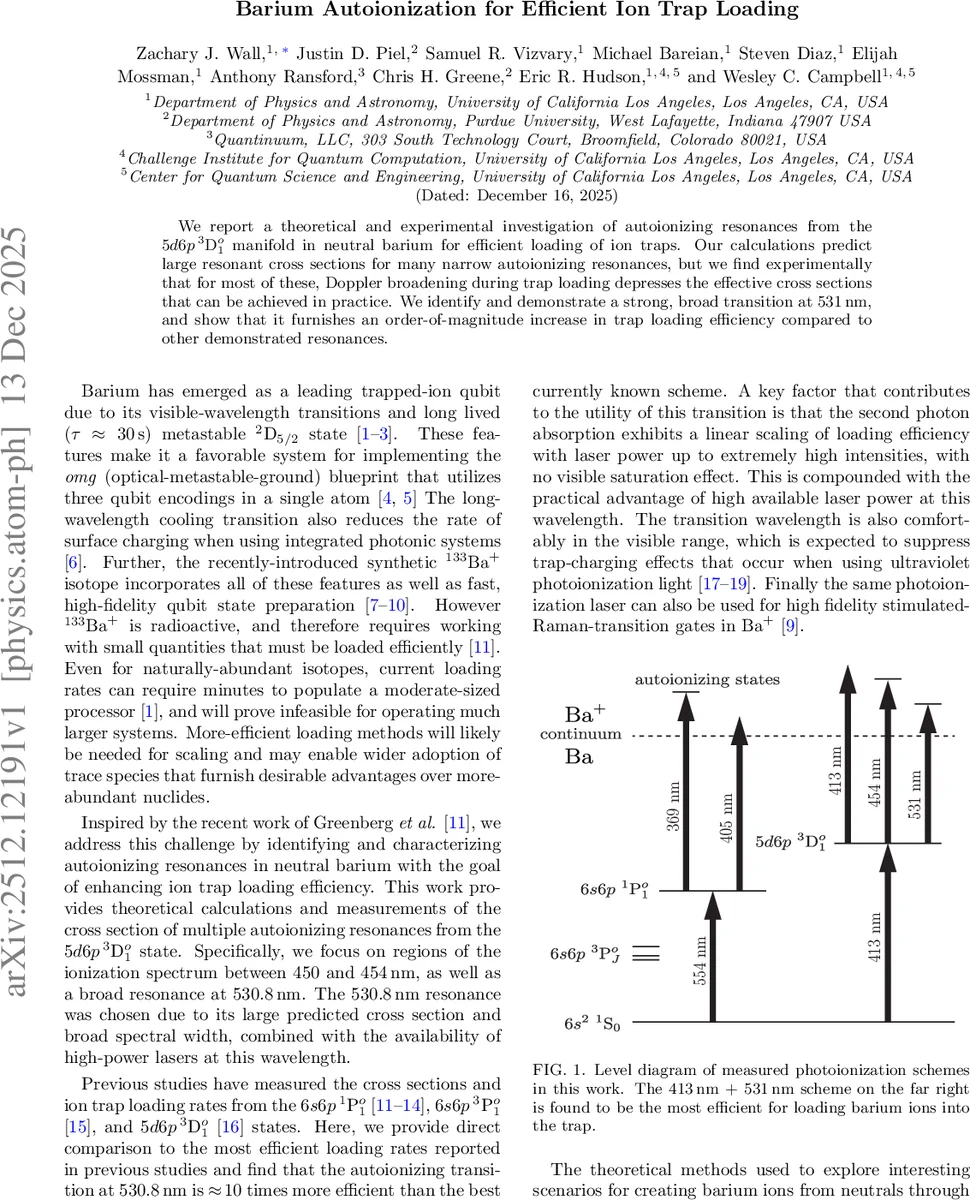
Theoretical calculations using variational R-matrix theory integrated with multichannel quantum defect theory predicted a spectrum of autoionizing resonances from the excited 5d6p 3D1o state of neutral barium, many with large cross-sections. The experimental setup involved generating a cloud of neutral barium atoms via laser ablation of a BaCl2 target. A first-step laser at 413 nm excited atoms from the ground state (6s2 1S0) to the 5d6p 3D1o state. A tunable spectroscopy laser was then used to drive transitions from this intermediate state to various autoionizing resonances, and the resulting ion yield was measured to determine cross-sections.
A key finding was the discrepancy between theory and experiment for narrow resonances in the 450-454 nm range. While peak positions agreed, the measured cross-sections were significantly lower than predicted. The authors identified Doppler broadening of the hot ablation plume (~350 K) as the primary cause. Convolving the theoretical spectrum with a Gaussian profile matching the measured Doppler width yielded much better agreement with experimental data, highlighting a major practical limitation for narrow resonances in typical trap-loading environments.
To overcome this, the researchers searched the theoretical spectrum for a resonance that was both strong and inherently broad, making it robust against Doppler broadening. They identified and characterized a transition at 530.8 nm (531 nm) to the 5d3/28d5/2 J=2 autoionizing state. This resonance exhibited an exceptionally large measured cross-section of (7400 ± 870) Mb, in good agreement with theory. Crucially, it provided approximately an order-of-magnitude increase in loading efficiency compared to the previously most efficient scheme (autoionization from the 6s6p 3P1o state at 389 nm).
The 531 nm transition offers several practical advantages: its large inherent width minimizes Doppler suppression, it operates at a wavelength where high-power laser technology (e.g., fiber lasers) is readily available, and its visible wavelength mitigates anomalous charging effects associated with ultraviolet photoionization light. Furthermore, the loading rate showed a linear scaling with laser intensity up to the measured power levels, with a calculated saturation intensity as high as .86 MW/cm2, indicating ample room to leverage high laser power for even faster loading.
In conclusion, the study demonstrates that the two-step photoionization scheme using 413 nm and 531 nm lasers represents the most efficient and practical method identified to date for loading barium ions into traps. This advancement is particularly valuable for scaling quantum processors and for working with isotopes where maximizing ion yield from limited material is critical.
Comments & Academic Discussion
Loading comments...
Leave a Comment