The local converse theorem for quasi-split $O_{2n}$ and $SO_{2n}$
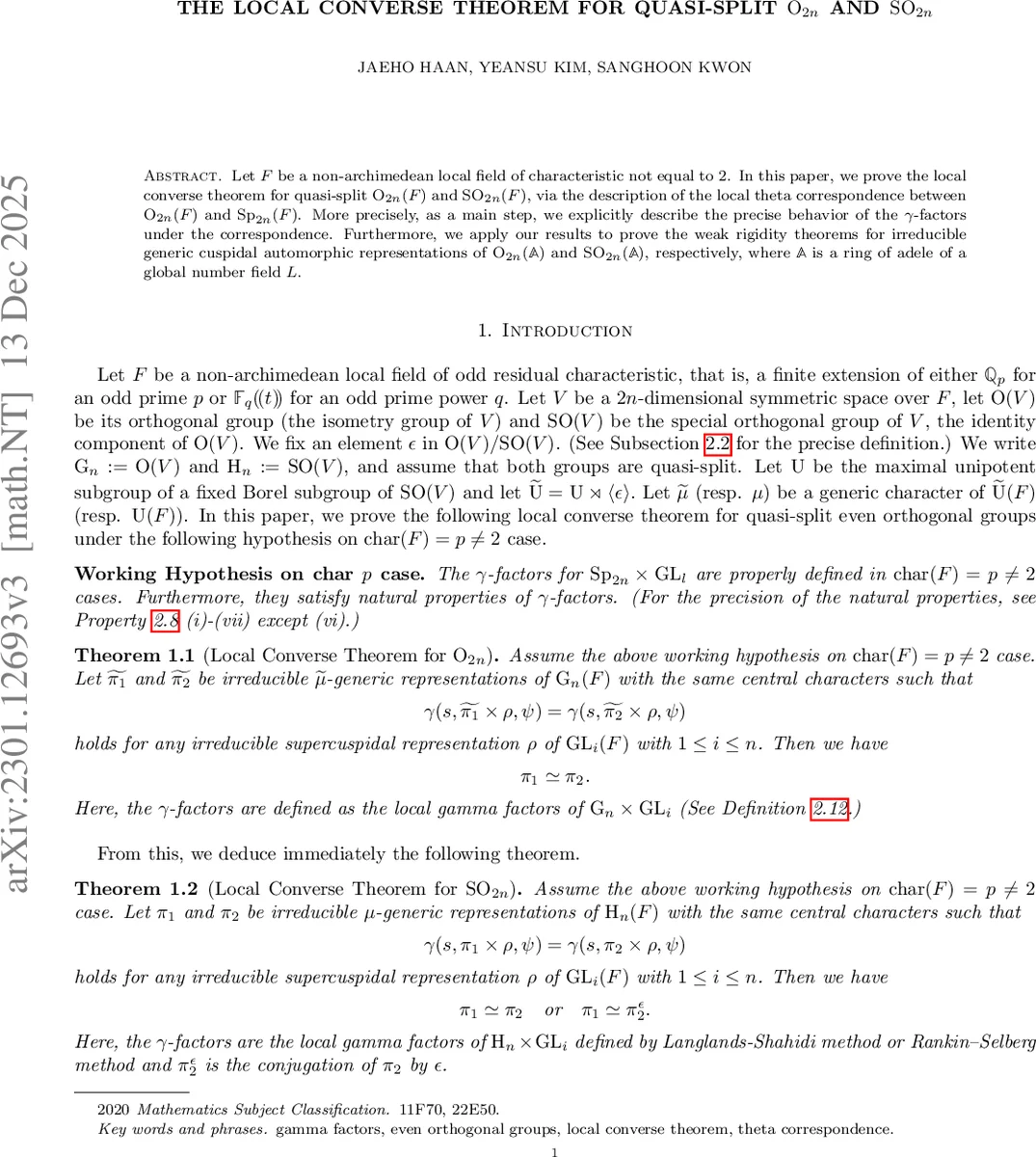
Let $F$ be a non-archimedean local field of characteristic not equal to 2. In this paper, we prove the local converse theorem for quasi-split $Ø_{2n}(F)$ and $\SO_{2n}(F)$, via the description of the local theta correspondence between $Ø_{2n}(F)$ and $\Sp_{2n}(F)$. More precisely, as a main step, we explicitly describe the precise behavior of the $γ$-factors under the correspondence. Furthermore, we apply our results to prove the weak rigidity theorems for irreducible generic cuspidal automorphic representations of $Ø_{2n}(\A)$ and $\SO_{2n}(\mathbb{A})$, respectively, where $\A$ is a ring of adele of a global number field $L$.
💡 Research Summary
This paper establishes the Local Converse Theorem (LCT) for quasi-split even orthogonal groups O_{2n} and SO_{2n} over non-archimedean local fields F of characteristic not equal to 2, and derives global rigidity theorems as applications.
The main objective is to prove that an irreducible generic representation of O_{2n}(F) (or SO_{2n}(F)) is uniquely determined, up to isomorphism (and up to conjugation by an outer automorphism for SO_{2n}), by the family of its twisted local gamma factors γ(s, π × ρ, ψ) as ρ ranges over all irreducible supercuspidal representations of GL_i(F) for 1 ≤ i ≤ n. This result, conjectured for classical groups, generalizes prior work that primarily focused on split groups or fields of characteristic zero.
The core innovation of the proof lies in its use of the local theta correspondence between O_{2n} and Sp_{2n}. Instead of relying on Arthur’s classification or the local Langlands correspondence, the authors independently analyze the precise behavior of γ-factors under this correspondence. Their key technical theorem (Theorem 4.3) shows that for an irreducible generic representation π̃ of O_{2n}(F) and its theta lift θ(π̃) to Sp_{2n}(F), the equality γ(s, π̃ × ρ, ψ) = γ(s, θ(π̃) × ρ, ψ) holds for any supercuspidal representation ρ of GL_i(F). This pivotal identity bridges the LCT for orthogonal groups to the known LCT for symplectic groups (proven by Jo, 2022). The proof of this gamma factor relation involves a detailed study of the theta correspondence and the properties of Rankin-Selberg γ-factors.
The paper is structured as follows: After introducing the groups and their generic characters, it reviews the theory of local theta correspondence. It then dedicates a central section to proving the aforementioned compatibility of γ-factors. This result is subsequently deployed to prove the main theorems:
- Theorem 1.1 (LCT for O_{2n}): Two irreducible generic representations π̃₁, π̃₂ of O_{2n}(F) with the same central character are isomorphic if their γ-factors agree for all supercuspidal representations ρ of GL_i(F) (1 ≤ i ≤ n).
- Theorem 1.2 (LCT for SO_{2n}): Two irreducible generic representations π₁, π₂ of SO_{2n}(F) with the same central character are either isomorphic or conjugated by an outer automorphism if their γ-factors agree under the same conditions.
The proof for O_{2n} reduces the problem to the symplectic case via theta correspondence. The result for SO_{2n} is then deduced from the O_{2n} case by examining the restriction of representations.
In the final section, the authors apply their local results to the global setting. They prove weak rigidity theorems for irreducible generic cuspidal automorphic representations of O_{2n} and SO_{2n} over the ring of adeles of a number field. These theorems state that if two such global representations are locally isomorphic (or differ by the determinant character for O_{2n}) at almost all places, then they are in fact locally isomorphic at all places. These global applications are achieved without invoking Arthur’s multiplicity formula, instead relying directly on the local converse theorems and strong approximation.
The work extends recent results on split SO_{2n} to the quasi-split case and handles local fields of positive characteristic (p≠2), contingent on a working hypothesis about the definition and properties of γ-factors for Sp_{2n} × GL_l in characteristic p. The paper includes appendices providing foundational proofs and technical details essential for establishing the main theorems on theta correspondence and gamma factors. Overall, this research provides a robust, correspondence-based framework for solving converse theorems and offers new insights into the relationship between representations of orthogonal and symplectic groups via theta lifting.
Comments & Academic Discussion
Loading comments...
Leave a Comment