Directional dead-cone effect in QCD matter
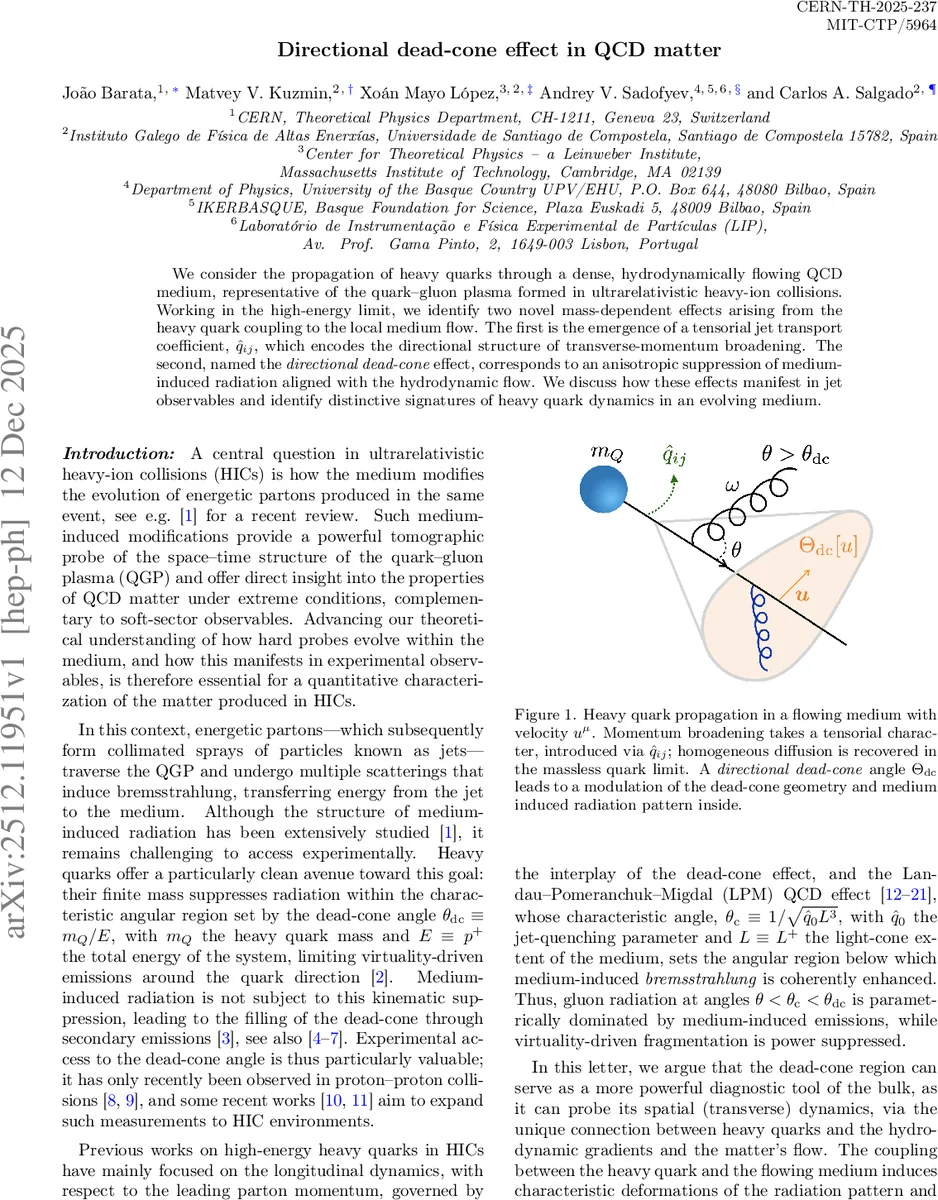
We consider the propagation of heavy quarks through a dense, hydrodynamically flowing QCD medium, representative of the quark-gluon plasma formed in ultrarelativistic heavy-ion collisions. Working in the high-energy limit, we identify two novel mass-dependent effects arising from the heavy quark coupling to the local medium flow. The first is the emergence of a tensorial jet transport coefficient, $\hat{q}_{ij}$, which encodes the directional structure of transverse-momentum broadening. The second, named the directional dead-cone effect, corresponds to an anisotropic suppression of medium-induced radiation aligned with the hydrodynamic flow. We discuss how these effects manifest in jet observables and identify distinctive signature of heavy quark dynamics in an evolving medium.
💡 Research Summary
This paper presents a theoretical investigation into the propagation of high-energy heavy quarks (like charm or bottom) through a flowing Quark-Gluon Plasma (QGP), as created in ultrarelativistic heavy-ion collisions. The central finding is the identification of two novel, mass-dependent phenomena that emerge from the coupling between the heavy quark’s finite mass and the local velocity field of the expanding medium, effects which are absent for light partons.
The first major result is the generalization of the standard jet transport coefficient (\hat{q}), which quantifies transverse momentum broadening, from a scalar to a tensor (\hat{q}{ij}). The authors demonstrate that within a perturbative framework, resumming multiple soft scatterings of a heavy quark off the flowing medium leads to an anisotropic diffusion process. The derived tensor has the form (\hat{q}{ij} \propto \delta_{ij} - (u_i u_j/(u^-)^2)(m_Q^2/E^2)), explicitly showing that momentum diffusion is stronger in directions transverse to the medium flow vector (\mathbf{u}) compared to along it. This anisotropy is proportional to the heavy quark mass (m_Q) and vanishes in the massless limit, recovering the conventional isotropic (\hat{q}_0).
The second and namesake discovery is the “directional dead-cone effect.” The dead-cone, a characteristic angular region around a heavy quark where vacuum-like radiation is suppressed by its mass, is traditionally defined by the angle (\theta_{dc} = m_Q/E). The paper shows that in a flowing medium, this suppression becomes anisotropic. By calculating the medium-induced soft gluon radiation spectrum in the presence of a flow field, the authors find that the effective dead-cone angle is modulated: (\Theta_{dc}^2(\mathbf{k} \cdot \mathbf{u}) = \theta_{dc}^2 (1 - (\mathbf{k} \cdot \mathbf{u})/(u^- \omega))), where (\mathbf{k}) is the gluon’s transverse momentum and (\omega) its energy. This implies that radiation emitted with (\mathbf{k}) parallel to the flow (\mathbf{u}) experiences maximal suppression, while radiation emitted anti-parallel to the flow experiences minimal suppression within the cone. Consequently, the radiation pattern inside the dead-cone acquires an elliptic asymmetry relative to the flow direction.
The theoretical derivation employs the high-energy and soft-gluon limits to make the complex calculation tractable, while retaining the leading-power corrections due to the mass and flow coupling. The amplitude for quark propagation and gluon emission is expressed in terms of Wilson lines modified by the background flow velocity. Numerical evaluations under a harmonic oscillator approximation for the medium interactions visually confirm the effect, showing clear differences in the radiation spectrum for gluons emitted parallel, perpendicular, and anti-parallel to the transverse flow across various kinematic conditions (gluon energy, medium length, quark energy).
In summary, this work establishes that heavy quarks are not just passive probes of energy loss but are uniquely sensitive to the hydrodynamic flow of the QGP via their mass. The predicted tensorial momentum broadening and the directional dead-cone effect provide new, differential observables. These could be leveraged in future jet substructure analyses in heavy-ion collisions to gain unprecedented insight into the spatial dynamics and evolution of the hot QCD matter.
Comments & Academic Discussion
Loading comments...
Leave a Comment