Electric and spin-valley currents induced by structured light in 2D Dirac materials
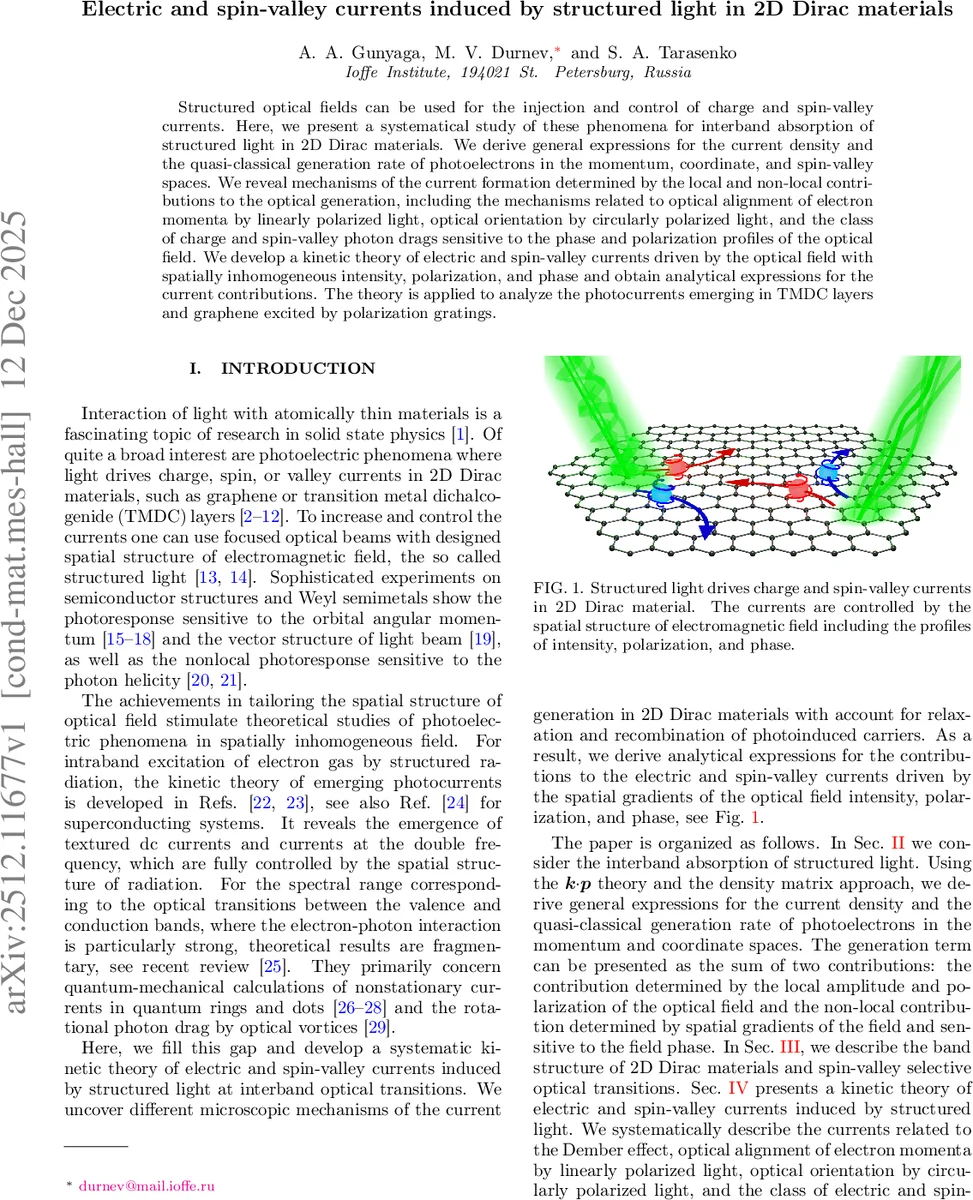
Structured optical fields can be used for the injection and control of charge and spin-valley currents. Here, we present a systematical study of these phenomena for interband absorption of structured light in 2D Dirac materials. We derive general expressions for the current density and the quasi-classical generation rate of photoelectrons in the momentum, coordinate, and spin-valley spaces. We reveal mechanisms of the current formation determined by the local and non-local contributions to the optical generation, including the mechanisms related to optical alignment of electron momenta by linearly polarized light, optical orientation by circularly polarized light, and the class of charge and spin-valley photon drags sensitive to the phase and polarization profiles of the optical field. We develop a kinetic theory of electric and spin-valley currents driven by the optical field with spatially inhomogeneous intensity, polarization, and phase and obtain analytical expressions for the current contributions. The theory is applied to analyze the photocurrents emerging in TMDC layers and graphene excited by polarization gratings.
💡 Research Summary
This paper presents a comprehensive theoretical study on the generation and control of charge and spin-valley currents in two-dimensional (2D) Dirac materials, such as graphene and transition metal dichalcogenide (TMDC) monolayers, using structured light. Structured light refers to optical fields with designed spatial inhomogeneity in intensity, polarization, and phase.
The authors develop a systematic kinetic theory to describe these phenomena for interband optical transitions. The core of their formalism involves deriving general expressions for the photocurrent density and the quasi-classical generation rate of photoelectrons in momentum, coordinate, and spin-valley spaces. A key advancement is the decomposition of the optical generation term into a local contribution, determined by the field amplitude and polarization at a given point, and a non-local contribution, sensitive to the spatial gradients (particularly the phase gradient) of the optical field.
The local generation mechanism encompasses effects like optical alignment of electron momenta by linearly polarized light and optical orientation (valley/spin selectivity) by circularly polarized light. The non-local generation gives rise to a distinct class of charge and spin-valley photon drag currents that depend on the phase profile of the light beam.
The theory is applied to materials described by a generic 2D Dirac Hamiltonian. Explicit analytical expressions are obtained for the current contributions driven by spatial gradients of the optical field’s Stokes parameters (intensity S0, linear polarization S1/S2, and circular polarization S3). The resulting photocurrents are classified into two main categories: 1) currents arising from the relaxation of a spatially inhomogeneous electron distribution created by local absorption (e.g., diffusion currents akin to the Dember effect), and 2) currents directly generated by the non-local optical transition process itself.
The paper concludes by indicating the application of this general theory to analyze photocurrents emerging in TMDC layers and graphene excited by polarization gratings—interference patterns with a periodic modulation of polarization. This work establishes a fundamental theoretical framework for manipulating charge and spin flows in 2D materials using the sophisticated spatial structure of light, with potential implications for valleytronics and spintronics.
Comments & Academic Discussion
Loading comments...
Leave a Comment