Existence and dependency results for coupled Schrödinger equations with critical exponent on waveguide manifold
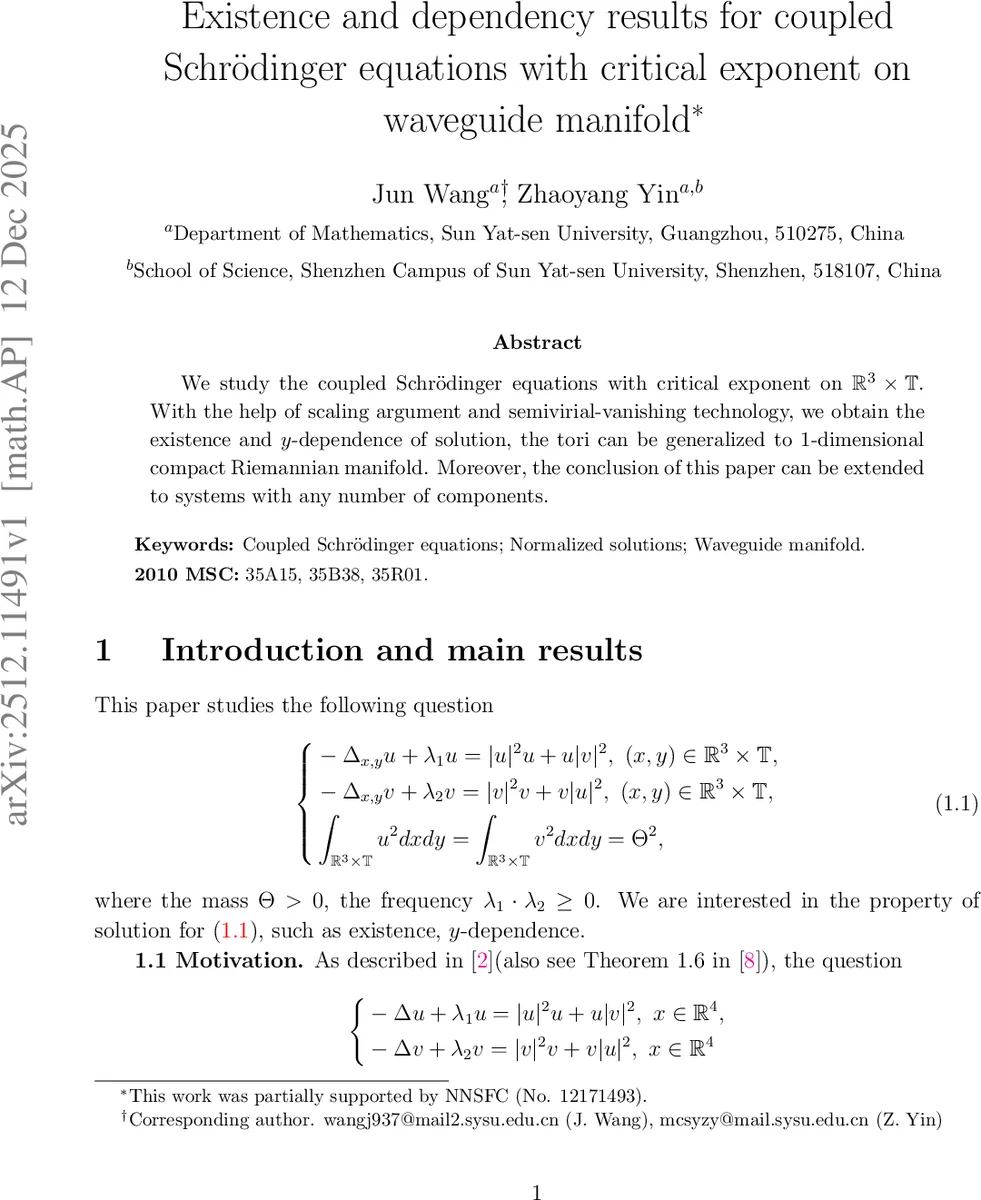
We study the coupled Schrödinger equations with critical exponent on $\mathbb{R}^3 \times \mathbb{T}$. With the help of scaling argument and semivirial-vanishing technology, we obtain the existence and $y$-dependence of solution, the tori can be generalized to $1$-dimensional compact Riemannian manifold. Moreover, the conclusion of this paper can be extended to systems with any number of components.
💡 Research Summary
This research paper addresses a fundamental problem in the field of nonlinear partial differential equations (PDEs): the existence of solutions for coupled nonlinear Schrödinger equations (NLS) characterized by a critical exponent on a waveguide manifold, specifically $\mathbb{R}^3 \times \mathbb{T}$. The primary mathematical difficulty in studying equations with a critical exponent lies in the loss of compactness in the Sobolev embedding. This loss of compactness prevents the direct application of standard variational methods, as the minimizing sequences for the energy functional may fail to converge to a non-trivial limit due to concentration or dispersion.
To overcome this challenge, the authors employ a sophisticated combination of a scaling argument and the “semivirial-vanishing” technology. The scaling argument is utilized to analyze the behavior of the energy functional near the critical threshold, effectively bridging the gap between subcritical and critical regimes. The semivirial-vanishing technique is a crucial tool used to rule out the possibility of the solution “vanishing”—a phenomenon where the energy density spreads out across the domain such that the limit becomes zero. By controlling this vanishing behavior, the authors are able to establish the existence of a non-trivial solution.
A significant highlight of this work is the investigation of the $y$-dependence of the solutions. The researchers demonstrate that the solutions are not merely translations of the $\mathbb{R}^3$ component but are intrinsically influenced by the geometry of the compact part of the manifold. Furthermore, the scope of the findings is remarkably broad; the authors prove that the results can be generalized from the torus $\mathbb{T}$ to any one-dimensional compact Riemannian manifold. Additionally, the methodology is shown to be applicable to multi-component systems, meaning the conclusions hold for complex, multi-wave interactions. This research provides a rigorous mathematical framework for understanding nonlinear wave phenomena in constrained geometries, such as optical waveguides and quantum tubes, where the interaction between the infinite Euclidean space and the compact manifold plays a decisive role in the stability and existence of wave states.
Comments & Academic Discussion
Loading comments...
Leave a Comment