On free wreath products of classical groups
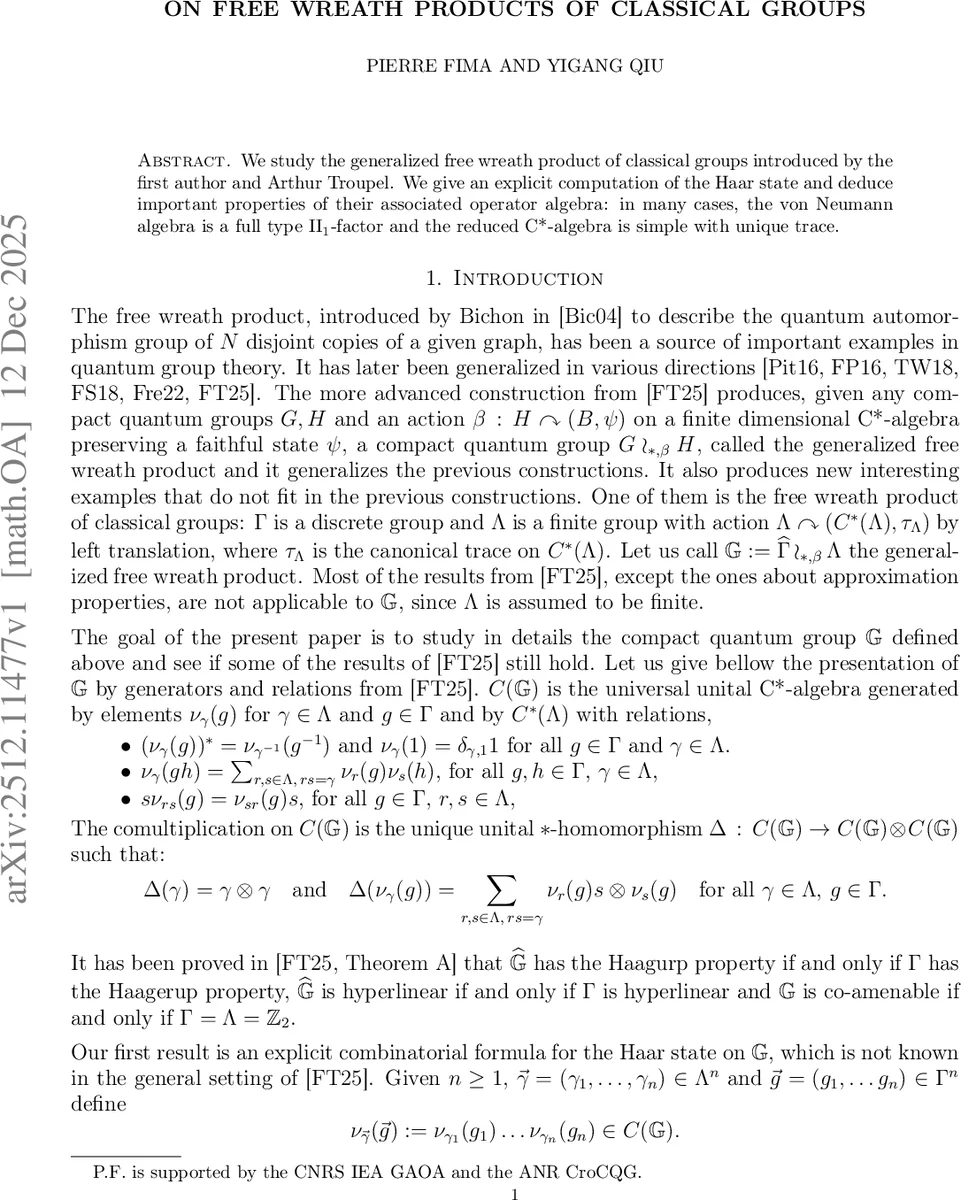
We study the generalized free wreath product of classical groups introduced by the first author and Arthur Troupel. We give an explicit computation of the Haar state and deduce important properties of their associated operator algebra: in many cases, the von Neumann algebra is a full type ${\rm II}_1$-factor and the reduced C*-algebra is simple with unique trace.
💡 Research Summary
The paper investigates the generalized free wreath product of classical groups, focusing on the case where a discrete group Γ and a finite group Λ are combined via the construction introduced by Fima and Troupel. The authors first recall the universal C*-algebra C(G) generated by elements ν_γ(g) (γ∈Λ, g∈Γ) together with the group C*-algebra C*(Λ), subject to relations that encode the group operations of Γ and the multiplication in Λ. The comultiplication Δ is defined so that Δ(γ)=γ⊗γ and Δ(ν_γ(g))=∑_{rs=γ} ν_r(g)⊗ν_s(g).
A central achievement of the work is an explicit combinatorial formula for the Haar state h on the compact quantum group G=Γ ≀* Λ. For any n≥1, a tuple γ⃗∈Λ^n and g⃗∈Γ^n, the authors introduce the non‑crossing partition sets NC(γ⃗) and NC(g⃗). NC(γ⃗) consists of those non‑crossing partitions whose blocks multiply to the identity in Λ, while NC(g⃗) consists of partitions whose blocks multiply to the identity in Γ. The intersection NC(g⃗)∩NC(γ⃗) indexes the terms that survive in the Haar state. For each partition π in this intersection, a Möbius‑type weight μ_π(g⃗) is defined using the Möbius function on the lattice of non‑crossing partitions together with free cumulants. The Haar state is then given by
h(ν_{γ⃗}(g⃗)·s)=δ_{s,1} ∑_{π∈NC(g⃗)∩NC(γ⃗)} μ_π(g⃗) |Λ|^{,n−|π|},
where s∈Λ and δ_{s,1} forces the state to vanish unless the auxiliary Λ‑factor is trivial. This formula shows that h is a trace, faithful, and explicitly computable in terms of free probability data.
Using this explicit description, the paper proceeds to analyze the reduced C*-algebra C_r(G) and the von Neumann algebra L^∞(G). Theorem B states that if Γ is ICC (i.e., has infinite conjugacy classes) and Λ has trivial centre, then C_r(G) is simple and possesses a unique tracial state, while L^∞(G) is a full type II₁ factor. The proof relies on the fact that the Haar state annihilates all non‑trivial reduced words, which together with the ICC property prevents the existence of non‑trivial ideals. When Λ has a non‑trivial centre, the authors compute the centre of L^∞(G) explicitly as L(Z(Λ)), showing that the von Neumann algebra decomposes as a direct integral over the centre of Λ.
Technical tools employed include crossed‑product decompositions (Lemma 2.1) that separate the action of the centre of Λ, and free product constructions that allow the authors to view C(G) as a subalgebra of a free product of C*(Γ) and matrix algebras. Proposition 3.2 gives an explicit description of the universal quantum homomorphism from C*(Γ) to C*(Λ)⊗U, where U is the C*-algebra generated by the coefficients of the homomorphism. The associated state e_ω on U is identified as a free product state built from the canonical traces on C*(Γ) and C*(Λ). This concrete model enables the authors to verify the Haar state formula and to deduce the structural results for the operator algebras.
Overall, the paper fills a gap in the literature by providing a complete Haar state computation for free wreath products involving a finite group, and by establishing simplicity, uniqueness of trace, and factor properties for the associated reduced C*-algebras and von Neumann algebras under natural group‑theoretic hypotheses. The results extend previous work on generalized free wreath products, showing that even in the classical (non‑quantum) setting, these constructions yield rich operator‑algebraic phenomena.
Comments & Academic Discussion
Loading comments...
Leave a Comment