Defect-Engineered Multifunctionality in Cu-Doped Bi2Te2: Interplay of Thermoelectric, Piezoelectric, and Optoelectronic Properties from First-Principles Insights
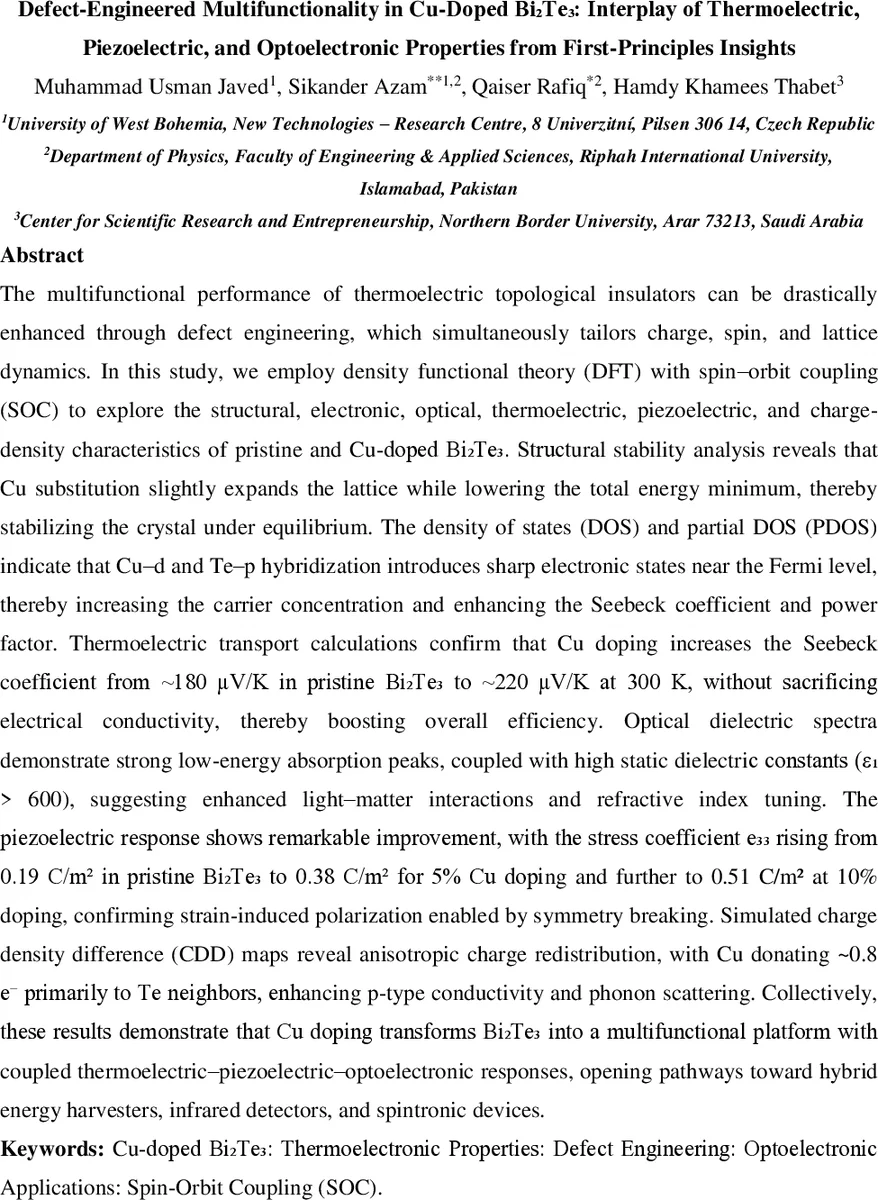
Defect engineering can improve the linked charge, spin, and lattice behavior of thermoelectric topological insulators. Using density functional theory with spin orbit coupling, we study structural, electronic, optical, thermoelectric, piezoelectric, and charge density features of pristine and Cu doped Bi2Te3. Cu substitution slightly expands the lattice and lowers the total energy minimum, which stabilizes the structure. The density of states shows that Cu d and Te p hybridization creates sharp states near the Fermi level, raising the carrier concentration and supporting higher Seebeck coefficient and power factor. Transport calculations show an increase in the Seebeck coefficient from about 180 microvolts per kelvin in pristine Bi2Te3 to about 220 microvolts per kelvin at 300 K while keeping the electrical conductivity nearly unchanged. Optical spectra reveal strong low energy absorption and very large static dielectric constants (greater than 600), indicating tunable light matter coupling. The piezoelectric coefficient e33 rises from 0.19 C/m2 in pristine Bi2Te3 to 0.38 C/m2 at 5 percent Cu and 0.51 C/m2 at 10 percent Cu, reflecting symmetry breaking and strain driven polarization. Charge density difference maps show anisotropic redistribution, with Cu donating about 0.8 electrons mainly to Te sites, which enhances p type behavior and phonon scattering. Overall, Cu doping reshapes Bi2Te3 into a multifunctional material with coupled thermoelectric, piezoelectric, and optical responses suitable for hybrid energy harvesting, infrared detection, and spin based devices.
💡 Research Summary
This research presents a comprehensive investigation into the multifunctional properties of Cu-doped $\text{Bi}_2\text{Te}_3$, utilizing first-principles calculations with spin-orbit coupling (SOC) to explore the impact of defect engineering on its physical characteristics. The study focuses on how the substitution of Cu into the $\text{Bi}_2\text{Te}_3$ lattice can simultaneously enhance thermoelectric, piezoelectric, and optoelectronic functionalities, making it a prime candidate for integrated energy-harvesting and sensing technologies.
From a structural perspective, the researchers found that Cu substitution leads to a slight expansion of the lattice and a reduction in total energy, which contributes to the structural stabilization of the material. The electronic structure analysis reveals that the hybridization between Cu $d$-orbitates and Te $p$-orbitals creates sharp states near the Fermi level. This phenomenon is crucial as it increases the carrier concentration and boosts the Seebeck coefficient from approximately 180 $\mu\text{V/K}$ to 220 $\mu\text{V/K}$ at 300 K, all while maintaining a stable electrical conductivity. This enhancement in the power factor is a significant step forward for thermoelectric efficiency.
The study also highlights a dramatic increase in piezoelectricity. The piezoelectric coefficient $e_{33}$ rises significantly from 0.19 $\text{C/m}^2$ in pristine $\text{Bi}_2\text{Te}_3$ to 0.51 $\text{C/m}^2$ at 10% Cu doping. This enhancement is attributed to the breaking of crystal symmetry and the induction of strain-driven polarization caused by the Cu dopants. Furthermore, the optical properties are significantly altered, showing strong low-energy absorption and an exceptionally large static dielectric constant (exceeding 600), which indicates highly tunable light-matter coupling.
Charge density difference maps provide a microscopic explanation for these changes, showing that Cu donates approximately 0.8 electrons to the Te sites. This electron transfer enhances the p-type behavior and promotes phonon scattering, which is beneficial for reducing thermal conductivity. In conclusion, the research demonstrates that Cu-doped $\text{Bi}_2\text{Te}_3$ is a versatile multifunctional material. Its ability to integrate thermoelectric, piezoelectric, and optical responses makes it an ideal candidate for next-generation hybrid energy harvesting systems, infrared detection, and spin-based electronic devices.
Comments & Academic Discussion
Loading comments...
Leave a Comment