Gradient higher integrability of bounded solutions to parabolic double-phase systems
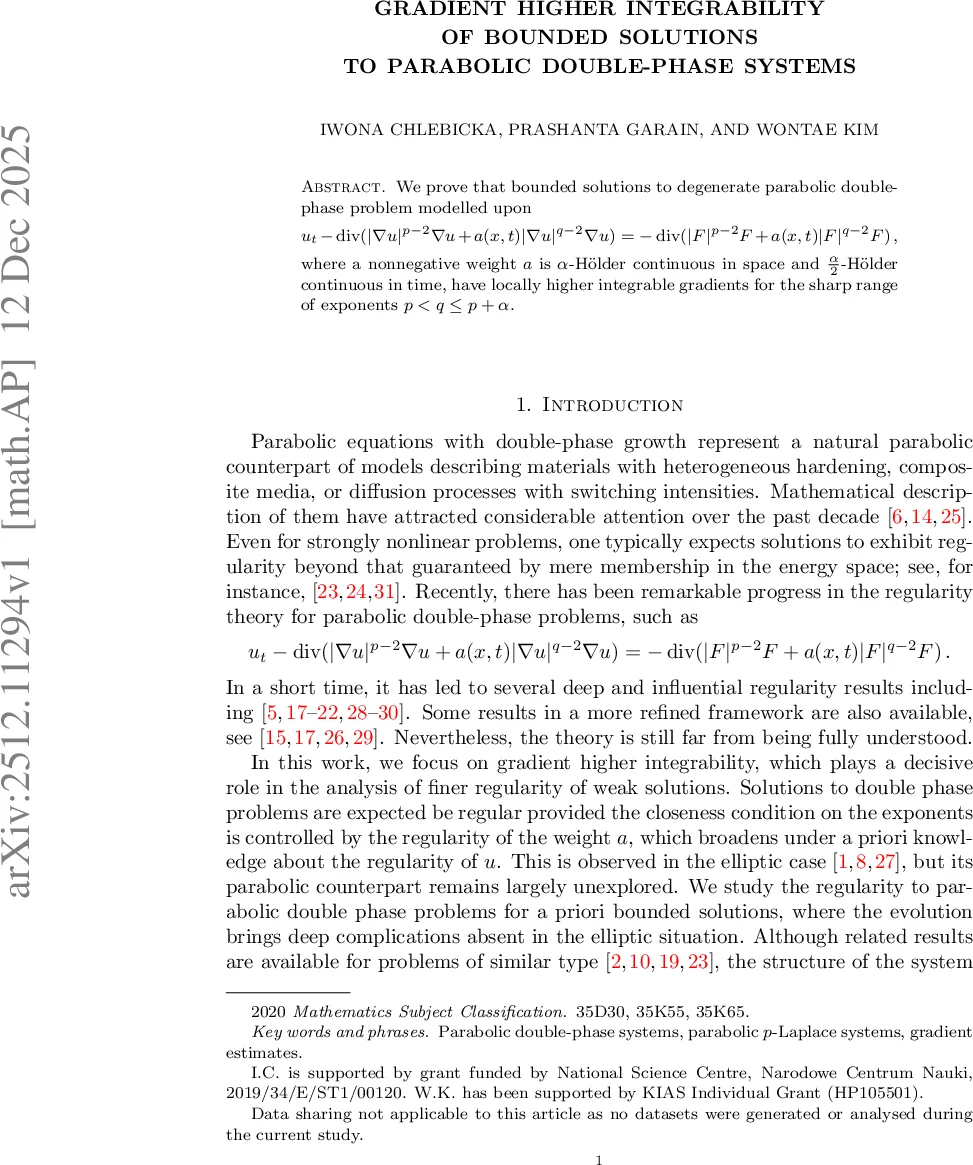
We prove that bounded solutions to degenerate parabolic double-phase problem modelled upon [u_t-\dv(|\na u|^{p-2}\na u+a(x,t)|\na u|^{q-2}\na u)=-\dv(|F|^{p-2}F+a(x,t)|F|^{q-2}F),, ] where a nonnegative weight $a$ is $α$-Hölder continuous in space and $\tfrac α2$-Hölder continuous in time, have locally higher integrable gradients for the sharp range of exponents $p<q\le p+α$.
💡 Research Summary
This paper establishes the local higher integrability of the gradient for bounded solutions to degenerate parabolic double-phase systems. The problem is modeled by the equation u_t - div(|∇u|^{p-2}∇u + a(x,t)|∇u|^{q-2}∇u) = -div(|F|^{p-2}F + a(x,t)|F|^{q-2}F), where the nonnegative weight function a is α-Hölder continuous in space and α/2-Hölder continuous in time. The main result, Theorem 1.1, proves that for bounded weak solutions, the gradient enjoys higher integrability within the sharp range of exponents p < q ≤ p + α.
The proof employs a sophisticated phase-separation strategy, distinguishing between p-intrinsic and (p,q)-intrinsic geometries. In the p-intrinsic regime, the problem is treated as a perturbed p-Laplace evolution, where the perturbation is controlled by the L∞-norm of the solution. In the (p,q)-intrinsic regime, the behavior resembles that of a q-Laplace problem. A pivotal element is the derivation of a reverse Hölder inequality, which is achieved separately for each phase in Lemma 4.8 and Lemma 4.18. A key technical lemma, Lemma 4.1, provides an essential decay property that allows the handling of the non-zero right-hand side datum F.
The paper is structured as follows: Section 2 introduces notation, auxiliary results, and the definition of weak solutions. Section 3 provides foundational energy estimates, including a Caccioppoli-type inequality. Section 4 is the core of the analysis, dedicated to proving the reverse Hölder inequalities adapted to the intrinsic geometries. This involves careful analysis of exit times and stopping time arguments that depend on the energy of both ∇u and F. Finally, Section 5 synthesizes the local estimates into the global result stated in Theorem 1.1. A modified Vitali covering lemma (Lemma 5.7) is crucial here, as the intrinsic scalings vary from point to point. The Hölder continuity of the coefficient a (Lemma 5.6) ensures the comparability of these scaling factors, making the covering argument possible. The sharp condition q ≤ p + α is precisely what guarantees that the oscillation of a over the cylinders remains below the threshold required for the proof to be valid.
This work significantly advances the regularity theory for parabolic double-phase problems by providing gradient higher integrability for bounded solutions under the optimal relation between the growth exponents p, q and the Hölder exponent α of the weight, even in the presence of a non-homogeneous right-hand side.
Comments & Academic Discussion
Loading comments...
Leave a Comment