Drinfeld associators and Kashiwara-Vergne associators in higher genera
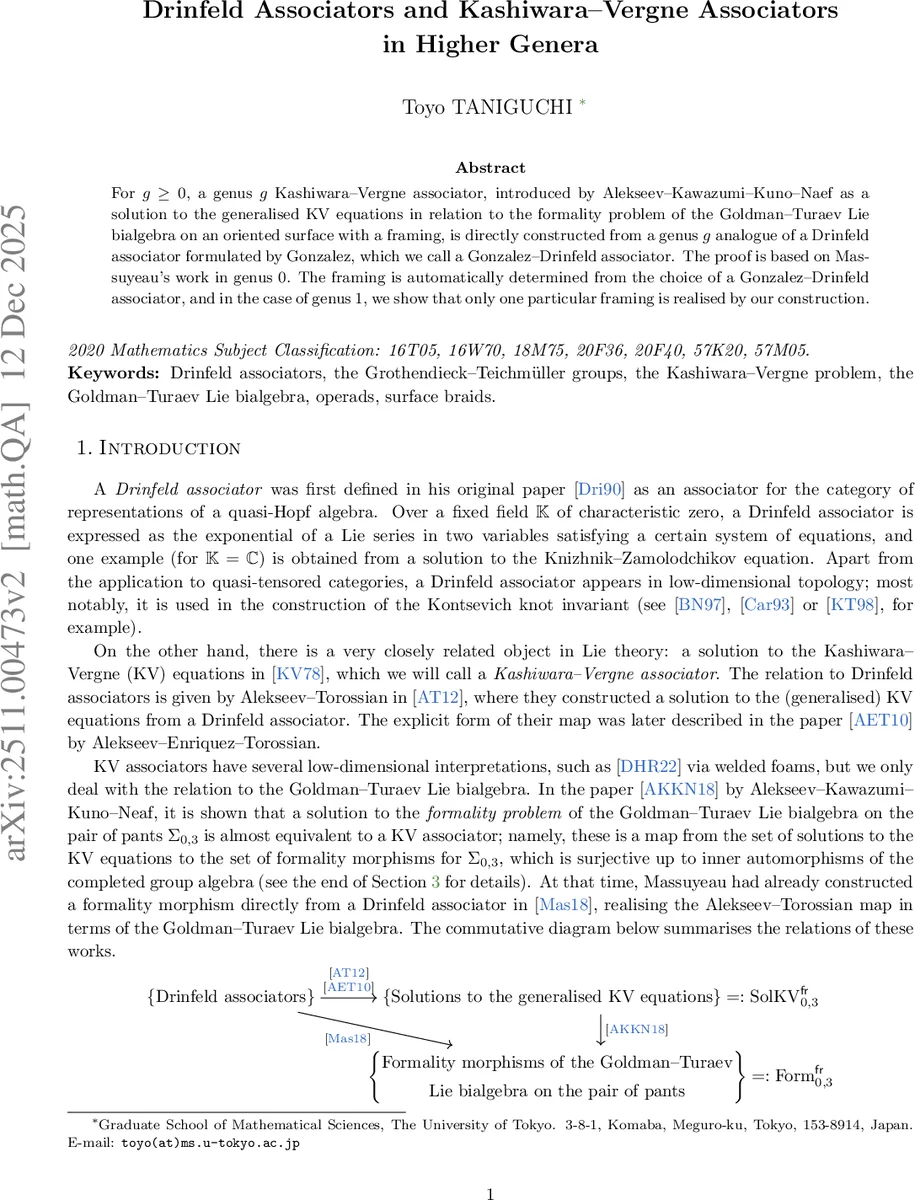
For $g\geq 0$, a genus $g$ Kashiwara-Vergne associator, introduced by Alekseev-Kawazumi-Kuno-Naef as a solution to the generalised KV equations in relation to the formality problem of the Goldman-Turaev Lie bialgebra on an oriented surface with a framing, is directly constructed from a genus $g$ analogue of a Drinfeld associator formulated by Gonzalez, which we call a Gonzalez-Drinfeld associator. The proof is based on Massuyeau’s work in genus 0. The framing is automatically determined from the choice of a Gonzalez-Drinfeld associator, and in the case of genus 1, we show that only one particular framing is realised by our construction.
💡 Research Summary
This paper establishes a direct construction of genus‑(g) Kashiwara‑Vergne (KV) associators from genus‑(g) analogues of Drinfeld associators, called Gonzalez‑Drinfeld associators. The work builds on Massuyeau’s genus‑0 construction of a formality morphism for the Goldman‑Turaev Lie bialgebra and extends it to arbitrary genus.
The author first reviews the definition of Gonzalez‑Drinfeld associators as isomorphisms between the completed Hopf groupoids (\widehat{\mathbb K,PaB_f}) and (\widehat{PaCD_f^g}). These objects encode framed pure braid groups on a surface and their graded Lie algebras ( \mathfrak t_f^{g,I}). A correction to the original definition of (\mathfrak t_f^{g,I}) is provided, adding a term ((g-1)t_{ii}) to the central relation, which is essential for the operadic module structure.
Using the three‑dimensional loop operations introduced by Massuyeau—namely the Fox‑pairing (\eta) and the quasi‑derivation (\mu)—the paper defines a map
\
Comments & Academic Discussion
Loading comments...
Leave a Comment