Modification of adhesion between microparticles and engineered silicon surfaces
A key challenge in performing experiments with microparticles is controlling their adhesion to substrates. For example, levitation of a microparticle initially resting on a surface requires overcoming the surface adhesion forces to deliver the microparticle into a mechanical potential acting as a trap. By engineering the surface of silicon substrates, we aim to decrease the adhesion force between a metallic microparticle and the silicon surface. To this end, we investigate different methods of surface engineering that are based on chemical, physical, or physio-chemical modifications of the surface of silicon. We give quantitative results on the detachment force, finding a correlation between the water contact angle and the mean detachment force, indicating that hydrophobic surfaces are desired for low microparticle adhesion. We develop surface preparations decreasing the mean detachment force by more than a factor of three compared to an untreated silicon surface. Our results will enable reliable levitation of microparticles and are relevant for experiments requiring low adhesion between microparticles and a surface.
💡 Research Summary
The paper addresses a critical bottleneck in magnetic levitation experiments of micrometer‑sized superconducting particles: the need to overcome the adhesion between the particle and the substrate before the magnetic lift force can act. The authors focus on 50 µm Sn‑63 %–Pb‑37 % alloy spheres (mass ≈0.5 µg) that become superconducting below 6.4 K and are representative of particles used in recent levitation studies. Theoretical considerations based on the Lennard‑Jones potential suggest that adhesion forces could be on the order of several micronewtons, but real systems are dominated by a combination of van‑der‑Waals, capillary, electrostatic, and roughness‑related effects. Consequently, the authors perform a systematic experimental investigation of eight surface‑modification strategies applied to silicon chips, keeping the particle surface pristine to ensure generality of the results.
The modifications fall into three categories: (1) purely physical structuring – KOH wet‑etching (microscale grooves) and reactive‑ion plasma etching (nanometer‑scale roughness); (2) chemical coatings – parylene‑C, poly‑methyl‑methacrylate (PMMA), hydrogen‑silsesquioxane (HSQ), and gold sputtering; and (3) a physico‑chemical approach – attachment of a thin polytetrafluoroethylene (PTFE) membrane. After each treatment, the authors characterize surface roughness (root‑mean‑square S_q via AFM), wettability (water contact angle, WCA), and tip‑particle adhesion measured with an AFM cantilever (F_AFM_adh).
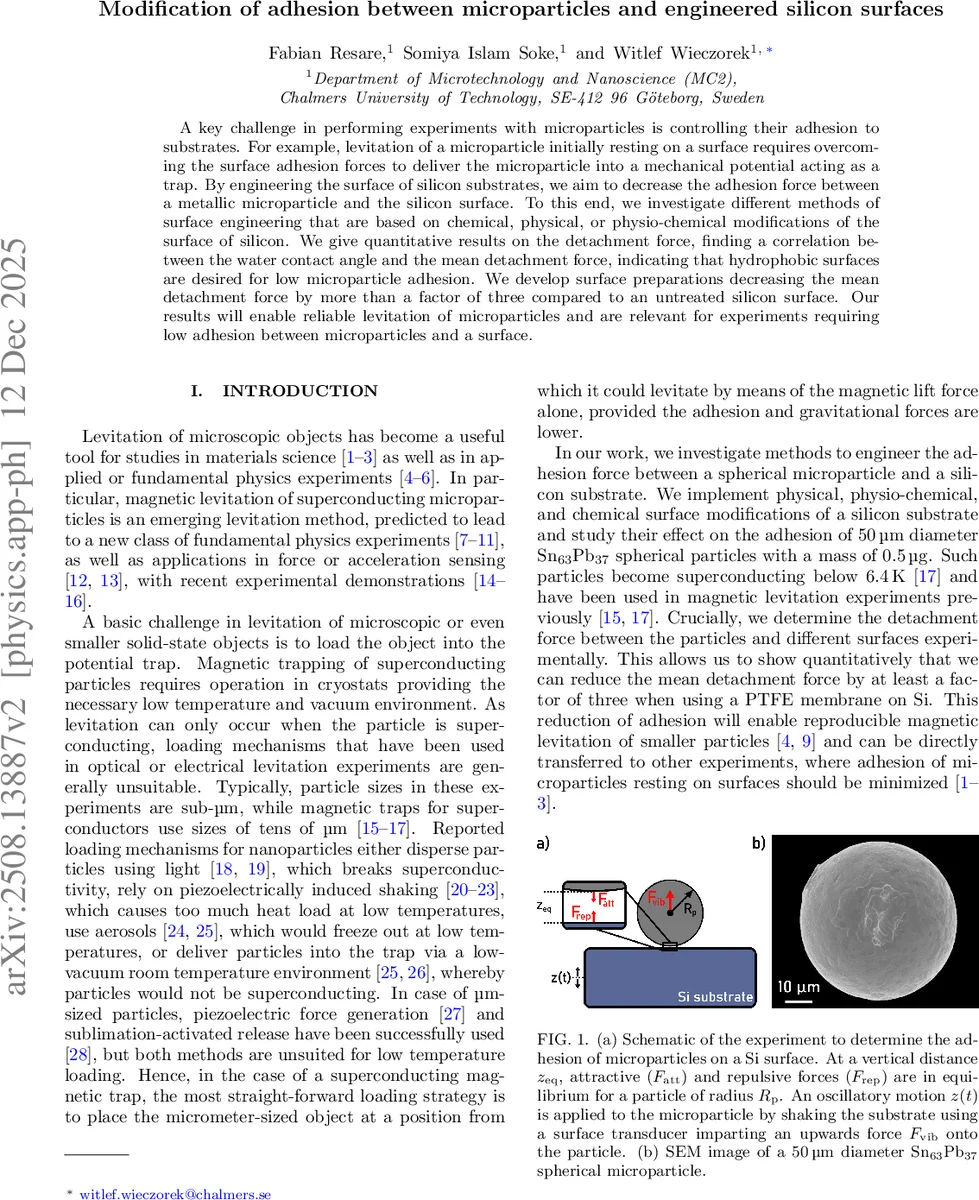
To quantify particle‑substrate adhesion, a calibrated piezo‑electric transducer shakes the chip at 453 Hz while the acceleration amplitude is increased stepwise. The resulting inertial force (m ω² A) is compared to the unknown detachment force. A maximum applied force of 306 nN is reachable within the instrument’s calibrated range. For each chip, 10–20 particles are placed with a grounded micromanipulator, and a motion‑detection algorithm records whether a particle detaches at each force level. The cumulative detachment probability is fitted with a gamma distribution, and Markov‑chain Monte‑Carlo sampling yields posterior estimates of the mean detachment force (µ_F) and its standard deviation (σ_F).
Results show that untreated silicon exhibits the highest adhesion (µ_F ≈ 1.25 µN). Physical structuring increases roughness but paradoxically reduces WCA, leading to higher adhesion (e.g., plasma‑etched Si µ_F ≈ 3.15 µN). Chemical coatings produce mixed outcomes: parylene‑C modestly reduces adhesion (µ_F ≈ 0.73 µN), while gold dramatically increases it (µ_F ≈ 4.9 µN) due to its high surface energy. HSQ spin‑coating yields a low‑energy surface (γ_S ≈ 80 mJ m⁻²) and reduces adhesion to µ_F ≈ 0.51 µN. The most effective treatment is the PTFE membrane, which creates a highly hydrophobic surface (WCA ≈ 130°) and achieves µ_F ≈ 0.34 µN—a reduction by a factor of more than three relative to the bare silicon.
A clear correlation emerges between water contact angle and mean detachment force: higher WCA (greater hydrophobicity) corresponds to lower adhesion, confirming that surface free‑energy reduction is a more powerful lever than roughness modification for this system. AFM tip adhesion measurements also correlate with particle detachment, but differences in tip and particle material prevent direct quantitative translation.
The authors note practical considerations: PTFE adds ≈75 µm thickness and is opaque, which may be undesirable for optical diagnostics, and its tendency to acquire negative charge could affect electrostatic forces. HSQ, by contrast, is thin, transparent, and still provides a substantial adhesion reduction.
In summary, the study demonstrates that engineering silicon surfaces to be highly hydrophobic—particularly via PTFE membranes—can lower the adhesion of 50 µm metallic microparticles by more than threefold, bringing the required magnetic lift force within experimentally accessible limits. This surface‑engineering strategy is compatible with high‑vacuum and cryogenic environments and can be generalized to other metallic microparticles, offering a valuable tool for reliable loading of particles into magnetic traps and for broader micro‑mechanical applications where low particle‑substrate adhesion is essential.
Comments & Academic Discussion
Loading comments...
Leave a Comment