Skew Calabi-Yau property of faithfully flat Hopf Galois extensions
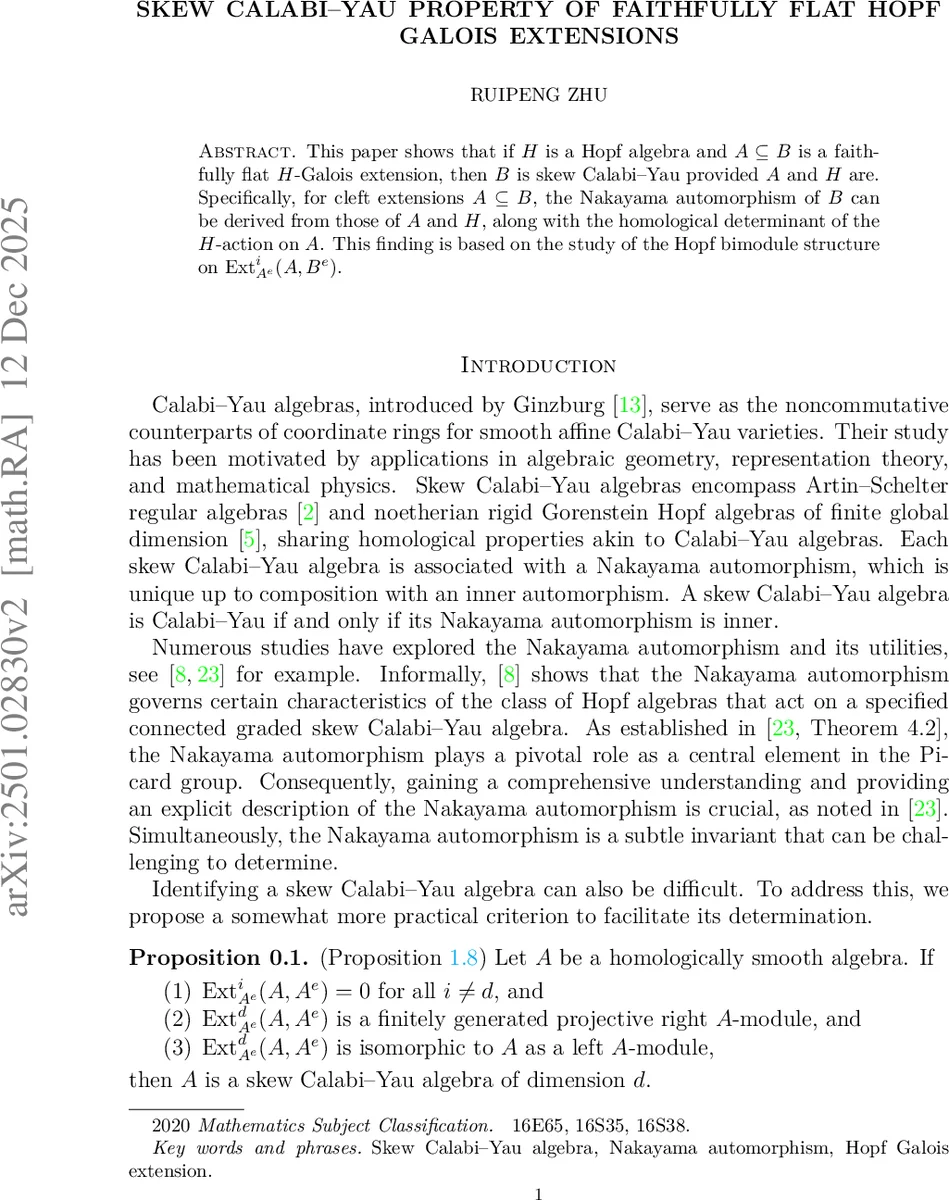
This paper shows that if $H$ is a Hopf algebra and $A \subseteq B$ is a faithfully flat $H$-Galois extension, then $B$ is skew Calabi-Yau provided $A$ and $H$ are. Specifically, for cleft extensions $A \subseteq B$, the Nakayama automorphism of $B$ can be derived from those of $A$ and $H$, along with the homological determinant of the $H$-action on $A$. This finding is based on the study of the Hopf bimodule structure on $\mathrm{Ext}^i_{A^e}(A, B^e)$.
💡 Research Summary
This paper establishes a significant homological property preservation theorem in noncommutative algebra. The central result is that the skew Calabi-Yau property, a crucial homological smoothness condition generalizing the concept of Calabi-Yau varieties to noncommutative algebras, is preserved under faithfully flat Hopf Galois extensions.
The authors consider a Hopf algebra H and a faithfully flat right H-Galois extension A ⊆ B, where A = B^(coH) is the subalgebra of H-coinvariant elements. The main theorem (Theorem 0.2/2.15) states that if both the base algebra A and the Hopf algebra H are skew Calabi-Yau of dimensions d and n respectively, then the extension algebra B is also skew Calabi-Yau, and its dimension is the sum d+n. This generalizes previous results known for specific constructions like smash products.
The proof strategy is homological and intricate. A key insight is the study of the Hopf bimodule structure on the Ext groups Ext^i_{A^e}(A, B^e), where A^e and B^e are the enveloping algebras. The authors show that these Ext groups naturally carry a structure of an H^e-comodule, making them Hopf bimodules in the category B^e M^{H^e}H. This structure allows for a coherent analysis of the associated Stefan spectral sequence, which converges from Ext^p_H(k, Ext^q{A^e}(A, B^e)) to Ext^{p+q}{B^e}(B, B^e). By applying the criterion for a homologically smooth algebra to be skew Calabi-Yau (Proposition 1.8) within this spectral sequence framework, the preservation result is deduced.
While this general proof confirms the skew Calabi-Yau property for B, it does not yield an explicit formula for the Nakayama automorphism ν_B of B, which is a unique (up to inner automorphism) algebra automorphism characterizing the duality. To address this, the paper focuses on the important subclass of cleft extensions (e.g., smash products A#H and crossed products A#_σ H). For these, a more detailed structure theory is available.
By revisiting Schauenburg’s structure theorem for relative Hopf bimodules, the authors demonstrate that the category _B^e M^{H^e}_H is equivalent to a left module category over a certain subalgebra Λ_1 of B^e. In the case of a crossed product B = A #_σ H, there exists a natural algebra embedding of H into Λ_1. This embedding allows the definition of a homological determinant, denoted Hdet, which captures the homological effect of the H-action on A. The paper’s second major result (Theorem 0.3/4.11) provides an explicit formula for the Nakayama automorphism of the crossed product: ν_B(a # h) = ν_A(a) Hdet(S^{-2}h_1) # S^{-2}h_2 χ(S h_3), where ν_A is the Nakayama automorphism of A, S is the antipode of H, χ:H→k is the algebra homomorphism satisfying Ext^n_H(k, H) ≅ _χ k, and the homological determinant Hdet is defined with respect to a ν_A-twisted volume element of A.
This work deepens the understanding of homological invariants under Hopf-theoretic constructions. It unifies and extends previous studies on smash products and crossed products into the broader framework of Hopf Galois extensions, offering powerful tools for establishing the skew Calabi-Yau property in a wide range of algebraic settings encountered in noncommutative geometry and representation theory.
Comments & Academic Discussion
Loading comments...
Leave a Comment