Financial Management Challenges in Enterprises Employing Remote and Hybrid Workforces
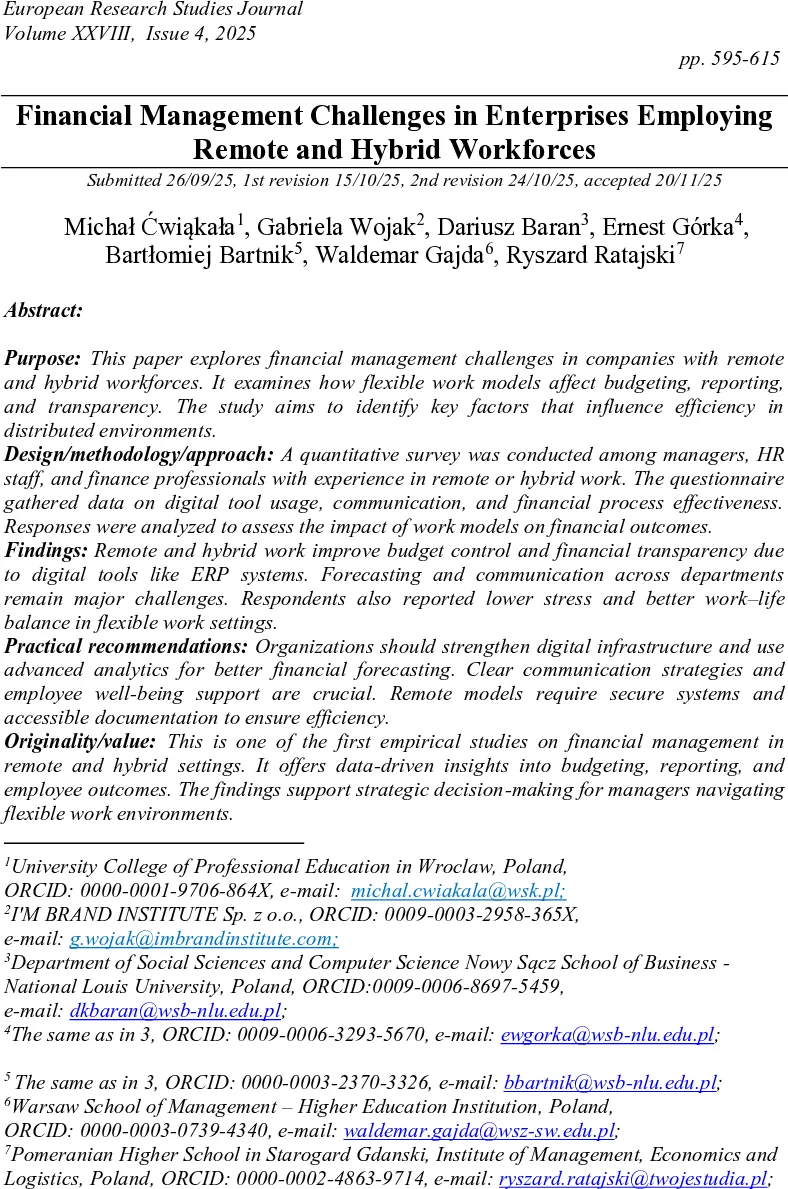
The paper examines financial management challenges faced by organizations operating under remote and hybrid work models. It investigates how these flexible arrangements influence budgeting, reporting, and financial transparency in distributed teams. Using a quantitative survey of managers, HR staff, and finance professionals, the study analyzes the role of digital tools, communication, and organizational practices in shaping financial outcomes. Results indicate that remote and hybrid work can improve budget control and process transparency through the use of ERP systems and digital workflows. However, forecasting accuracy and interdepartmental communication remain major challenges, particularly in organizations with insufficient digital integration. Respondents also reported lower stress levels and improved work-life balance, suggesting potential well-being and productivity benefits. The paper recommends that companies enhance digital infrastructure, adopt advanced analytics for forecasting, and develop clear communication frameworks supported by employee well-being programs. The study contributes original empirical evidence on financial management in flexible work environments, offering practical insights for leaders navigating the digital transformation of finance.
💡 Research Summary
This research paper, published in the European Research Studies Journal, presents an empirical investigation into the financial management challenges and opportunities faced by enterprises operating with remote and hybrid workforces. The study moves beyond the prevalent focus on productivity and psychosocial aspects of flexible work, zeroing in on its concrete impact on core financial functions such as budgeting, reporting, transparency, and forecasting.
The introduction establishes the context of the rapid shift to remote/hybrid models accelerated by the COVID-19 pandemic, highlighting a research gap in understanding how these distributed environments affect financial decision-making processes. The literature review comprehensively defines remote and hybrid work models, outlining their benefits (e.g., cost savings, talent pool access, employee work-life balance) and risks (e.g., increased IT/security costs, cybersecurity threats, employee isolation). It identifies critical success enablers, including robust digital infrastructure (ERP systems, collaborative platforms), trust-based leadership, digital upskilling, and strong security governance.
The methodology is quantitative, based on a survey administered to managers, HR professionals, and finance/operations employees with direct experience in remote or hybrid settings. The questionnaire gathered data on digital tool usage, communication effectiveness, team coordination, and the perceived efficiency of financial processes.
The key findings reveal a nuanced picture. On the positive side, the use of integrated digital tools, particularly ERP systems, is associated with improved budget control and financial process transparency in distributed teams. The structured, digital workflows inherent to remote work can enforce discipline and centralize data, enhancing oversight. Furthermore, a significant majority of respondents reported lower stress levels and better work-life balance under flexible models, pointing to important human capital benefits.
However, the study identifies persistent and significant challenges. Financial forecasting accuracy emerges as a major difficulty, attributed to reduced informal, cross-departmental communication flows that often supply crucial qualitative context for predictions. Interdepartmental coordination and communication are also cited as substantial hurdles, especially in organizations with insufficient digital integration. This underscores that technology alone is not a panacea.
Based on these insights, the paper offers practical recommendations for business leaders and financial managers. Organizations are advised to: 1) Strengthen their digital infrastructure, investing in cloud-based ERP and real-time analytics platforms; 2) Adopt advanced predictive analytics tools to compensate for the loss of informal forecasting inputs; 3) Develop clear, structured communication frameworks and regular check-in rituals to maintain cross-functional alignment; and 4) Implement comprehensive employee well-being programs that address the unique stressors of remote work, recognizing that psychological health is foundational to sustained productivity and financial performance. In conclusion, the study provides original empirical evidence that effective financial management in the hybrid era requires a balanced, integrated strategy addressing technology, process redesign, and human factors simultaneously.
Comments & Academic Discussion
Loading comments...
Leave a Comment