A Differentiable Digital Twin of Distributed Link Scheduling for Contention-Aware Networking
Many routing and flow optimization problems in wired networks can be solved efficiently using minimum cost flow formulations. However, this approach does not extend to wireless multi-hop networks, where the assumptions of fixed link capacity and linear cost structure collapse due to contention for shared spectrum resources. The key challenge is that the long-term capacity of a wireless link becomes a non-linear function of its network context, including network topology, link quality, and the traffic assigned to neighboring links. In this work, we pursue a new direction of modeling wireless network under randomized medium access control by developing an analytical network digital twin (NDT) that predicts link duty cycles from network context. We generalize randomized contention as finding a Maximal Independent Set (MIS) on the conflict graph using weighted Luby’s algorithm, derive an analytical model of link duty cycles, and introduce an iterative procedure that resolves the circular dependency among duty cycle, link capacity, and contention probability. Our numerical experiments show that the proposed NDT accurately predicts link duty cycles and congestion patterns with up to a 5000x speedup over packet-level simulation, and enables us to optimize link scheduling using gradient descent for reduced congestion and radio footprint.
💡 Research Summary
This paper introduces a novel analytical Network Digital Twin (NDT) designed to model and optimize distributed link scheduling in wireless multi-hop networks, where traditional wired-network optimization methods fail due to contention for shared spectrum.
The core problem is that the long-term capacity of a wireless link is not fixed but a non-linear function of its network context—topology, link quality, and traffic on neighboring links. Existing strategies to handle this either ignore contention, use inefficient online probing, or rely on data-heavy machine learning models that lack generalizability.
To address this, the authors formalize distributed random access (e.g., CSMA) as a Maximal Independent Set (MIS) problem on the network’s conflict graph. They propose a weighted variant of Luby’s distributed MIS algorithm (Algorithm 1), where link-specific weights (z) influence winning probabilities, providing a flexible model for various MAC policies.
The primary technical contribution is the derivation of an analytical model that predicts the long-term duty cycle (x) of each link under this weighted Luby scheduler. The model calculates the probability of a link winning channel access in each contention round by integrating over the conditional distributions of its neighbors’ random draws (Eq. 3b).
However, a circular dependency exists: duty cycle (x) determines effective link capacity (μ = x * r), which influences the probability a link has packets to contend (b), which in turn affects the duty cycle. The paper breaks this loop by embedding the analytical model into an iterative procedure (Algorithm 2, f_NDT). Starting from an initial estimate, the algorithm iteratively refines the duty cycle, capacity, and contention probability estimates until convergence, typically within a few iterations.
Numerical experiments on randomly generated networks of varying sizes (20-100 nodes) and traffic loads demonstrate that the proposed NDT achieves high-fidelity predictions of link duty cycles and congestion patterns, showing a correlation greater than 0.99 with packet-level simulations (e.g., NS-3). Crucially, it does so with a speedup of up to 5000x.
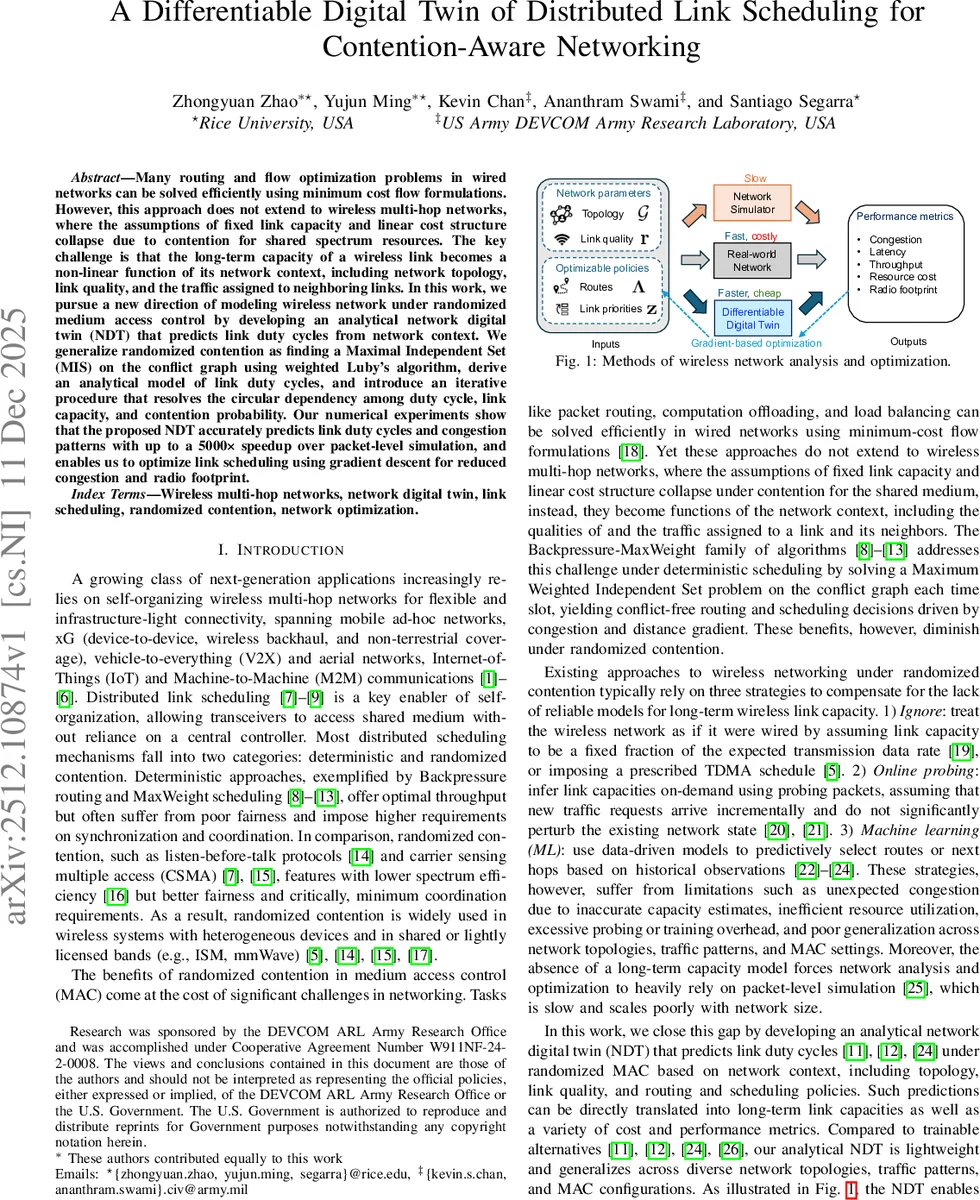
A key advantage of this analytical approach is its differentiability. Because the model is expressed in closed-form, gradients of performance metrics (like total congestion or number of active links) with respect to optimizable policy parameters (like the link priority weights z) can be computed. The authors leverage this to perform gradient-descent-based optimization, successfully finding scheduling policies that simultaneously minimize network congestion and radio footprint (active transmission time), showcasing the NDT’s utility for automated network configuration.
In summary, this work provides a fast, accurate, and differentiable digital twin for wireless networks, enabling efficient analysis and gradient-based optimization of scheduling policies without the need for costly simulations, paving the way for more autonomous and efficient wireless network design.
Comments & Academic Discussion
Loading comments...
Leave a Comment