Beyond the Black Box: Identifiable Interpretation and Control in Generative Models via Causal Minimality
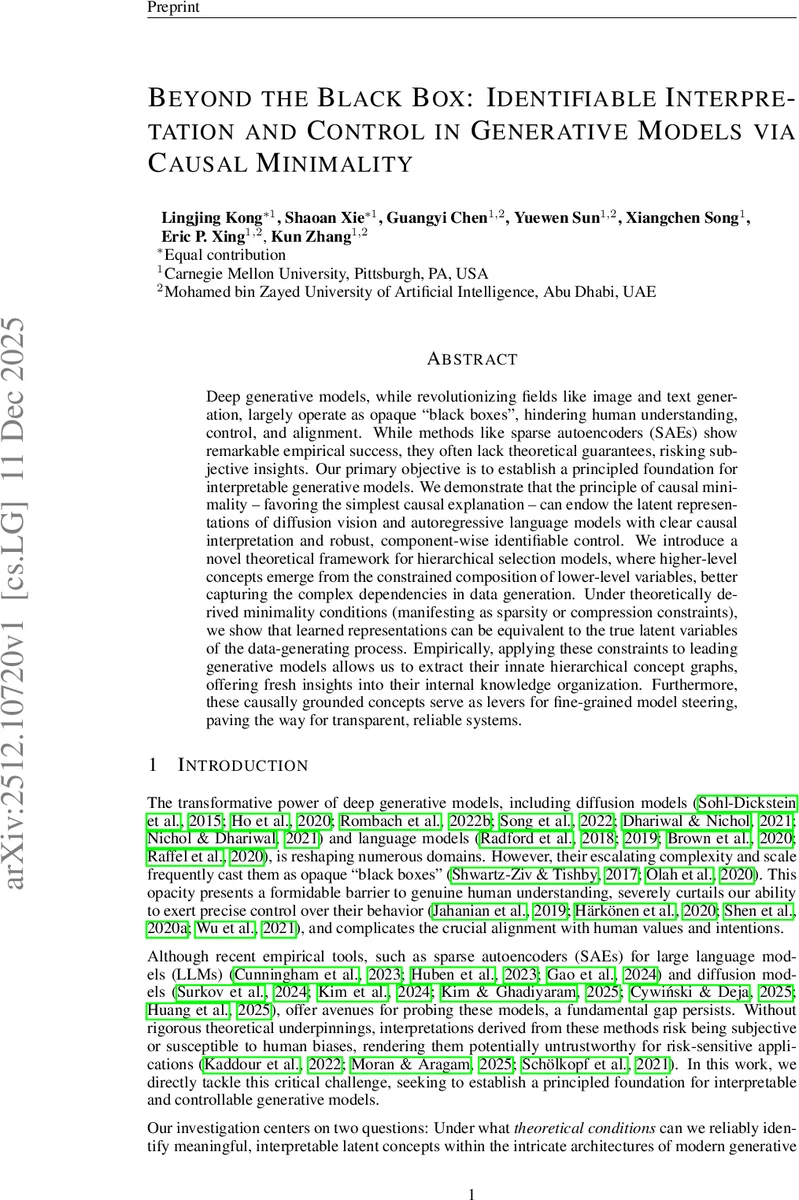
Deep generative models, while revolutionizing fields like image and text generation, largely operate as opaque black boxes, hindering human understanding, control, and alignment. While methods like sparse autoencoders (SAEs) show remarkable empirical success, they often lack theoretical guarantees, risking subjective insights. Our primary objective is to establish a principled foundation for interpretable generative models. We demonstrate that the principle of causal minimality – favoring the simplest causal explanation – can endow the latent representations of diffusion vision and autoregressive language models with clear causal interpretation and robust, component-wise identifiable control. We introduce a novel theoretical framework for hierarchical selection models, where higher-level concepts emerge from the constrained composition of lower-level variables, better capturing the complex dependencies in data generation. Under theoretically derived minimality conditions (manifesting as sparsity or compression constraints), we show that learned representations can be equivalent to the true latent variables of the data-generating process. Empirically, applying these constraints to leading generative models allows us to extract their innate hierarchical concept graphs, offering fresh insights into their internal knowledge organization. Furthermore, these causally grounded concepts serve as levers for fine-grained model steering, paving the way for transparent, reliable systems.
💡 Research Summary
The paper tackles the fundamental opacity of modern deep generative models—diffusion‑based image generators and large autoregressive language models—by grounding interpretability and controllability in the principle of causal minimality. Causal minimality favors the simplest causal explanation consistent with observed data, which the authors operationalize as either sparsity in the latent concept graph or maximal compression of active latent states.
The authors introduce a novel hierarchical selection model. Unlike traditional hierarchical causal models where higher‑level variables directly cause lower‑level ones, the selection model treats higher‑level concepts as effects of specific configurations of lower‑level variables. Formally, a higher‑level variable (V_\ell) is generated by a selection function (g_\ell) applied to its detailed constituents (V_{\ell+1}): (V_\ell = g_\ell(V_{\ell+1})). This captures the intuition that a “car” concept emerges only when wheels, doors, and a roof are arranged coherently, rather than being a simple parent that independently samples each part.
Under well‑defined minimality conditions (Conditions 4.2‑iv for sparsity and B.1‑iii for compression), the paper proves component‑wise identifiability for both continuous and discrete hierarchical selection models. Theorem 4.1 shows that the learned latent representations are equivalent to the true latent variables of the data‑generating process up to a simple (often linear) invertible transformation. This result surpasses prior work that only achieved subspace‑level identifiability or relied on restrictive linearity assumptions.
To validate the theory, the authors impose sparsity‑inducing regularizers on state‑of‑the‑art diffusion models (e.g., Stable Diffusion, DALL‑E‑2) and on large language models (e.g., GPT‑3‑style transformers). They then train sparse autoencoders (SAEs) on the internal activations. The SAEs recover a hierarchical concept graph: high‑noise timesteps (large diffusion steps) yield abstract concepts such as “vehicle” or “animal,” while low‑noise timesteps expose fine‑grained features like “wheel” or “fur.” In language models, discrete selection variables (tokens) select continuous semantic vectors, allowing precise manipulation of word meanings without degrading generation quality.
The extracted graphs serve as control levers. By activating, suppressing, or swapping individual nodes, the authors demonstrate fine‑grained steering of image synthesis (e.g., changing the shape of a generated chair while keeping its material) and targeted semantic edits in text (e.g., reinforcing the notion of “speed” in a story). These interventions are more systematic and theoretically justified than heuristic prompt engineering or ad‑hoc parameter tweaks.
The paper also situates its contribution relative to prior literature. Traditional hierarchical causal models often avoid intra‑layer edges, leading to overly dense graphs when modeling realistic part‑whole dependencies. The selection model, by treating higher‑level concepts as colliders, captures these dependencies with far fewer edges, aligning with the minimality principle. Moreover, by linking SAEs to causal minimality, the authors provide a statistical guarantee that the discovered features are not merely artifacts of a particular training run or human bias.
Limitations are acknowledged: enforcing minimality requires explicit regularization terms, which may complicate training pipelines; estimating highly non‑linear selection functions (g_\ell) remains challenging; and empirical evaluation is currently confined to vision and language modalities, leaving audio or video domains for future work.
In summary, the paper delivers the first comprehensive theoretical framework that connects causal minimality, hierarchical selection mechanisms, and component‑wise identifiability to practical interpretability and controllability of deep generative models. It offers a principled path toward transparent, steerable AI systems, with significant implications for safety, alignment, and human‑centric AI design.
Comments & Academic Discussion
Loading comments...
Leave a Comment