$Φ^4_2$ theory limit of a many-body bosonic free energy
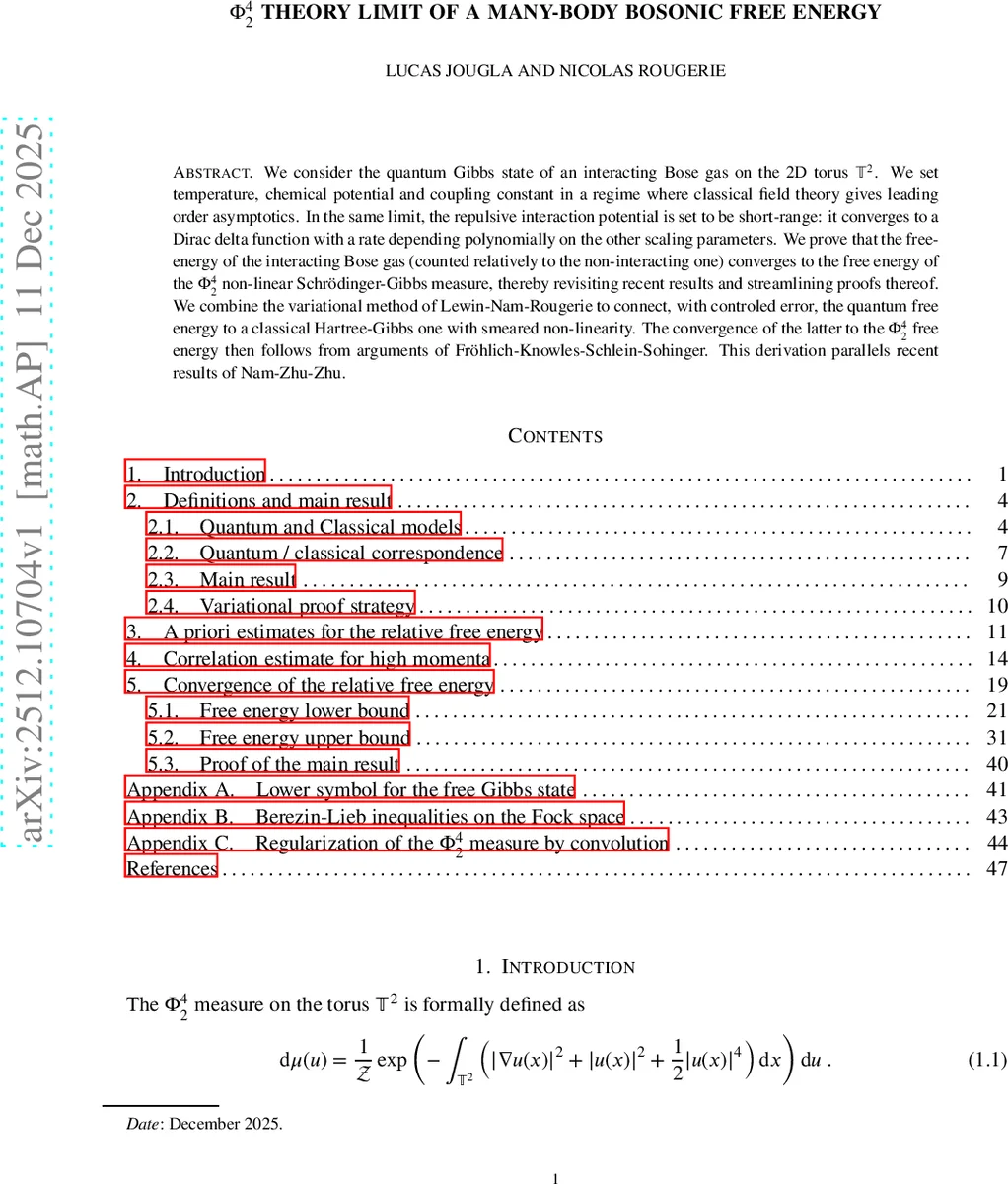
We consider the quantum Gibbs state of an interacting Bose gas on the 2D torus. We set temperature, chemical potential and coupling constant in a regime where classical field theory gives leading order asymptotics. In the same limit, the repulsive interaction potential is set to be short-range: it converges to a Dirac delta function with a rate depending polynomially on the other scaling parameters. We prove that the free-energy of the interacting Bose gas (counted relatively to the non-interacting one) converges to the free energy of the $Φ^4_2$ non-linear Schr{ö}dinger-Gibbs measure, thereby revisiting recent results and streamlining proofs thereof. We combine the variational method of Lewin-Nam-Rougerie to connect, with controled error, the quantum free energy to a classical Hartree-Gibbs one with smeared non-linearity. The convergence of the latter to the $Φ^4_2$ free energy then follows from arguments of Fr{ö}hlich-Knowles-Schlein-Sohinger. This derivation parallels recent results of Nam-Zhu-Zhu.
💡 Research Summary
This paper provides a rigorous mathematical derivation demonstrating that the free energy of an interacting Bose gas on a 2D torus converges to the free energy of the $\Phi^4_2$ non-linear Schrödinger-Gibbs measure under a specific scaling limit. The study focuses on the quantum Gibbs state of a many-body bosonic system, specifically investigating a regime where the temperature, chemical potential, and coupling constant are scaled such that classical field theory dictates the leading-order asymptotic behavior.
A central component of the research is the treatment of the interaction potential. The authors consider a repulsive, short-range potential that converges to a Dirac delta function, with the rate of convergence being polynomially dependent on the other scaling parameters. This precise control over the potential’s decay is crucial for establishing the stability of the limit.
The mathematical methodology is structured as a multi-step convergence process. First, the authors employ the variational method developed by Lewin, Nam, and Rougerie to bridge the gap between the quantum many-body free energy and a classical Hartree-Gibbs free energy characterized by a smeared non-linearity. By doing so, they are able to connect the complex quantum-mechanical energy to a more tractable classical model while maintaining controlled error bounds. Second, the convergence of this classical Hartree-Gibbs free energy to the final $\Phi^4_2$ free energy is established by utilizing the established framework of Fröhlich, Knowles, Schlein, and Sohinger.
The significance of this work lies in its ability to streamline and refine recent advancements in the field. While building upon the foundational results of Nam, Zhu, and Zhu, this paper provides a more efficient and streamlined proof, reinforcing the mathematical link between quantum many-body systems and classical field-theoretic limits in two dimensions. This contribution is vital for the broader understanding of how macroscopic classical field theories emerge from underlying microscopic quantum mechanical descriptions, providing a robust framework for studying the transition from quantum to classical regimes in many-body physics.
Comments & Academic Discussion
Loading comments...
Leave a Comment