Constraining non-commutative geometry with W/Z+jet production at the LHC
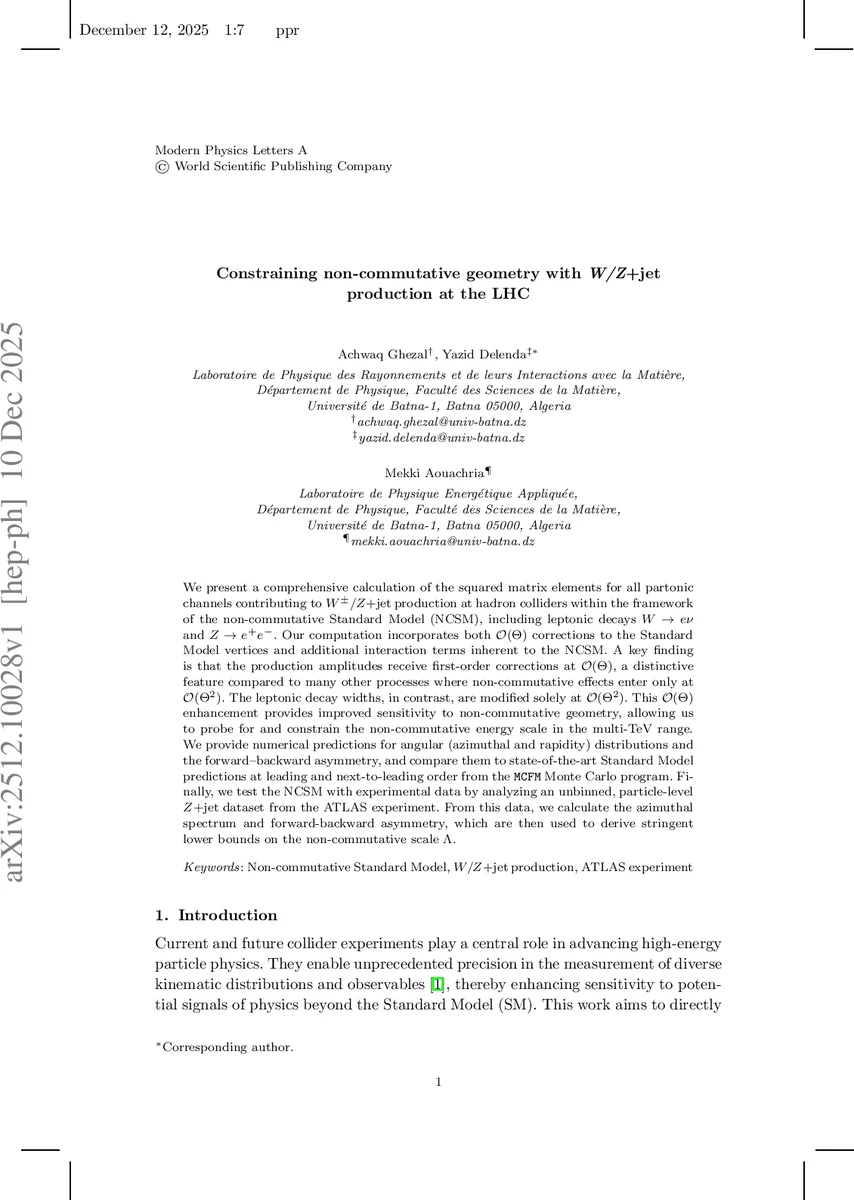
We present a comprehensive calculation of the squared matrix elements for all partonic channels contributing to $W^\pm/Z$+jet production at hadron colliders within the framework of the non-commutative Standard Model (NCSM), including leptonic decays $W\to eν$ and $Z\to e^+e^-$. Our computation incorporates both $\mathcal{O}(Θ)$ corrections to the Standard Model vertices and additional interaction terms inherent to the NCSM. A key finding is that the production amplitudes receive first-order corrections at $\mathcal{O}(Θ)$, a distinctive feature compared to many other processes where non-commutative effects enter only at $\mathcal{O}(Θ^2)$. The leptonic decay widths, in contrast, are modified solely at $\mathcal{O}(Θ^2)$. This $\mathcal{O}(Θ)$ enhancement provides improved sensitivity to non-commutative geometry, allowing us to probe for and constrain the non-commutative energy scale in the multi-TeV range. We provide numerical predictions for angular (azimuthal and rapidity) distributions and the forward–backward asymmetry, and compare them to state-of-the-art Standard Model predictions at leading and next-to-leading order from the \texttt{MCFM} Monte Carlo program. Finally, we test the NCSM with experimental data by analyzing an unbinned, particle-level $Z$+jet dataset from the ATLAS experiment. From this data, we calculate the azimuthal spectrum and forward-backward asymmetry, which are then used to derive stringent lower bounds on the non-commutative scale $Λ$.
💡 Research Summary
This paper presents a rigorous investigation into the potential existence of non-commutative geometry through the analysis of $W/Z$ + jet production at the Large Hadlab Collider (LHC). The study is situated within the framework of the Non-Commutative Standard Model (NCSM), which posits that spacetime coordinates do not commute, introducing a fundamental energy scale, $\Lambda$, associated with the non-commutative parameter $\theta$.
The researchers performed a comprehensive calculation of the squared matrix elements for all relevant partonic channels contributing to $W^\pm/Z$ + jet production, including the leptonic decay channels $W \to e\nu$ and $Z \to e^+e^-$. A pivotal contribution of this work is the identification of a unique sensitivity enhancement in the production amplitudes. While non-commutative effects in many other physical processes are suppressed and only appear at the second order, $\mathcal{O}(\theta^2)$, the authors demonstrate that the production amplitudes for $W/Z$ + jet receive first-order corrections at $\mathcal{O}(\theta)$. Interestingly, they found that the leptonic decay widths are only modified at $\mathcal{O}(\theta^2)$, meaning the primary sensitivity to the non-commutative scale arises from the production stage of the process rather than the decay stage.
To validate the theoretical predictions, the study compares the NCSM-derived results with state-of-the-art Standard Model (SM) predictions provided by the MCFM Monte Carlo program at both leading and next-to-leading order. The analysis focuses on key kinematic observables, including azimuthal and rapidity distributions, as well as the forward-backward asymmetry ($A_{FB}$). The researchers further tested the NCSM framework against real-world experimental evidence by analyzing unbinned, particle-level $Z$+jet datasets from the ATLAS experiment. By calculating the azimuthal spectrum and $A_{FB}$ from the experimental data and comparing them to the theoretical models, the study successfully derived stringent lower bounds on the non-commutative energy scale $\Lambda$. This research provides a critical constraint on the possible scale of non-commutative geometry, narrowing the window for new physics beyond the Standard Model and establishing a benchmark for future high-energy collider searches.
Comments & Academic Discussion
Loading comments...
Leave a Comment