Sharp mapping properties of Poisson transforms and the Baum-Connes conjecture
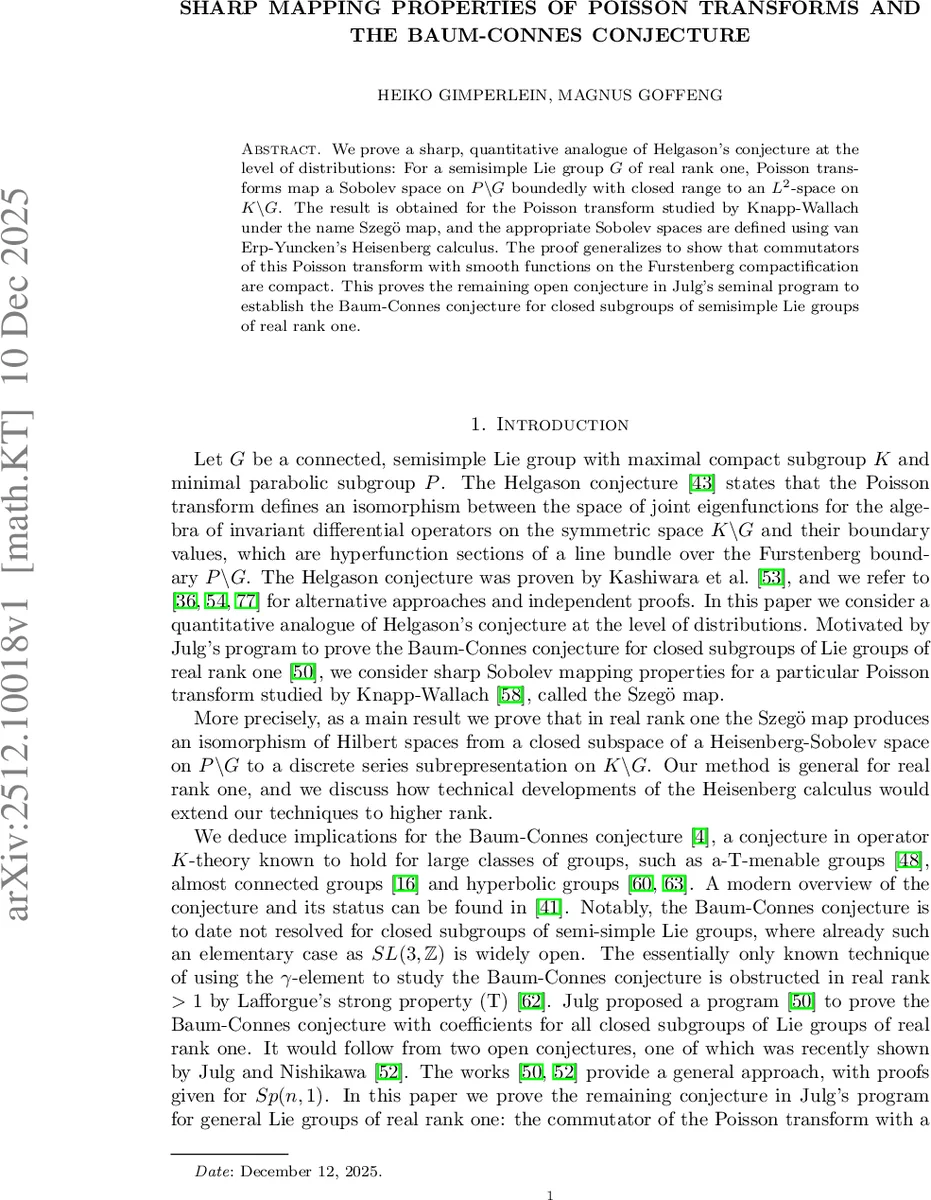
We prove a sharp, quantitative analogue of Helgason’s conjecture at the level of distributions: For a semisimple Lie group $G$ of real rank one, Poisson transforms map a Sobolev space on $P\backslash G$ boundedly with closed range to an $L^2$-space on $K\backslash G$. The result is obtained for the Poisson transform studied by Knapp-Wallach under the name Szegö map, and the appropriate Sobolev spaces are defined using van Erp-Yuncken’s Heisenberg calculus. The proof generalizes to show that commutators of this Poisson transform with smooth functions on the Furstenberg compactification are compact. This proves the remaining open conjecture in Julg’s seminal program to establish the Baum-Connes conjecture for closed subgroups of semisimple Lie groups of real rank one.
💡 Research Summary
The paper establishes sharp, quantitative mapping properties of a particular Poisson transform—known as the Szegö map in the work of Knapp and Wallach—for real‑rank‑one semisimple Lie groups. The authors work with a connected semisimple Lie group (G) of real rank one, a maximal compact subgroup (K), and a minimal parabolic subgroup (P). The Szegö map \
Comments & Academic Discussion
Loading comments...
Leave a Comment