An Ehresmann-Schein-Nambooripad-type theorem for left restriction semigroupoids
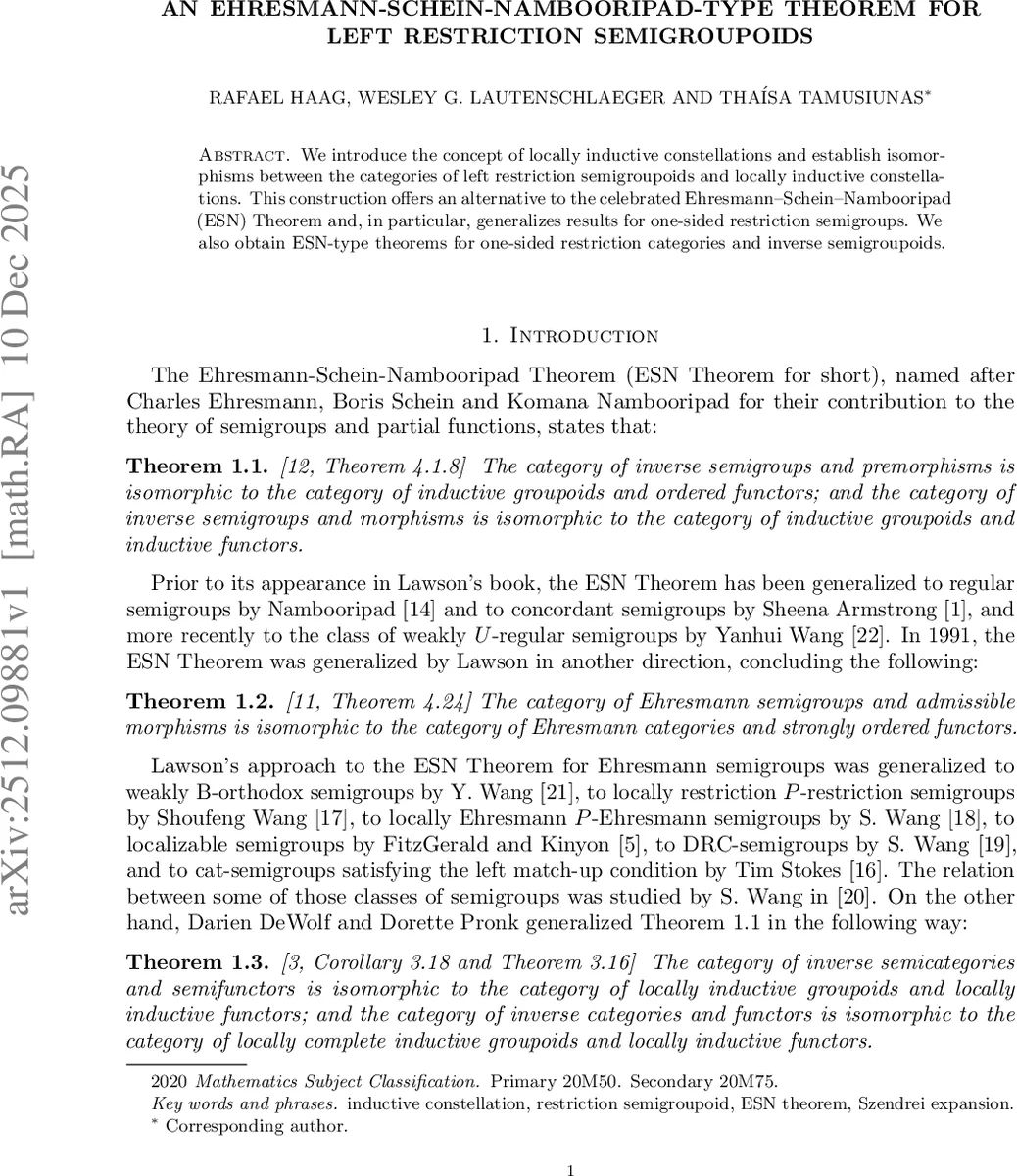
We introduce the concept of locally inductive constellations and establish isomorphisms between the categories of left restriction semigroupoids and locally inductive constellations. This construction offers an alternative to the celebrated Ehresmann-Schein-Nambooripad (ESN) Theorem and, in particular, generalizes results for one-sided restriction semigroups. We also obtain ESN-type theorems for one-sided restriction categories and inverse semigroupoids.
💡 Research Summary
This paper introduces the notion of locally inductive constellations and establishes categorical equivalences between left restriction semigroupoids and these constellations, thereby providing a one‑sided analogue of the classic Ehresmann‑Schein‑Nambooripad (ESN) theorem. The authors begin by recalling the definition of a left restriction semigroupoid, a structure consisting of a set equipped with a partially defined binary operation and a unary “restriction” operation satisfying axioms (lr1)–(lr4). Two types of morphisms are defined: restriction morphisms, which preserve both composition and the restriction operation, and premorphisms, which satisfy weaker compatibility conditions. Both give rise to well‑defined categories.
Next, the paper reviews left constellations—a one‑sided generalization of categories introduced by Gould and Hollings—and extends them to locally inductive constellations (li‑constellations). A partial order ≤ is imposed on the underlying set, requiring each connected component to be a meet‑semilattice. Additional axioms (O1)–(O7) guarantee the existence of restriction and corestriction operations, the compatibility of the unary + operation with the order, and that the set of “restricted” elements forms a meet‑semilattice. These axioms capture the essence of an ordered left constellation and specialize to the inductive left constellations previously studied.
The first main result (Section 4) constructs a functor from the category of left restriction semigroupoids with restriction morphisms to the category of locally inductive constellations with inductive radiants. Given a left restriction semigroupoid S, the authors form a constellation C(S) whose objects are the elements of S⁺ (the image of the restriction map) and whose arrows are the original elements of S, with composition inherited from S. They prove that any restriction morphism φ: S → T induces an inductive radiant ψ: C(S) → C(T), and conversely, that any inductive radiant arises uniquely from a restriction morphism. This establishes an isomorphism of categories, providing a one‑sided ESN‑type correspondence.
Section 5 introduces the Szendrei expansion, a universal construction that, given any locally inductive constellation T, produces a left restriction semigroupoid Sz(T). The expansion adds formal “restriction” elements to ensure that every arrow has a well‑defined source and target in the sense of the unary + operation. The authors prove a universal property: any restriction morphism from Sz(T) to a left restriction semigroupoid factors uniquely through Sz(T). This mirrors the role of the Szendrei expansion in the classical ESN theory for inverse semigroups.
The second main result (Section 6) deals with premorphisms. Using the Szendrei expansion, the authors show that premorphisms between left restriction semigroupoids correspond precisely to inductive preradiants between locally inductive constellations. The construction again yields a categorical isomorphism, now between the category of left restriction semigroupoids with premorphisms and the category of locally inductive constellations with inductive preradiants.
Finally, Section 7 applies the general theorems to several important special cases. For left restriction categories (as introduced by Cockett and Lack), the equivalence recovers and extends the Gould‑Hollings one‑sided ESN theorem, showing that restriction functors correspond to inductive radiants. For ordinary left restriction semigroups, the results collapse to the known one‑sided ESN correspondence. For inverse semigroupoids, the authors obtain a one‑sided version of the DeWolf‑Pronk ESN theorem, demonstrating that inverse semigroupoids with morphisms are equivalent to locally inductive constellations equipped with appropriate radiants.
Overall, the paper provides a unified framework that generalizes the ESN theorem to a broad class of one‑sided algebraic structures. By introducing locally inductive constellations and exploiting the Szendrei expansion, the authors bridge restriction semigroupoid theory, partial algebra, and categorical structures, offering new tools for studying restriction phenomena in semigroup theory and related areas.
Comments & Academic Discussion
Loading comments...
Leave a Comment