Anti-Ramsey Number of Stars in 3-uniform hypergraphs
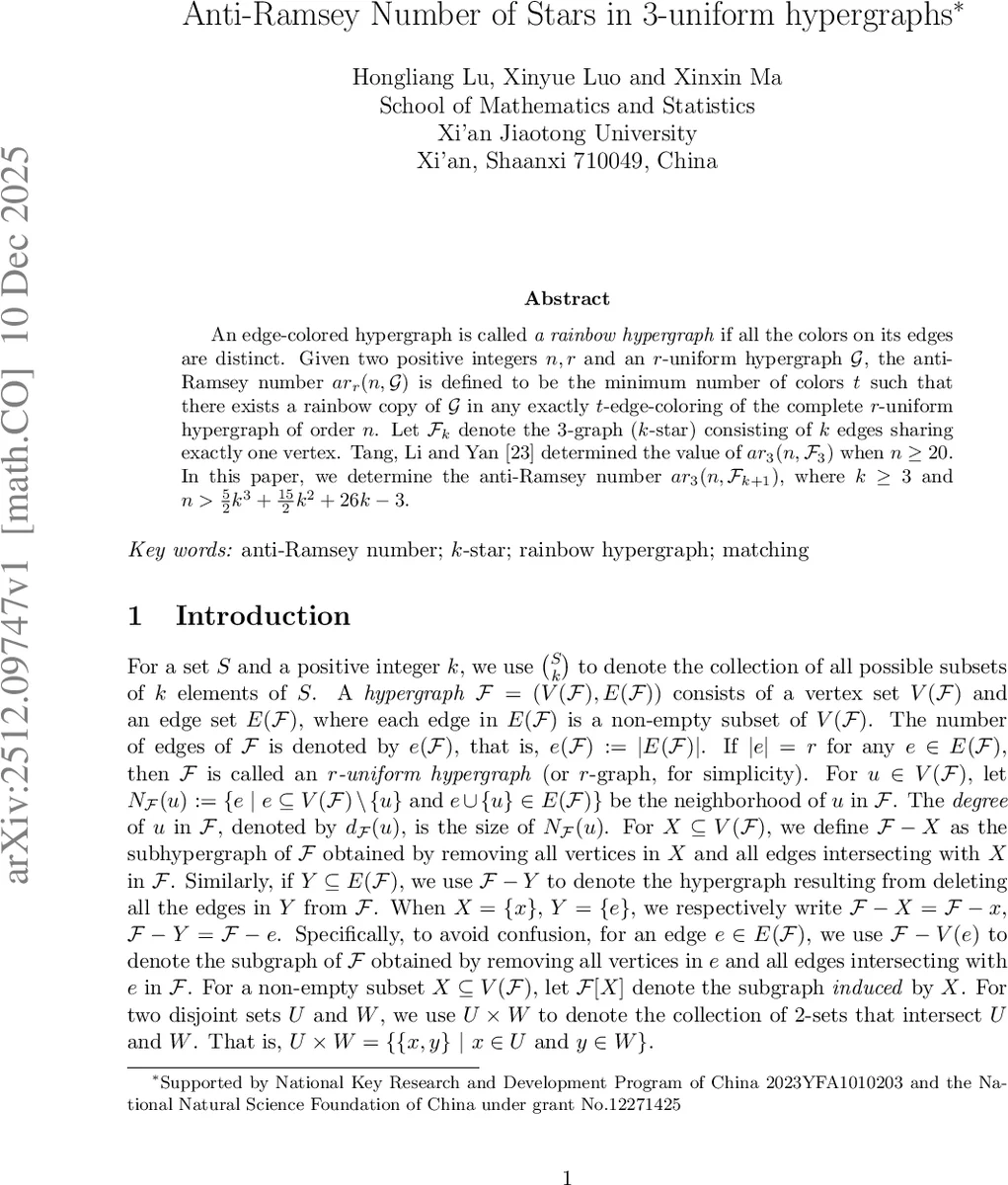
An edge-colored hypergraph is called \emph{a rainbow hypergraph} if all the colors on its edges are distinct. Given two positive integers $n,r$ and an $r$-uniform hypergraph $\mathcal{G}$, the anti-Ramsey number $ar_r(n,\mathcal{G})$ is defined to be the minimum number of colors $t$ such that there exists a rainbow copy of $\mathcal{G}$ in any exactly $t$-edge-coloring of the complete $r$-uniform hypergraph of order $n$. Let $ \mathcal{F}_k $ denote the 3-graph ($k$-star) consisting of $k$ edges sharing exactly one vertex. Tang, Li and Yan \cite{YTG} determined the value of $ar_3(n,\mathcal{F}3)$ when $n\geq 20$. In this paper, we determine the anti-Ramsey number $ar_3(n,\mathcal{F}{k+1})$, where $k\geq 3$ and $n> \frac{5}{2}k^3+\frac{15}{2}k^2+26k-3$.
💡 Research Summary
The paper determines the anti‑Ramsey number for a (k + 1)‑star in 3‑uniform hypergraphs. For a fixed integer k ≥ 3 and sufficiently large n (specifically n > (5/2)k³ + (15/2)k² + 26k − 3), the authors prove that
ar₃(n, F_{k+1}) = f(n, k) + 2,
where F_{k+1} denotes the 3‑graph consisting of k + 1 edges that all share a single core vertex, and f(n, k) is the extremal number of edges in a 3‑graph on n vertices that contains no k‑star. The value of f(n, k) had been obtained earlier by Chung and Frankl for n ≥ (5/2)k³, together with a precise description of the extremal constructions (odd k: the “Fᵒ_k” construction; even k: the “Fᵉ_k” construction).
The authors start from the general lower bound for anti‑Ramsey numbers, arᵣ(n, 𝔽) ≥ exᵣ(n,{𝔽 − e : e∈E(𝔽)}) + 2, which in the present setting reduces to ar₃(n, F_{k+1}) ≥ f(n, k) + 2 because removing any edge from F_{k+1} yields a k‑star. The main contribution is to show that this bound is tight.
Assume, for contradiction, that there exists an exact edge‑coloring of the complete 3‑graph Kₙ³ with exactly c(n,k) = f(n,k) + 2 colors that contains no rainbow copy of F_{k+1}. The proof proceeds in several steps:
-
Good pairs. For each unordered pair {u,v} define z_c(u,v) as the number of distinct colors appearing on edges containing {u,v}. A pair is called “good’’ if z_c(u,v) ≤ 3k. Lemma 9 guarantees the existence of 2k + 6 pairwise vertex‑disjoint good pairs Q = { {u_i,v_i} }.
-
Removal of colors associated with Q. Let C_Q be the set of all colors that appear on edges covering any pair from Q. By Lemma 9, |C_Q| ≤ 6k² + 18k. Delete from Kₙ³ all edges whose colors belong to C_Q, obtaining a subhypergraph G with e(G) = c(n,k) − |C_Q| edges. By construction G uses none of the colors in C_Q and is still exactly (c(n,k) − |C_Q|)‑colored.
-
G is F_k‑free. If G contained a k‑star F_k with centre u, then because Q contains more than 2k + 5 disjoint good pairs, one can find a good pair {u_i,v_i} disjoint from V(F_k). Adding the edge {u, u_i, v_i} (which uses a new color not in C_Q) would create a rainbow (k + 1)‑star, contradicting the assumption. Hence G contains no k‑star.
-
Weight function. Following Chung and Frankl, assign to each triple T∈G a weight distribution ω(T,p) over its three constituent pairs p, depending on the pair frequencies z(p). For each vertex v define W_v = ∑_{p∈N_G(v)} ω(v∪p, p). Lemma 8 shows that for any 3‑graph without a k‑star, W_v ≤ k(k − 1) for all v, with equality only when the link graph N_G(v) is the disjoint union of two complete graphs K_k.
-
Excluding the equality case. If some vertex attained W_v = k(k − 1), the corresponding link graph would have the special structure described above. However, such a structure would force many pairs in its link to have high pair‑frequency, contradicting the “good’’ property of the pairs in Q. Consequently every vertex satisfies the stricter bound W_v ≤ k(k − 1) − 2/3.
-
Deriving a contradiction. Summing W_v over all vertices yields e(G) = ∑_v W_v ≤ nk(k − 1) − (2/3)n. On the other hand, from the lower bound on e(G) (obtained by substituting the explicit formula for f(n,k) and subtracting |C_Q|) we have
e(G) ≥ (n − 2k)k(k − 1) + (2/3)k³ + 2 − 6k² − 18k.
For n larger than the stated cubic threshold, the right‑hand side exceeds nk(k − 1) − (2/3)n, a contradiction. Therefore the assumed coloring without a rainbow (k + 1)‑star cannot exist.
The proof also relies on auxiliary lemmas about factor‑critical graphs (Lemma 10) and Hamiltonicity of small degree‑sequence graphs (Lemma 11), which are used to control the structure of link graphs N_G(v) when they are near‑regular.
Putting everything together, the authors establish the exact anti‑Ramsey number for (k + 1)‑stars in 3‑uniform hypergraphs for all sufficiently large n, extending the known results for k = 2 and k = 3. The work showcases a powerful combination of extremal hypergraph theory, the weight‑function method, and classical matching theory, and it suggests that similar techniques may resolve anti‑Ramsey problems for other small hypergraph configurations.
Comments & Academic Discussion
Loading comments...
Leave a Comment