OxEnsemble: Fair Ensembles for Low-Data Classification
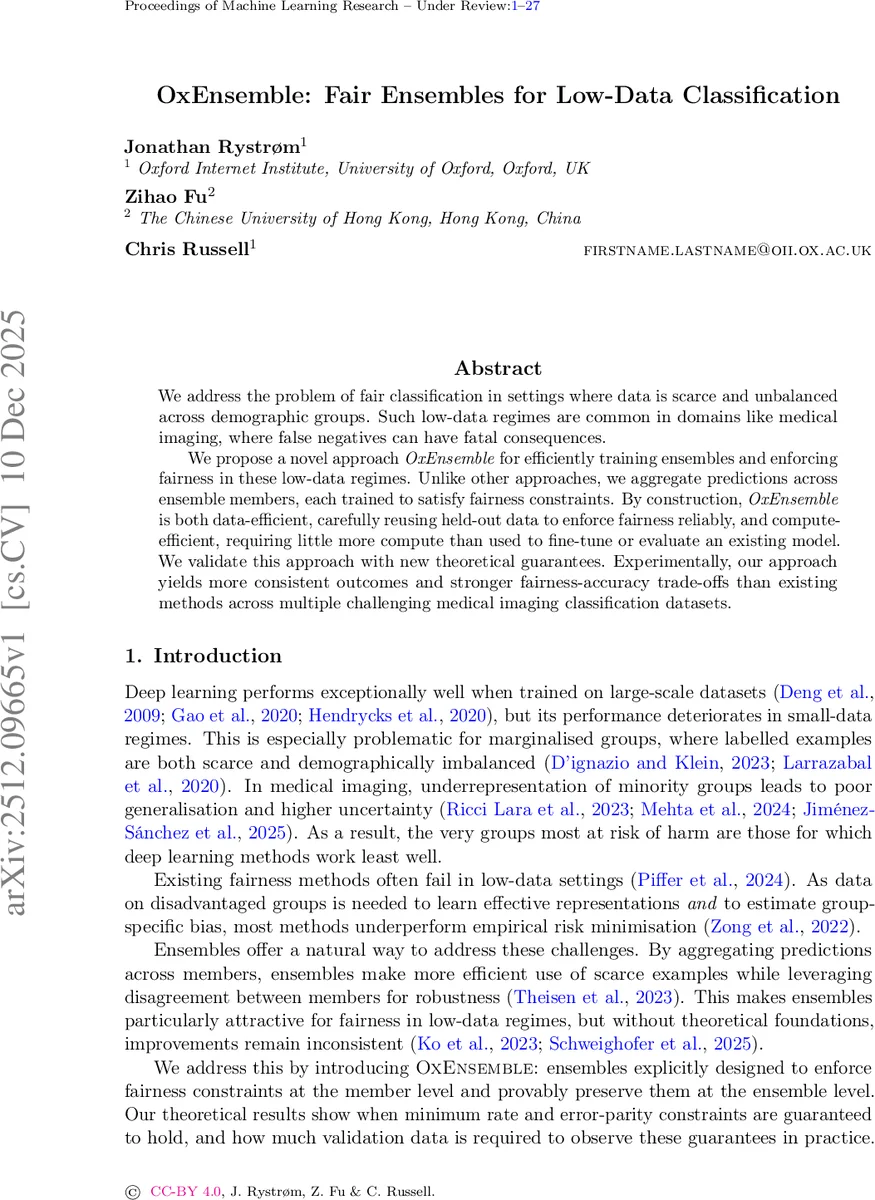
We address the problem of fair classification in settings where data is scarce and unbalanced across demographic groups. Such low-data regimes are common in domains like medical imaging, where false negatives can have fatal consequences. We propose a novel approach \emph{OxEnsemble} for efficiently training ensembles and enforcing fairness in these low-data regimes. Unlike other approaches, we aggregate predictions across ensemble members, each trained to satisfy fairness constraints. By construction, \emph{OxEnsemble} is both data-efficient, carefully reusing held-out data to enforce fairness reliably, and compute-efficient, requiring little more compute than used to fine-tune or evaluate an existing model. We validate this approach with new theoretical guarantees. Experimentally, our approach yields more consistent outcomes and stronger fairness-accuracy trade-offs than existing methods across multiple challenging medical imaging classification datasets.
💡 Research Summary
OxEnsemble tackles the challenging problem of fair classification when data are scarce and demographically imbalanced, a situation common in medical imaging where false negatives can be life‑threatening. The authors propose a novel ensemble framework that enforces fairness at the level of each individual member and then aggregates predictions via majority voting, thereby inheriting the fairness guarantees at the ensemble level.
Key architectural choices include sharing a pretrained EfficientNetV2 backbone across all ensemble members while attaching separate task‑prediction and protected‑attribute heads to each member. This multi‑head design, combined with a loss‑masking scheme, ensures that only the relevant head is updated for each training example, allowing the backbone to be computed once per batch. Consequently, the computational cost is comparable to a single ERM model, far lower than naïvely training M independent models.
Fairness is enforced using the OxonFair multi‑head surgery: each member is trained with a standard cross‑entropy loss for the primary task and a squared loss for predicting the protected attribute. Validation data from the member’s own fold are used to select head weights that satisfy a chosen fairness constraint (minimum recall or equal opportunity) while maximizing accuracy. Because each member uses a distinct fold, the entire dataset is effectively utilized for training, leaving only a small held‑out set for validation.
The theoretical contribution centers on extending the notion of “competent ensembles” (Theisen et al., 2023) to group‑wise subsets of the data. The authors define restricted group‑wise competence (C⁺_ρ(t) ≥ 0) and prove three main results: (1) If every member satisfies a minimum‑recall constraint and the ensemble is restricted‑groupwise competent, then the ensemble also satisfies the same minimum‑recall guarantee. (2) If every member approximately satisfies an error‑parity measure (e.g., equal opportunity), then the ensemble’s fairness deviation is bounded by the disagreement‑error ratio (DER) and the average group losses, formalized in Equation 4. (3) Enforcing a minimum recall above 50 % guarantees restricted‑groupwise competence, leveraging classic jury theorems to show that majority voting will not degrade recall. These results provide clear conditions under which fairness improvements at the member level transfer to the whole ensemble.
Empirically, the method is evaluated on three medical imaging datasets (HAM10000, Fitzpatrick17k, and a third unnamed set). Compared against strong baselines—including post‑processing thresholding, standard ERM with fairness regularization, and prior ensemble‑based fairness approaches—OxEnsemble consistently achieves a better trade‑off between overall accuracy and fairness metrics. Notably, the recall for minority groups improves substantially without sacrificing performance on the majority, demonstrating the practical benefit of the approach in safety‑critical domains.
The paper is organized as follows: Section 2 reviews related work on low‑data fairness and fairness in ensembles. Section 3 details the construction, training pipeline, and the formal fairness guarantees. Sections 4 and 5 present experimental methodology, results, and ablation studies. Appendices provide additional efficiency comparisons, implementation details, and full proofs.
In summary, OxEnsemble offers a data‑efficient, compute‑efficient, and theoretically grounded solution for fair classification under low‑data constraints. By sharing a backbone, using multi‑head fairness enforcement, and leveraging majority‑vote competence, it delivers reliable fairness guarantees while keeping computational overhead minimal—making it a compelling candidate for deployment in medical imaging and other domains where both fairness and data scarcity are paramount.
Comments & Academic Discussion
Loading comments...
Leave a Comment