Beyond the Hype: Critical Analysis of Student Motivations and Ethical Boundaries in Educational AI Use in Higher Education
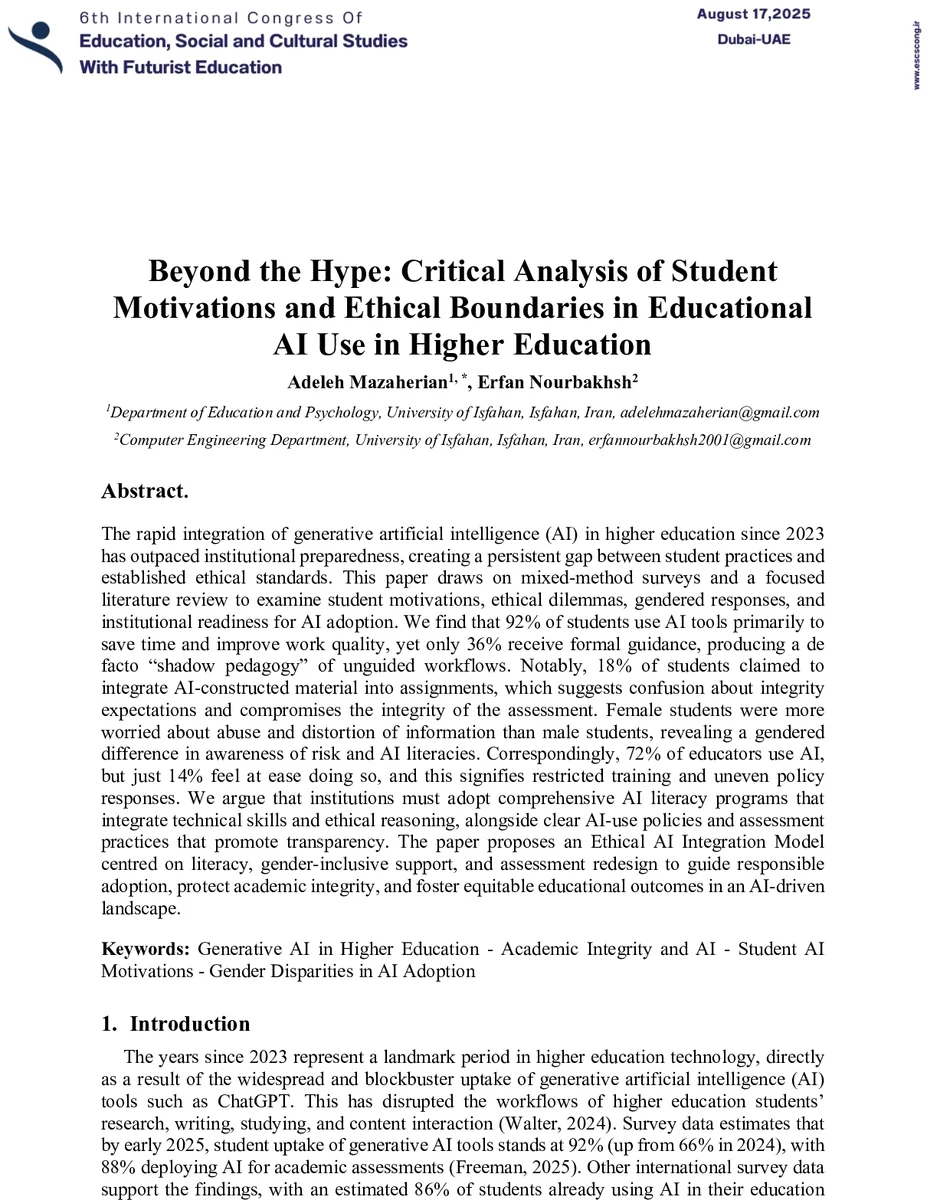
The rapid integration of generative artificial intelligence (AI) in higher education since 2023 has outpaced institutional preparedness, creating a persistent gap between student practices and established ethical standards. This paper draws on mixed-method surveys and a focused literature review to examine student motivations, ethical dilemmas, gendered responses, and institutional readiness for AI adoption. We find that 92% of students use AI tools primarily to save time and improve work quality, yet only 36% receive formal guidance, producing a de facto “shadow pedagogy” of unguided workflows. Notably, 18% of students reported integrating AI-constructed material into assignments, which suggests confusion about integrity expectations and compromises the integrity of the assessment. Female students expressed greater concern about abuse and distortion of information than male students, revealing a gendered difference in awareness of risk and AI literacies. Correspondingly, 72% of educators use AI, but only 14% feel at ease doing so, reflecting limited training and uneven policy responses. We argue that institutions must adopt comprehensive AI literacy programs that integrate technical skills and ethical reasoning, alongside clear AI-use policies and assessment practices that promote transparency. The paper proposes an Ethical AI Integration Model centered on literacy, gender-inclusive support, and assessment redesign to guide responsible adoption, protect academic integrity, and foster equitable educational outcomes in an AI-driven landscape.
💡 Research Summary
The paper provides a comprehensive mixed‑methods investigation of how generative artificial intelligence (AI) has been adopted in higher education since 2023 and what ethical, gender‑based, and institutional challenges have emerged. Drawing on the 2025 HEPI/Kortext survey of 1,041 full‑time undergraduates, a suite of international reports, and systematic literature reviews, the authors address four research questions (RQ1‑RQ4).
RQ1 examines student motivations. The data show an overwhelming 92 % of students have used AI tools, with 51 % citing time‑saving and 50 % citing quality improvement as primary drivers. Secondary motives include skill development (28 %) and curiosity about AI (15 %). These findings confirm that pragmatic efficiency, rather than pedagogical curiosity, fuels most adoption.
RQ2 explores the gap between student practices and perceived ethical limits. Although 88 % of respondents employ AI in assessments, only 36 % have received formal institutional guidance. Eighteen percent admit to copying AI‑generated text verbatim into assignments, and merely 20 % consider such copying acceptable. The authors argue that ambiguous policies and a lack of clear guidance create a “shadow pedagogy” where students experiment with AI without ethical scaffolding, increasing the risk of academic misconduct, privacy breaches, and bias propagation.
RQ3 investigates gender disparities. Female students demonstrate markedly higher concern about academic misconduct (53 % vs. 35 % for males) and misinformation (51 % vs. 30 %). They are also less likely to use AI for skill‑building (22 % vs. 36 %) and more likely to avoid AI due to perceived risks. This aligns with broader literature on the “gender digital gap,” suggesting that women’s heightened ethical sensitivity may limit their AI tool adoption and, consequently, their future participation in AI‑related fields.
RQ4 assesses institutional readiness. While 72 % of faculty report experimenting with generative AI, only 14 % feel confident using it in teaching. Fewer than half of institutions have comprehensive AI policies, and only about half provide regular access to AI tools for students. The mismatch between rapid student‑driven adoption and sluggish institutional support underscores the need for systematic policy, infrastructure, and professional‑development interventions.
To address these intertwined issues, the authors propose an Ethical AI Integration Model centered on three pillars: (1) AI literacy that blends technical proficiency with critical evaluation and ethical reasoning; (2) gender‑inclusive support structures that recognize differing risk perceptions and confidence levels; and (3) transparent AI‑use policies coupled with assessment redesign that explicitly defines permissible AI roles, requires disclosure of AI‑assisted work, and integrates AI usage metadata into submission workflows. The model advocates for faculty development programs, continuous policy refinement, and institutional investment in AI governance frameworks.
In conclusion, the study highlights that the rapid diffusion of generative AI has outpaced the ethical and pedagogical frameworks of higher education. Without coordinated literacy initiatives, gender‑sensitive strategies, and clear policy guidance, institutions risk compromising academic integrity, exacerbating equity gaps, and undermining the development of critical thinking skills. The paper offers empirically grounded recommendations that can help universities transition from reactive “shadow pedagogy” to a proactive, responsible AI‑enhanced learning environment.
Comments & Academic Discussion
Loading comments...
Leave a Comment