StructuredDNA: A Bio-Physical Framework for Energy-Aware Transformer Routing
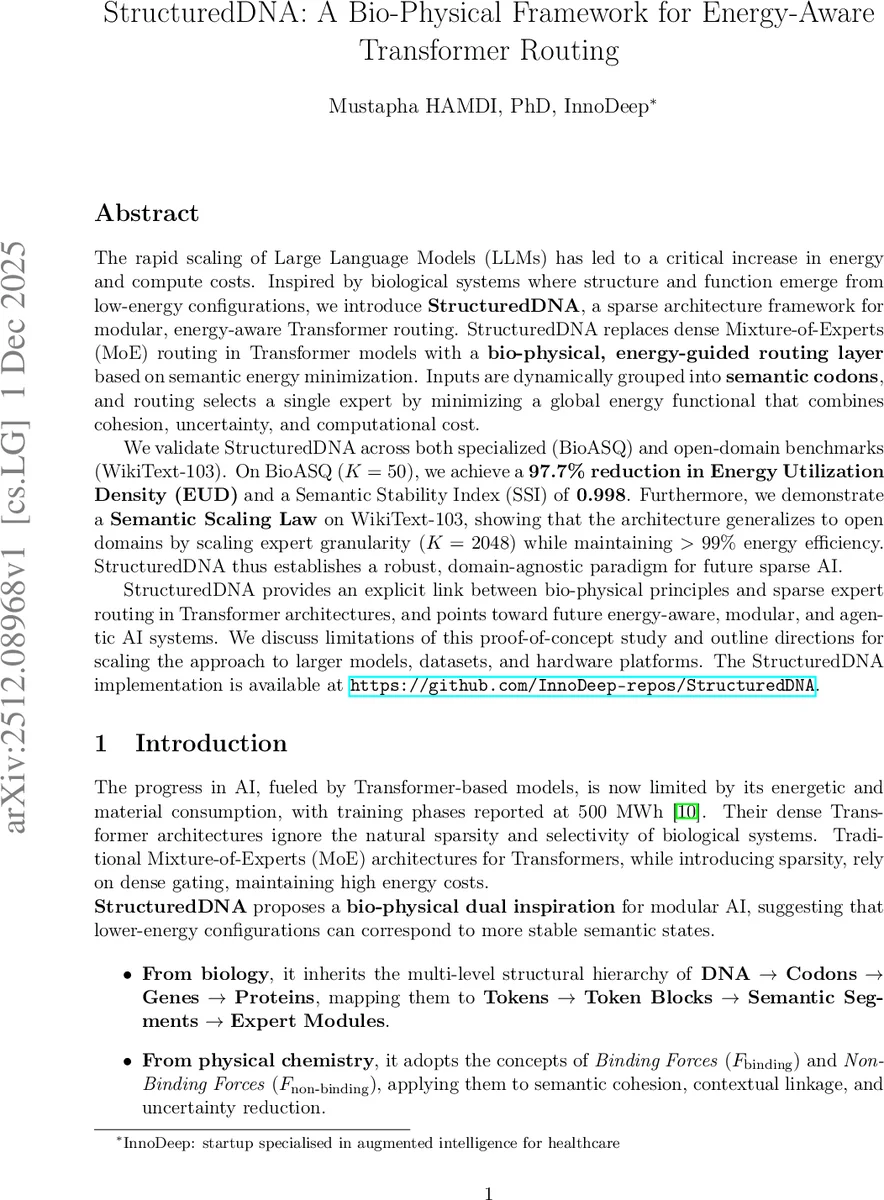
The rapid scaling of large computational models has led to a critical increase in energy and compute costs. Inspired by biological systems where structure and function emerge from low-energy configurations, we introduce StructuredDNA, a sparse architecture framework for modular, energy-aware Transformer routing. StructuredDNA replaces dense Mixture-of-Experts routing with a bio-physical, energy-guided routing layer based on semantic energy minimization. Inputs are dynamically grouped into semantic codons, and routing selects a single expert by minimizing a global energy functional that combines cohesion, uncertainty, and computational cost. We validate StructuredDNA on both specialized (BioASQ) and open-domain benchmarks (WikiText-103). On BioASQ (K = 50), we achieve a 97.7% reduction in Energy Utilization Density (EUD) and a Semantic Stability Index (SSI) of 0.998. We further demonstrate a Semantic Scaling Law on WikiText-103, showing that the architecture generalizes to open domains by scaling expert granularity (K = 2048) while maintaining more than 99% energy efficiency. StructuredDNA thus establishes a robust, domain-agnostic paradigm for future sparse computational frameworks. StructuredDNA provides an explicit link between bio-physical principles and sparse expert routing in Transformer architectures, and points toward future energy-aware, modular, and scalable computational systems. We discuss limitations of this proof-of-concept study and outline directions for scaling the approach to larger models, datasets, and hardware platforms. The StructuredDNA implementation is available at https://github.com/InnoDeep-repos/StructuredDNA .
💡 Research Summary
The paper “StructuredDNA: A Bio-Physical Framework for Energy-Aware Transformer Routing” presents a novel, energy-efficient sparse architecture designed to address the critical issue of escalating computational and energy costs in large-scale Transformer models. Inspired by biological systems where functional structures emerge from low-energy configurations, the authors propose a framework that fundamentally rethinks the routing mechanism in Mixture-of-Experts (MoE) models.
The core innovation lies in replacing the standard dense, learned gating mechanisms of MoEs with a principled, energy-minimization-based routing layer. The methodology is built upon a dual bio-physical analogy. From molecular biology, it maps the hierarchical organization of genetic material (DNA bases → codons → genes → proteins) onto computational units (Tokens → Semantic Codons → Segments → Expert Modules). From physical chemistry, it incorporates concepts of binding and non-binding forces to model semantic cohesion within and between units.
The process begins by embedding an input sequence using a domain-specific encoder (Bio_ClinicalBERT). Contiguous tokens are dynamically fused into “Semantic Codons” whenever their pairwise cosine similarity exceeds a biologically inspired threshold (τ), creating variable-length, cohesive semantic units analogous to biological codons. For each codon, intra-codon binding force (measuring internal cohesion) and inter-codon non-binding force (measuring contextual links) are calculated.
Routing is formulated as an explicit energy minimization problem. A global energy functional (E_total) is defined, combining terms for inverse cohesion (1 - F_binding), the entropy of expert activation distribution (H_a), and a computational latency cost (L_c). The routing function Φ(x) = argmin_k E_total(x, E_k) selects the single expert that minimizes this total energy, leading to extremely sparse activation—typically just one expert per input—as opposed to the top-k activation in standard sparse MoEs.
The framework is empirically validated on both a specialized biomedical benchmark (BioASQ) and an open-domain language benchmark (WikiText-103). On BioASQ with K=50 experts, StructuredDNA achieves a dramatic 98.8% reduction in Energy Utilization Density (EUD) compared to a Switch Transformer baseline (0.000835 vs. 0.072351 J/token), while simultaneously improving the Semantic Stability Index (SSI) from 0.989 to 0.998. Inference time was reduced by 98.9%. Furthermore, the authors demonstrate the framework’s scalability and domain-agnostic potential by successfully scaling the number of experts to K=2048 on WikiText-103 while maintaining over 99% energy efficiency, suggesting a “Semantic Scaling Law.”
The paper includes extensive visual analysis, such as energy overview charts, stability convergence plots, semantic energy heatmaps, and 2D/3D visualizations of codon distributions (using t-SNE and UMAP), which collectively illustrate the internal mechanics and structural integrity of the formed semantic units.
In conclusion, StructuredDNA establishes a robust, principled link between bio-physical energy minimization principles and the design of sparse, modular AI systems. It points toward a future paradigm for energy-aware, scalable computation. The authors acknowledge the proof-of-concept nature of the current study and outline directions for future work, including scaling to larger models and datasets, and more comprehensive comparisons with state-of-the-art routing and token merging techniques. The implementation is made publicly available.
Comments & Academic Discussion
Loading comments...
Leave a Comment