Majoranas with a twist: Tunable Majorana zero modes in altermagnetic heterostructures
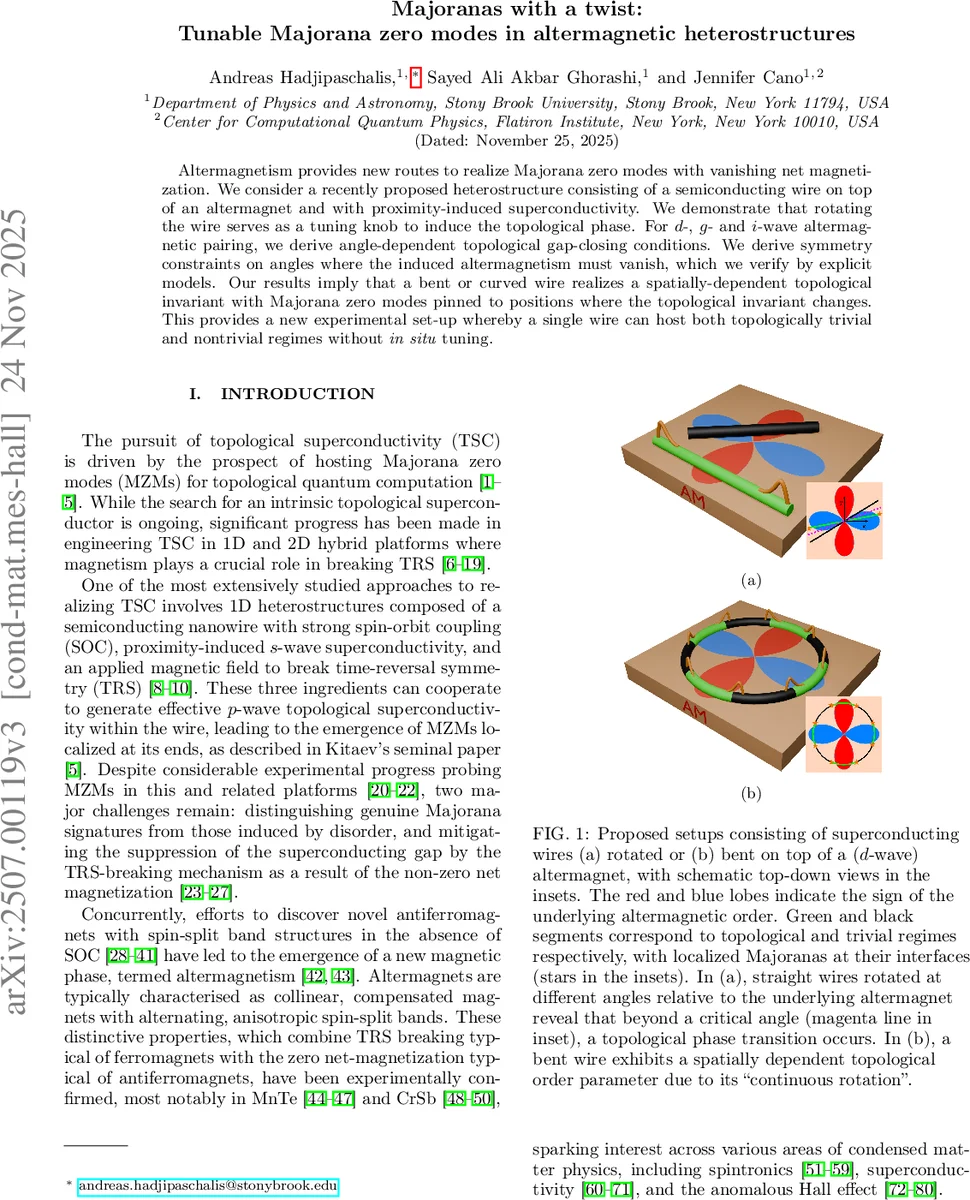
Altermagnetism provides new routes to realize Majorana zero modes with vanishing net magnetization. We consider a recently proposed heterostructure consisting of a semiconducting wire on top of an altermagnet and with proximity-induced superconductivity. We demonstrate that rotating the wire serves as a tuning knob to induce the topological phase. For $d$-, $g$- and $i$-wave altermagnetic pairing, we derive angle-dependent topological gap-closing conditions. We derive symmetry constraints on angles where the induced altermagnetism must vanish, which we verify by explicit models. Our results imply that a bent or curved wire realizes a spatially-dependent topological invariant with Majorana zero modes pinned to positions where the topological invariant changes. This provides a new experimental set-up whereby a single wire can host both topologically trivial and nontrivial regimes without $in$ $situ$ tuning.
💡 Research Summary
The pursuit of Majorana zero modes (MZMs) is fundamental to the development of fault-tolerant topological quantum computing. Traditionally, the creation of MZMs has relied on ferromagnetic-semiconductor heterostructures, which necessitate the application of external magnetic fields to induce spin-splitting. However, such magnetic fields can interfere with the delicate superconducting states and surrounding electronic components. This paper introduces a groundbreaking alternative by leveraging “altermagnetism”—a novel magnetic state characterized by zero net magnetization but significant spin-splitting in momentum space.
The researchers propose a heterostructure consisting of a semiconducting nanowire placed atop an altermagnet, with superconductivity induced via the proximity effect. The core innovation of this work is the demonstration that the orientation (rotation angle) of the nanowire serves as a highly effective tuning knob for the topological phase transition. By analyzing various altermagnetic pairing symmetries, including $d$-, $g$-, and $i$-wave types, the authors derive precise, angle-dependent conditions for the closing of the topological gap. Furthermore, they identify specific symmetry-protected angles where the induced altermagnetic effect vanishes, providing a roadmap for experimental verification.
A particularly transformative insight presented in the paper is the application of this principle to curved or bent nanowires. In a curved wire, the local angle relative to the altermagnetic axis changes continuously along the wire’s length. This spatial variation leads to a spatially-dependent topological invariant. Consequently, the wire can host both topologically trivial and non-trivial regimes simultaneously, with Majorana zero modes naturally “pinned” at the precise locations where the topological transition occurs.
The implications of this research are profound for the field of quantum engineering. Unlike conventional methods that require complex in situ tuning via external magnetic fields or gate voltages to manipulate MZMs, the proposed method allows for the spatial positioning of Majorana modes through purely geometric design. This “structural tuning” approach simplifies the experimental setup, reduces the need for external control lines, and offers a robust pathway toward the scalable fabrication of topological quantum devices. By utilizing the unique properties of altermagnetism, this study opens a new frontier in the manipulation of Majorana fermions through geometric and structural engineering.
Comments & Academic Discussion
Loading comments...
Leave a Comment