The properties of primordially-seeded black holes and their hosts in the first billion years: implications for JWST
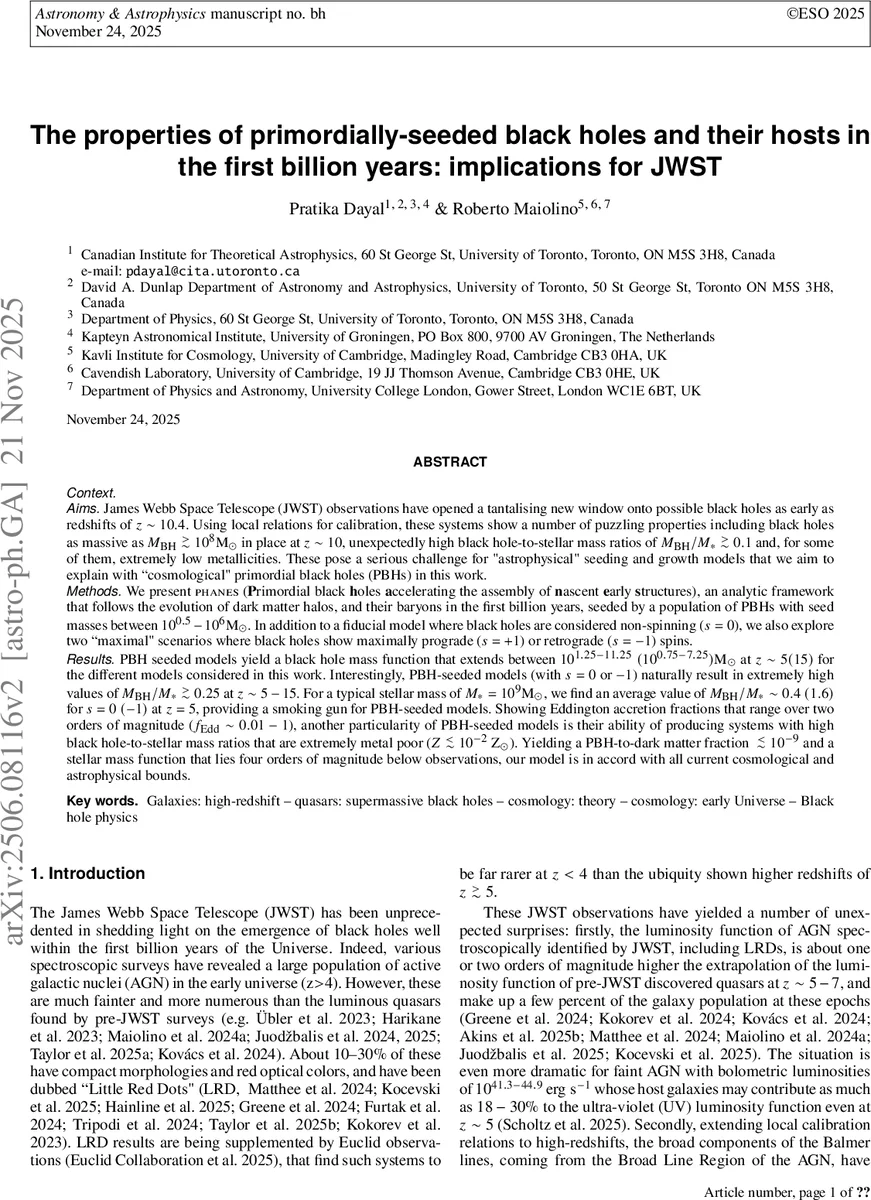
James Webb Space Telescope (JWST) observations have opened a tantalising new window onto possible black holes as early as redshifts of $z \sim 10.4$. These show a number of puzzling properties including unexpectedly massive black holes in place by $z \sim 10$ and inexplicably high black hole-to-stellar mass ratios of $M_{\rm BH}/M_\geq 0.1$. These pose a serious challenge for “astrophysical” seeding and growth models that we aim to explain with ``cosmological" primordial black holes (PBHs) in this work. We present PHANES, an analytic framework that follows the evolution of dark matter halos, and their baryons in the first billion years, seeded by a population of PBHs with seed masses between $10^{0.5}-10^6 M_\odot$. PBH seeded models yield a black hole mass function that extends between $10^{1.25-11.25} ~(10^{0.75-7.25})M_\odot$ at $z \sim 5 (15)$ for the different models considered in this work. Interestingly, PBH-seeded models (with spin $s=0$ or $-1$) naturally result in extremely high values of $M_{\rm BH}/M_\geq 0.25$ at $z \sim 5-15$. For a typical stellar mass of $M_* =10^9 M_\odot$, we find an average value of $M_{\rm BH}/M_* \sim 0.4~ (1.6)$ for $s=0~(-1)$ at $z=5$, providing a smoking gun for PBH-seeded models. Another particularity of PBH-seeded models is their ability of producing systems with high black hole-to-stellar mass ratios that are extremely metal poor ($Z \leq 10^{-2}~Z_\odot$). Yielding a PBH-to-dark matter fraction $\leq 10^{-9}$ and a stellar mass function that lies four orders of magnitude below observations, our model is in accord with all current cosmological and astrophysical bounds.
💡 Research Summary
**
The paper tackles a striking tension revealed by early JWST observations: massive black holes (M ≈ 10⁸ M⊙) already in place at redshifts z ≈ 10 and black‑hole‑to‑stellar‑mass ratios (MBH/M*) as high as 0.1–1, far exceeding the values seen in the local Universe. Conventional astrophysical seeding channels—light Pop III remnants, intermediate‑mass seeds from dense clusters, or direct‑collapse black holes—struggle to produce such objects within the limited time available. The authors therefore explore a cosmological seeding scenario: primordial black holes (PBHs) formed in the very early Universe (during inflation or phase transitions) that constitute only a tiny fraction of the dark matter (≤ 10⁻⁹).
They introduce PHANES (Primordial Black Holes Accelerating the Assembly of Nascent Early Structures), an analytic framework that follows the co‑evolution of dark‑matter halos, gas, stars, and central black holes from the epoch of matter‑radiation equality (z ≈ 3400) to z ≈ 5. The key ingredient is the “seed effect”: each PBH linearly accretes dark matter, building a halo whose mass scales as Mhalo = (zeq/z) MPBH. By z ≈ 34 the halo mass exceeds the PBH mass by two orders of magnitude, after which halo growth proceeds via smooth accretion from the intergalactic medium, modeled with the average accretion rate from high‑resolution N‑body simulations (Trac et al. 2015).
Gas can only be retained once a halo reaches a baryonic overdensity of δ = 200; the authors compute the minimum halo mass for this condition using the static gas model of Barkana & Loeb (2001). Within such halos, gas cools, forms stars (Salpeter IMF, 0.1–100 M⊙), and feeds the central black hole. Stellar feedback (SN II) couples 1 % of its energy to the gas (fw,sf = 10⁻²), while black‑hole feedback couples 0.1 % (fw,BH = 10⁻³).
Black‑hole growth is parameterised by an Eddington fraction fEdd and a spin‑dependent radiative efficiency ε. Three spin states are explored: non‑spinning (s = 0, ε = 0.057, fEdd = 0.25), retrograde (s = ‑1, ε = 0.037, fEdd = 1.0) and prograde (s = +1, ε = 0.42, fEdd = 1.0). The PBH mass spectrum is taken as a power law d n/d m = κ m⁻ᵅ with slopes α = 2 and 3, spanning 10⁰·⁵–10⁶ M⊙. The normalisation κ is calibrated to the observed number density of two z ≈ 10 black‑hole candidates (UHZ1 and GHZ9) and an assumed seed mass of 10³·⁶⁵ M⊙, yielding κ ≈ 10⁷·¹⁵ (α = 2) or 4.8 × 10⁵ (α = 3).
The model produces several robust predictions:
-
Black‑hole mass function – At z ≈ 5 the distribution spans 10¹·²⁵–10¹¹·²⁵ M⊙; at z ≈ 15 it extends from 10⁰·⁷⁵ to 10⁷·²⁵ M⊙, comfortably encompassing the JWST detections.
-
Extreme MBH/M* – For a typical stellar mass of 10⁹ M⊙, the average ratio is ≈ 0.4 for s = 0 and ≈ 1.6 for s = ‑1 at z = 5, well above the observed 0.1–1 range and providing a clear “smoking‑gun” signature of PBH seeding.
-
Eddington fractions – The model yields a broad range fEdd ≈ 0.01–1, with retrograde spins achieving near‑Eddington accretion, explaining the rapid growth required for the most massive early quasars.
-
Metallicity – Because gas is accreted before substantial star formation, the majority of PBH‑seeded systems remain extremely metal‑poor (Z ≤ 10⁻² Z⊙), matching the low‑metallicity AGN reported by JWST.
-
Cosmological consistency – The required PBH‑to‑dark‑matter fraction is ≤ 10⁻⁹, safely below constraints from CMB anisotropies, microlensing, and gravitational‑wave background.
-
Stellar mass function – The predicted stellar mass function lies four orders of magnitude below the observed high‑z galaxy counts, indicating that PBHs do not dominate the bulk of early galaxy formation; instead, they act as rare, high‑impact seeds that produce the outlier black‑hole‑rich systems seen by JWST.
The authors discuss the implications of spin dependence, noting that retrograde (s = ‑1) scenarios produce the highest MBH/M* and Eddington ratios, making future measurements of black‑hole spin a decisive test. They also acknowledge uncertainties: the PBH mass‑function normalisation is based on only two objects, the gas‑accretion model is static and neglects non‑linear shocks, and merger‑driven growth is not explicitly treated.
In summary, the paper presents a self‑consistent analytic framework in which a minute population of primordial black holes can seed the formation of ultra‑massive black holes and high‑ratio black‑hole‑to‑stellar‑mass systems within the first billion years, while remaining compatible with all existing cosmological and astrophysical bounds. The predictions—especially the extreme MBH/M* ratios, low metallicities, and spin‑dependent accretion signatures—offer clear observational targets for JWST, the upcoming ELT, and next‑generation X‑ray missions, opening a promising avenue to probe the possible primordial origin of the earliest supermassive black holes.
Comments & Academic Discussion
Loading comments...
Leave a Comment