Ab Initio Theory of Phonon Magnetic Moment Induced by Electron-Phonon Coupling in Magnetic Materials
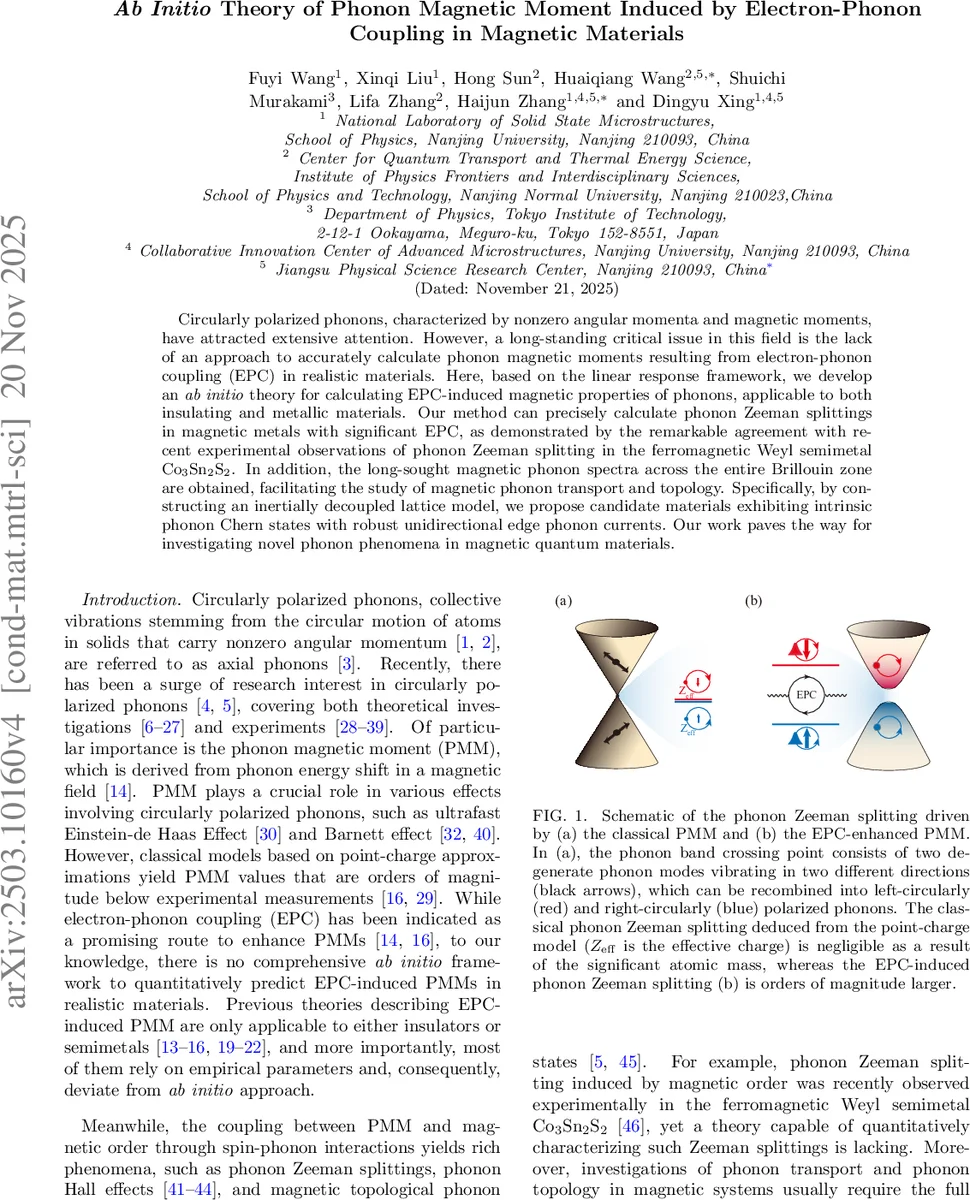
Circularly polarized phonons, characterized by nonzero angular momenta and magnetic moments, have attracted extensive attention. However, a long-standing critical issue in this field is the lack of an approach to accurately calculate phonon magnetic moments resulting from electron-phonon coupling (EPC) in realistic materials. Here, based on the linear response framework, we develop an ab initio theory for calculating EPC-induced magnetic properties of phonons, applicable to both insulating and metallic materials. Our method can precisely calculate phonon Zeeman splittings in magnetic metals with significant EPC, as demonstrated by the remarkable agreement with recent experimental observations of phonon Zeeman splitting in the ferromagnetic Weyl semimetal Co3Sn2S2. In addition, the long-sought magnetic phonon spectra across the entire Brillouin zone are obtained, facilitating the study of magnetic phonon transport and topology. Specifically, by constructing an inertially decoupled lattice model, we propose candidate materials exhibiting intrinsic phonon Chern states with robust unidirectional edge phonon currents. Our work paves the way for investigating novel phonon phenomena in magnetic quantum materials.
💡 Research Summary
The manuscript presents a comprehensive first‑principles framework for calculating phonon magnetic moments (PMMs) that arise from electron‑phonon coupling (EPC) in magnetic materials. The authors start from a phonon Hamiltonian that includes a time‑reversal‑symmetry‑breaking term, δH = − η·s_ph, where s_ph is the phonon angular momentum. By treating s_ph as an effective perturbative field acting on the coupled electron‑phonon system, they derive η from the TRS‑breaking phonon self‑energy using linear response theory. The key result is the relation η(q, ω) = (1/iω) χ⁻(q, ω), where χ⁻ is the spin‑polarized electronic susceptibility. χ⁻ is expressed as a Matsubara sum over electronic states and the EPC tensor V_k,αβ^c,s(q, ω), both of which can be obtained directly from density‑functional perturbation theory (DFPT) with Hubbard‑U corrections.
The theory predicts that χ⁻ becomes large when (i) the EPC tensor is sizable—typically in compounds containing light atoms—and (ii) electronic interband transitions satisfy ℏω ≈ ε_{k+q,α} − ε_{k,β}, i.e., when the phonon frequency resonates with electronic excitations. Under these conditions, the phonon g‑factor can approach the electronic g‑factor, leading to PMMs of order 10⁻³ μ_B, far exceeding the classical point‑charge estimates (10⁻⁵–10⁻⁴ μ_B).
Implementation is realized as a new module within Quantum ESPRESSO. After a standard DFPT calculation, the module extracts the response coefficients η and the effective phonon g‑factor g_ph = g_e ℏ²/(2iω) ∂χ⁺/∂E|_{E_F}. These quantities are inserted as a near‑degenerate perturbation into the dynamical matrix, yielding magnetic phonon dispersions that display Zeeman splittings.
The authors validate the approach on the ferromagnetic Weyl semimetal Co₃Sn₂S₂. Raman measurements have reported a Zeeman splitting of the Eg mode at the Γ point of ≈0.038 THz (≈1.27 cm⁻¹). The ab‑initio calculation reproduces a splitting of 0.042 THz (μ_ph ≈ 2.8 × 10⁻³ μ_B), in excellent agreement with experiment. Moreover, the full Brillouin‑zone magnetic phonon spectra reveal a crossing of the two circularly polarized branches along Γ–T, forming a phonon Weyl point protected by C₃v symmetry—an insight inaccessible without the complete magnetic phonon band structure.
Beyond quantitative validation, the paper leverages the calculated magnetic phonon spectra to explore topological phonon phases. By analogy with the Haldane model, the authors consider a two‑dimensional honeycomb lattice where inversion symmetry (Δ_I) and time‑reversal symmetry breaking (Δ_T) open gaps at Dirac points. In realistic materials, Δ_I is often non‑zero, suppressing the Chern number. To overcome this, they propose an “inertially decoupled model” (IDM) comprising a light, non‑magnetic honeycomb sublattice (mass m) and a heavy, magnetic triangular sublattice (mass M) with m ≪ M. The large mass disparity decouples high‑frequency phonons (dominated by the light atoms) from low‑frequency ones (dominated by the heavy atoms). The honeycomb sublattice preserves inversion symmetry (Δ_I = 0), while the magnetic sublattice provides a strong TRS‑breaking Δ_T via EPC‑induced Zeeman splitting. Consequently, |Δ_T| > |Δ_I| and a phonon Chern insulator with C = ±1 emerges, featuring topologically protected edge modes crossing the phonon gap. The authors extend the IDM to three dimensions by stacking alternating honeycomb and triangular layers, obtaining a 3D phonon Chern crystal with Weyl‑type bulk nodes and surface arcs.
The manuscript concludes by suggesting concrete material candidates: compounds that combine light elements (B, C, N, O) forming a honeycomb network with heavy transition‑metal magnetic ions (Fe, Co, Ni, Mn) arranged in a triangular lattice. First‑principles screening using the presented EPC‑based susceptibility can identify systems where the EPC tensor and spin polarization are simultaneously large, fulfilling the IDM criteria.
In summary, the work delivers (1) a rigorous linear‑response formalism linking EPC to phonon magnetic moments, (2) a practical computational workflow integrated into a widely used DFT package, (3) quantitative agreement with experimental Zeeman splittings in a prototypical ferromagnetic Weyl semimetal, (4) the first full‑zone magnetic phonon spectra enabling the study of phonon topology, and (5) a novel design principle— the inertially decoupled model— for realizing intrinsic phonon Chern states and unidirectional edge phonon currents in realistic magnetic crystals. This advances the field of magnetic phononics and opens pathways toward phonon‑based spintronic and topological devices.
Comments & Academic Discussion
Loading comments...
Leave a Comment