Interaction of geophysical flows with sea ice dynamics
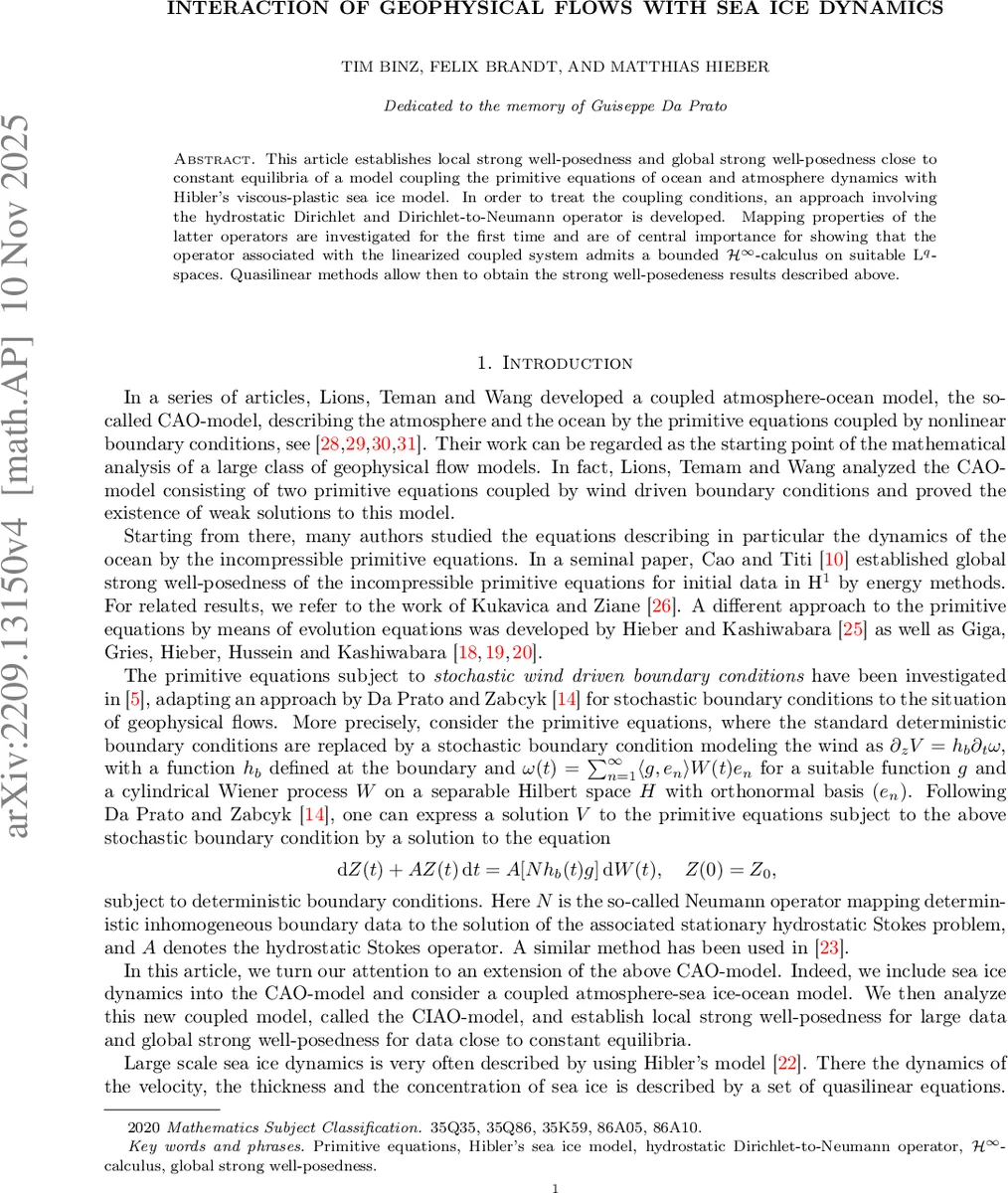
This article establishes local strong well-posedness and global strong well-posedness close to constant equilibria of a model coupling the primitive equations of ocean and atmospheric dynamics with Hibler’s viscous-plastic sea ice model. In order to treat the coupling conditions, an approach involving the hydrostatic Dirichlet and Dirichlet-to-Neumann operator is developed. Mapping properties of the latter operators are investigated for the first time and are of central importance for showing that the operator associated with the linearized coupled system admits a bounded $\mathcal{H}^\infty$-calculus on suitable $\mathrm{L}^q$-spaces. Quasilinear methods allow then to obtain the strong well-posedeness results described above.
💡 Research Summary
The paper introduces and rigorously analyses a novel coupled atmosphere‑ice‑ocean (CIAO) model that integrates the primitive equations for the atmosphere and the ocean with Hibler’s viscous‑plastic sea‑ice model. Building on the earlier CAO‑model, which only couples atmosphere and ocean through wind‑driven boundary conditions, the authors add a thin sea‑ice layer and formulate precise coupling conditions: atmospheric wind stress, oceanic shear stress, and continuity of horizontal velocity at the ice‑ocean interface. The sea‑ice dynamics are described by quasilinear equations for the ice velocity, thickness, and compactness, with an internal stress law that follows Hibler’s formulation and is regularised to avoid singularities.
A central methodological contribution is the introduction of the hydrostatic Dirichlet operator and the hydrostatic Dirichlet‑to‑Neumann operator. The authors study these operators for the first time in the context of geophysical flows, proving mapping properties and establishing that the linearised coupled operator possesses a bounded H^∞‑calculus on suitable L^q‑spaces (1<q<∞). This result implies R‑boundedness and maximal L^q‑regularity, which are essential prerequisites for applying modern quasilinear evolution equation theory.
The coupled system is rewritten as a quasilinear abstract evolution equation u′+A(u)u=F(u). Using the bounded H^∞‑calculus for A(u) and Lipschitz continuity of the nonlinear terms, the authors invoke the Da Prato‑Grisvard theorem and its extensions to obtain local strong well‑posedness for arbitrary (large) initial data in H^1‑type spaces. The solution exists on a short time interval, is unique, and depends continuously on the data.
For global results, the paper focuses on data close to constant equilibria (uniform ice thickness, compactness, and zero velocity). Linearisation around such an equilibrium yields an operator A₀ whose spectrum stays away from the origin, guaranteeing invertibility and preserving the H^∞‑calculus. By a perturbation argument and the maximal regularity framework, the authors prove global strong well‑posedness for sufficiently small perturbations of the equilibrium. Moreover, the solution decays exponentially to the equilibrium, establishing stability.
The analysis also covers the regularised ice stress σ_δ, the treatment of the stationary hydrostatic Stokes problem with inhomogeneous boundary data, and the derivation of Lipschitz estimates for the full nonlinear system. Although Coriolis forces, radiative terms, and more complex free‑surface dynamics are omitted for clarity, the authors note that these can be incorporated without fundamental changes to the analytical framework.
In summary, the paper delivers the first rigorous strong‑solution theory for a fully coupled atmosphere‑ice‑ocean system, combining sophisticated functional‑analytic tools (bounded H^∞‑calculus, maximal L^q‑regularity, quasilinear evolution equations) with realistic physical modelling of sea‑ice rheology. The results lay a solid mathematical foundation for future numerical simulations and for extending the model to include additional geophysical processes.
Comments & Academic Discussion
Loading comments...
Leave a Comment