Complex binomial theorem and pentagon identities
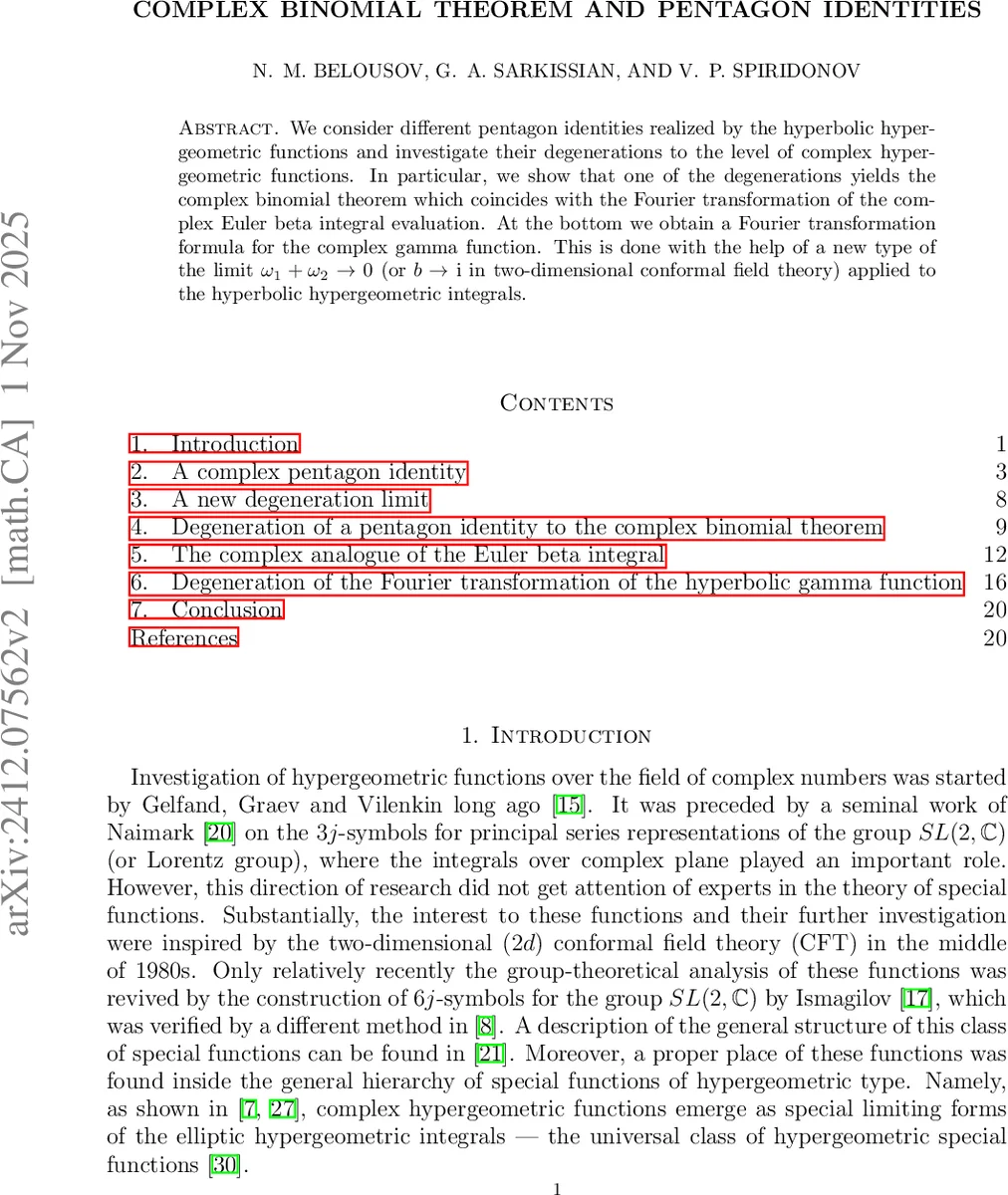
We consider different pentagon identities realized by the hyperbolic hypergeometric functions and investigate their degenerations to the level of complex hypergeometric functions. In particular, we show that one of the degenerations yields the complex binomial theorem which coincides with the Fourier transformation of the complex analogue of the Euler beta integral. At the bottom we obtain a Fourier transformation formula for the complex gamma function. This is done with the help of a new type of the limit $ω_1+ω_2\to 0$ (or $b\to \textrm{i}$ in two-dimensional conformal field theory) applied to the hyperbolic hypergeometric integrals.
💡 Research Summary
The paper investigates a family of pentagon identities built from hyperbolic hypergeometric functions and studies their degeneration to complex hypergeometric functions. The authors focus on a particular limit, ω₁ + ω₂ → 0 (equivalently b → i in two‑dimensional conformal field theory), which drives the hyperbolic gamma function γ^{(2)}(u; ω₁, ω₂) to a complex gamma function Γ(x, n) that depends simultaneously on a continuous complex variable x and an integer n. This limit, rigorously analyzed in earlier work, yields the asymptotic formula (2.4) and establishes functional relations (2.6)–(2.7) for the complex gamma function.
Starting from the Faddeev‑Volkov star‑triangle relation (2.1), the authors re‑parameterize the six spectral parameters (f_j, h_j) in a way that respects the balancing condition Σ(f_j + h_j)=ω₁ + ω₂. Applying the ω₁ + ω₂ → 0 limit leads to a Mellin‑Barnes type integral (2.9), which is identified as a complex analogue of Barnes’ second lemma. By introducing the notation B(x, y)=γ^{(2)}(x, y; ω)γ^{(2)}(x + y; ω), the star‑triangle relation is rewritten as a five‑term pentagon identity (2.10).
A key outcome of the degeneration is the “complex binomial theorem” (2.14)–(2.15). In this form, an infinite sum over integer shifts of the complex gamma function collapses into a product of two complex beta functions, mirroring the classical binomial expansion but now living in the complex number field. This result demonstrates that the binomial structure survives the transition from real to complex hypergeometric functions.
The paper proceeds to explore several further degeneration regimes. By sending one or more parameters to infinity while keeping appropriate linear combinations fixed, the authors obtain simpler pentagon identities that correspond to the first Barnes lemma (2.12)–(2.13) and to a Fourier‑type transformation (2.18)–(2.19). In the latter case the kernel ˜B(x, y)=γ^{(2)}(x; ω)γ^{(2)}(y; ω)γ^{(2)}(x + y; ω) plays the role of a Boltzmann weight, and the integral identity (2.19) is precisely a Fourier transform of this weight.
The most striking results are the Fourier transformation formulas for the complex gamma function itself, given in (2.21) and its “inverse” (2.22). Equation (2.21) reads
∫_{ℝ₊} e^{2πiλz/ω₁ω₂} e^{−πi/2(B₂,₂(z; ω)−B₂,₂(0; ω))} γ^{(2)}(z; ω) dz
= e^{−πi/2 B₂,₂(λ; ω)} γ^{(2)}(λ; ω),
with the convergence condition 0 < Re λ < ½ Re(ω₁ + ω₂) and a contour that bypasses the pole at z = 0 from the right. This identity shows that the complex gamma function is essentially an eigenfunction of a Fourier‑type operator, up to explicit prefactors involving the second order Bernoulli polynomial B₂,₂. The “inverse” formula (2.22) has a similar structure but with opposite signs in the exponential; although a naïve inversion fails due to divergence, a slight modification of the contour or regularization restores the duality between the two formulas.
In the concluding section the authors discuss the relevance of these identities to three‑dimensional topological field theories, supersymmetric partition functions, and quantum integrable models. The limit b → i corresponds to the central charge c → 1 in Liouville theory, and the pentagon identities encode the invariance of state integrals under 3‑2 Pachner moves, i.e., the elementary recombination of ideal tetrahedra. Thus the complex hypergeometric pentagon relations provide a unifying framework that connects special function theory, Fourier analysis, and quantum topology.
Overall, the paper delivers a comprehensive treatment of how hyperbolic hypergeometric integrals degenerate to complex hypergeometric objects, establishes a complex binomial theorem, and derives explicit Fourier transformation formulas for the complex gamma function, all within the broader context of pentagon identities and their applications in mathematical physics.
Comments & Academic Discussion
Loading comments...
Leave a Comment