On semigroups that are prime in the sense of Tarski, and groups prime in the senses of Tarski and of Rhodes
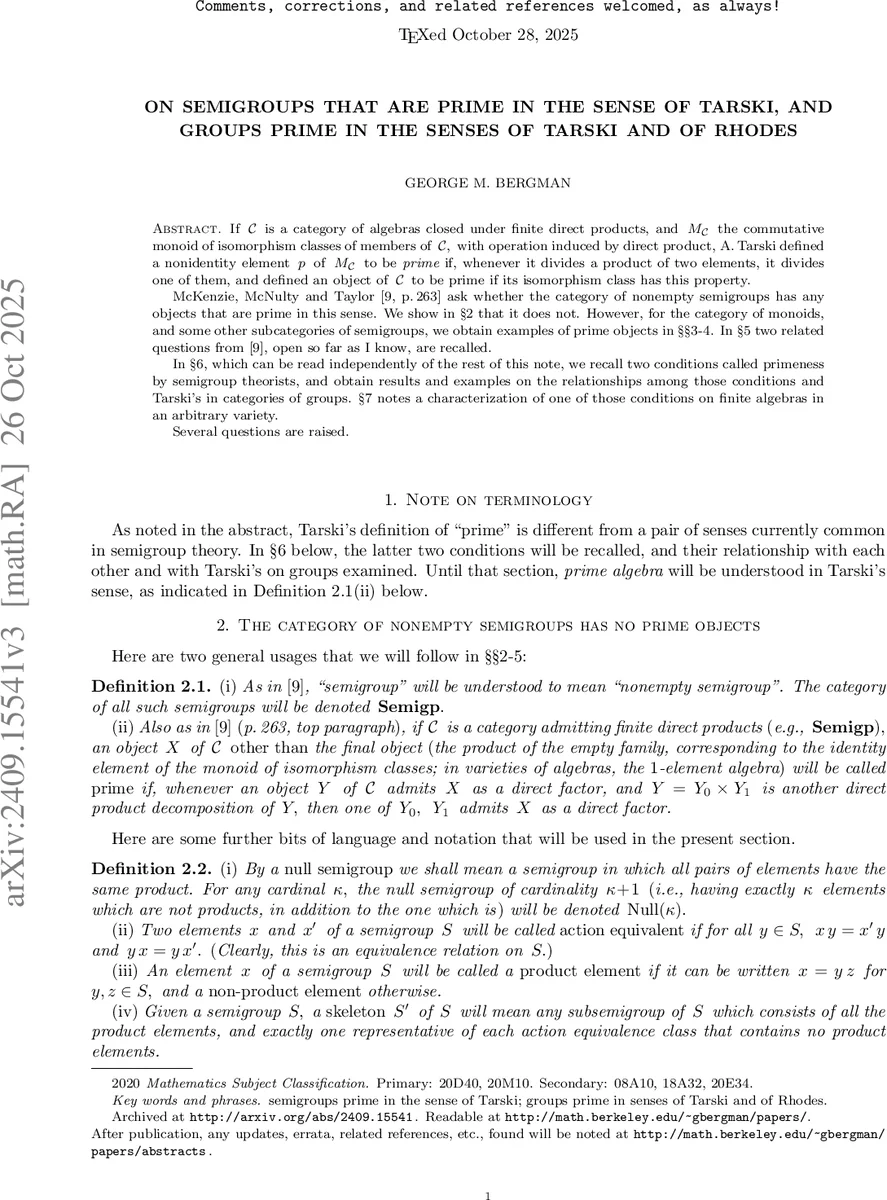
If $\mathcal{C}$ is a category of algebras closed under finite direct products, and $M_\mathcal{C}$ the commutative monoid of isomorphism classes of members of $\mathcal{C},$ with operation induced by direct product, A.Tarski defined a nonidentity element $p$ of $M_\mathcal{C}$ to be prime if, whenever it divides a product of two elements in that monoid, it divides one of them, and called an object of $\mathcal{C}$ prime if its isomorphism class has this property. McKenzie, McNulty and Taylor ask whether the category of nonempty semigroups has any prime objects. We show in section 2 that it does not. However, for the category of monoids, and some other subcategories of semigroups, we obtain examples of prime objects in sections 3-4. In section 5, two related questions open so far as I know, are recalled. In section 6, which can be read independently of the rest of this note, we recall two related conditions that are called primeness by semigroup theorists, and obtain results and examples on the relationships among those two conditions and Tarski’s, in categories of groups. Section 7 notes an interesting characterization of one of those conditions when applied to finite algebras in an arbitrary variety. Various questions are raised.
💡 Research Summary
The paper investigates the notion of “prime” introduced by A. Tarski within the framework of universal algebra and applies it to the categories of semigroups and groups. Tarski’s definition is categorical: for a category C closed under finite direct products, let M_C be the commutative monoid of isomorphism classes with the product induced by direct product. A non‑identity element p∈M_C is called prime if whenever p divides a product ab, it already divides a or b. An object of C is prime when its class is prime in M_C.
Section 2 – Non‑existence of prime semigroups.
The author first fixes terminology (non‑empty semigroups are called “semigroups” throughout). He introduces the equivalence relation of “action‑equivalence” (x≈y iff xz=yz and zx=zy for all z) and distinguishes product elements (those that can be written as a product of two elements) from non‑product elements. A “null” semigroup Null(κ) (all products equal) is defined for any cardinal κ. Lemma 2.3 shows that if two semigroups S and T have isomorphic skeleta (the subsemigroup consisting of all product elements together with a single representative of each action‑equivalence class of non‑product elements) and κ is an infinite cardinal larger than any action‑equivalence class, then S×Null(κ)≅T×Null(κ). Using this, Lemma 2.4 proves that any non‑null semigroup cannot be prime: by adjoining κ new elements to a chosen action‑class one obtains a semigroup S⁺ with S×Null(κ)≅S⁺×Null(κ); if S were prime it would have to be a direct factor of one side, which leads to a contradiction. Lemma 2.5 gives a necessary and sufficient condition for a semigroup to split as a direct product with a null factor, expressed in terms of the sizes of the action‑equivalence classes. Lemma 2.6 applies this to show that Null(κ) itself is never prime, constructing explicit counter‑examples for both infinite and finite κ. Consequently Theorem 2.7 concludes that the category Semigp of non‑empty semigroups has no prime objects. A corollary extends the non‑existence result to any full subcategory closed under binary products and direct factors that contains all zero‑semigroups with a three‑fold zero property, and the author raises the open question whether the finite‑semigroup category might contain a prime object.
Sections 3–4 – Positive results in restricted settings.
The paper then turns to categories where prime objects do exist. Lemma 3.1 is a technical tool: if A is an ideal of a semigroup S and π:A→G is a homomorphism into a group G, then π extends uniquely to a homomorphism \hatπ:S→G. The proof uses a “sandwich” construction and cancellation in the group. Corollary 3.2 shows that for any family of semigroups (S_i) the homomorphisms from the free product ⊔ S_i into a group extend uniquely to the free product of the monoids obtained by adjoining identities. Corollary 3.3 deduces that any homomorphism from a direct product S×T into a group factors uniquely as a product of homomorphisms from S and from T, with the images centralizing each other. These results enable the construction of prime objects in the category of monoids and in several natural subcategories of semigroups (e.g., cancellative semigroups), where the direct‑factor condition can be satisfied.
Section 5 – Open problems.
Two questions from McKenzie‑McNulty‑Taylor are recalled: (1) does the category of finite semigroups contain a prime object? (2) can the arguments be adapted to avoid the use of infinite cardinals? The author notes that his current proofs rely heavily on infinite null semigroups, leaving the finite case unresolved.
Section 6 – Prime groups: Tarski vs. Rhodes.
The paper shifts focus to groups. Two notions of “prime group” are compared: Tarski’s categorical prime (as above) and Rhodes’s prime (a group G such that whenever a normal subgroup N is a direct factor of G, then N is either trivial or G). The author exhibits examples showing that the two notions are independent in general, but proves that for abelian groups they coincide. He also discusses how the two definitions behave under extensions and direct products, providing a clearer picture of the landscape of prime groups.
Section 7 – A finite‑algebra characterization.
Finally, the author presents a characterization valid for any variety of algebras: a finite algebra A is Tarski‑prime if and only if every congruence class of A can be written as a direct product of a “prime” factor and a trivial factor. This ties the categorical prime notion to classical decomposition theory for finite algebras.
Overall contribution.
The work systematically explores Tarski’s prime concept beyond its original logical setting, establishing a comprehensive negative result for general semigroups, positive constructions for monoids and certain subcategories, and a nuanced comparison with existing notions of prime groups. It also raises natural open problems, especially concerning finite semigroups, and connects the prime notion to decomposition theory in finite universal algebras. The blend of categorical reasoning, combinatorial constructions (action‑equivalence, null semigroups), and classical group theory makes the paper a valuable reference for researchers interested in the interplay between direct‑product factorization and primality in algebraic structures.
Comments & Academic Discussion
Loading comments...
Leave a Comment