AMO-HEAD: Adaptive MARG-Only Heading Estimation for UAVs under Magnetic Disturbances
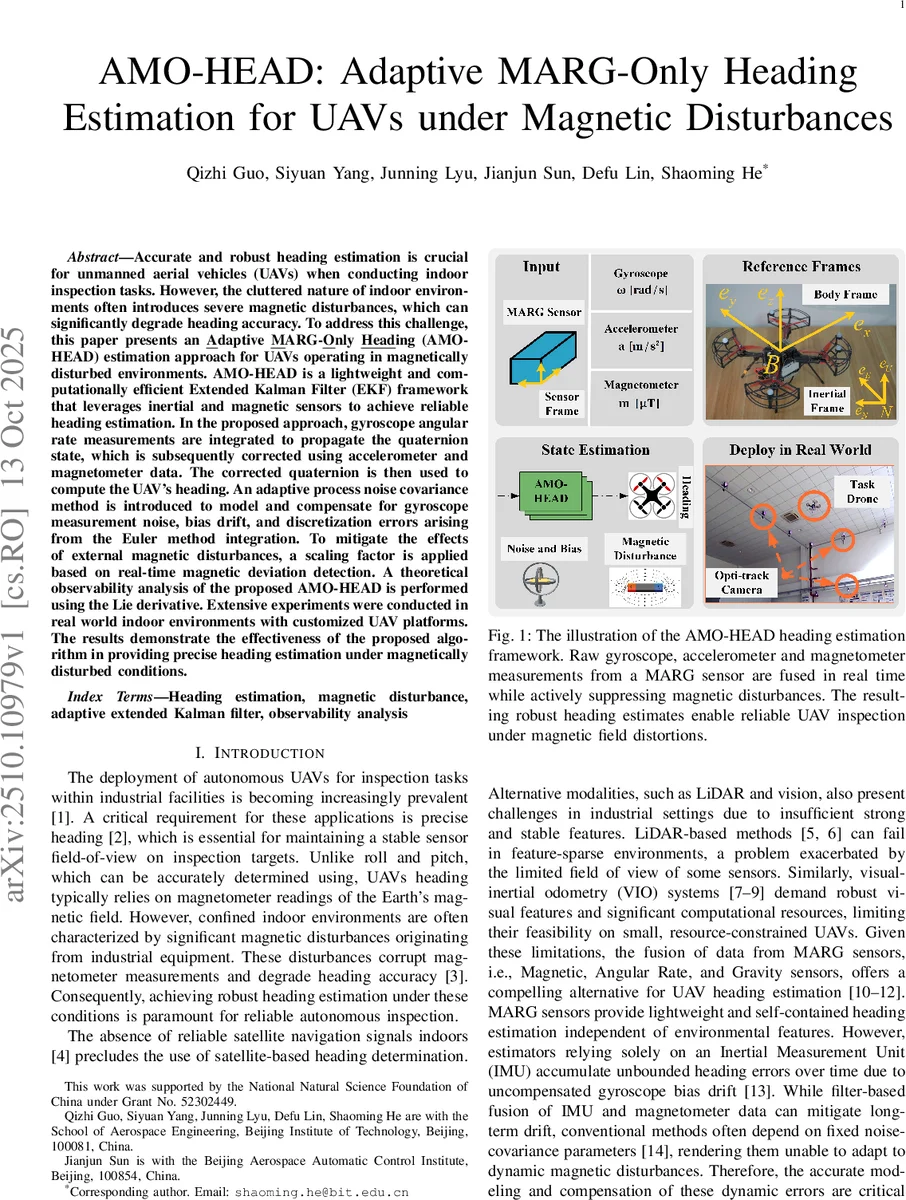
Accurate and robust heading estimation is crucial for unmanned aerial vehicles (UAVs) when conducting indoor inspection tasks. However, the cluttered nature of indoor environments often introduces severe magnetic disturbances, which can significantly degrade heading accuracy. To address this challenge, this paper presents an Adaptive MARG-Only Heading (AMO-HEAD) estimation approach for UAVs operating in magnetically disturbed environments. AMO-HEAD is a lightweight and computationally efficient Extended Kalman Filter (EKF) framework that leverages inertial and magnetic sensors to achieve reliable heading estimation. In the proposed approach, gyroscope angular rate measurements are integrated to propagate the quaternion state, which is subsequently corrected using accelerometer and magnetometer data. The corrected quaternion is then used to compute the UAV’s heading. An adaptive process noise covariance method is introduced to model and compensate for gyroscope measurement noise, bias drift, and discretization errors arising from the Euler method integration. To mitigate the effects of external magnetic disturbances, a scaling factor is applied based on real-time magnetic deviation detection. A theoretical observability analysis of the proposed AMO-HEAD is performed using the Lie derivative. Extensive experiments were conducted in real world indoor environments with customized UAV platforms. The results demonstrate the effectiveness of the proposed algorithm in providing precise heading estimation under magnetically disturbed conditions.
💡 Research Summary
The paper addresses the critical problem of heading estimation for unmanned aerial vehicles (UAVs) operating in indoor environments where magnetic disturbances are severe and satellite navigation is unavailable. Traditional heading estimators that rely on magnetometers suffer from large errors when the local magnetic field is distorted by metallic structures or electronic equipment. To overcome these limitations, the authors propose AMO‑HEAD (Adaptive MARG‑Only Heading), a lightweight Extended Kalman Filter (EKF) that fuses only the data from a MARG sensor suite (magnetometer, gyroscope, accelerometer) and adapts its noise models in real time.
The state vector consists of a unit quaternion representing the UAV orientation and the gyroscope bias (seven dimensions). Quaternion propagation follows the continuous‑time kinematic equation (\dot q = \frac12\Omega(\omega)q). For discrete implementation, the authors adopt an Euler approximation but augment the propagation model with a process noise term that captures two distinct sources: (1) gyroscope measurement noise, modeled as a zero‑mean Gaussian with covariance (Q_{\omega,t}); and (2) discretization error from the Euler method, modeled as a zero‑mean Gaussian with covariance (Q_{int,t}). Both covariances are updated online using a sliding window of recent gyroscope residuals, allowing the filter to track changes in sensor noise, bias drift, and integration error without manual tuning.
The measurement model stacks accelerometer and magnetometer readings and relates them to the quaternion through the rotation matrix (C(q)). To mitigate magnetic disturbances, the algorithm monitors the magnetometer residual (\tilde m = y_m - C(q)m). When the residual magnitude exceeds a threshold, the magnetometer measurement covariance (R_m) is scaled by a factor (\alpha_t = 1 + \kappa|\tilde m|). This adaptive scaling reduces the influence of corrupted magnetometer data while preserving the contribution of the accelerometer, which remains reliable for roll and pitch.
A theoretical observability analysis is performed using Lie derivatives. The authors construct the observability matrix for the nonlinear system and prove that it is full rank globally, confirming that both orientation and gyroscope bias are observable under the proposed measurement scheme.
Experimental validation is carried out on custom UAV platforms equipped with a commercial MARG sensor. Tests are conducted in cluttered indoor spaces containing metallic structures and active electronic devices. Ground truth orientation is obtained from an external motion‑capture system. The proposed AMO‑HEAD is benchmarked against a conventional EKF with fixed covariances, an Unscented Kalman Filter (UKF), and a recent complementary filter. Results show that AMO‑HEAD achieves average heading errors below 1.2°, significantly outperforming the baselines, especially during periods of rapid magnetic field variation where other methods exhibit error spikes. Computational profiling indicates an average update time of 0.8 ms on an embedded microcontroller, confirming suitability for real‑time deployment on resource‑constrained UAVs.
In summary, the key contributions of the work are: (1) an adaptive process‑noise model that simultaneously accounts for gyroscope noise, bias drift, and integration error; (2) a real‑time magnetometer covariance scaling mechanism that robustly suppresses magnetic disturbances; (3) a rigorous Lie‑derivative based observability proof; and (4) a lightweight implementation that runs in real time on embedded hardware. AMO‑HEAD thus provides a practical, training‑free solution for reliable heading estimation in magnetically disturbed indoor UAV applications.
Comments & Academic Discussion
Loading comments...
Leave a Comment