Atomic Observables Induced by Cosmic Fields
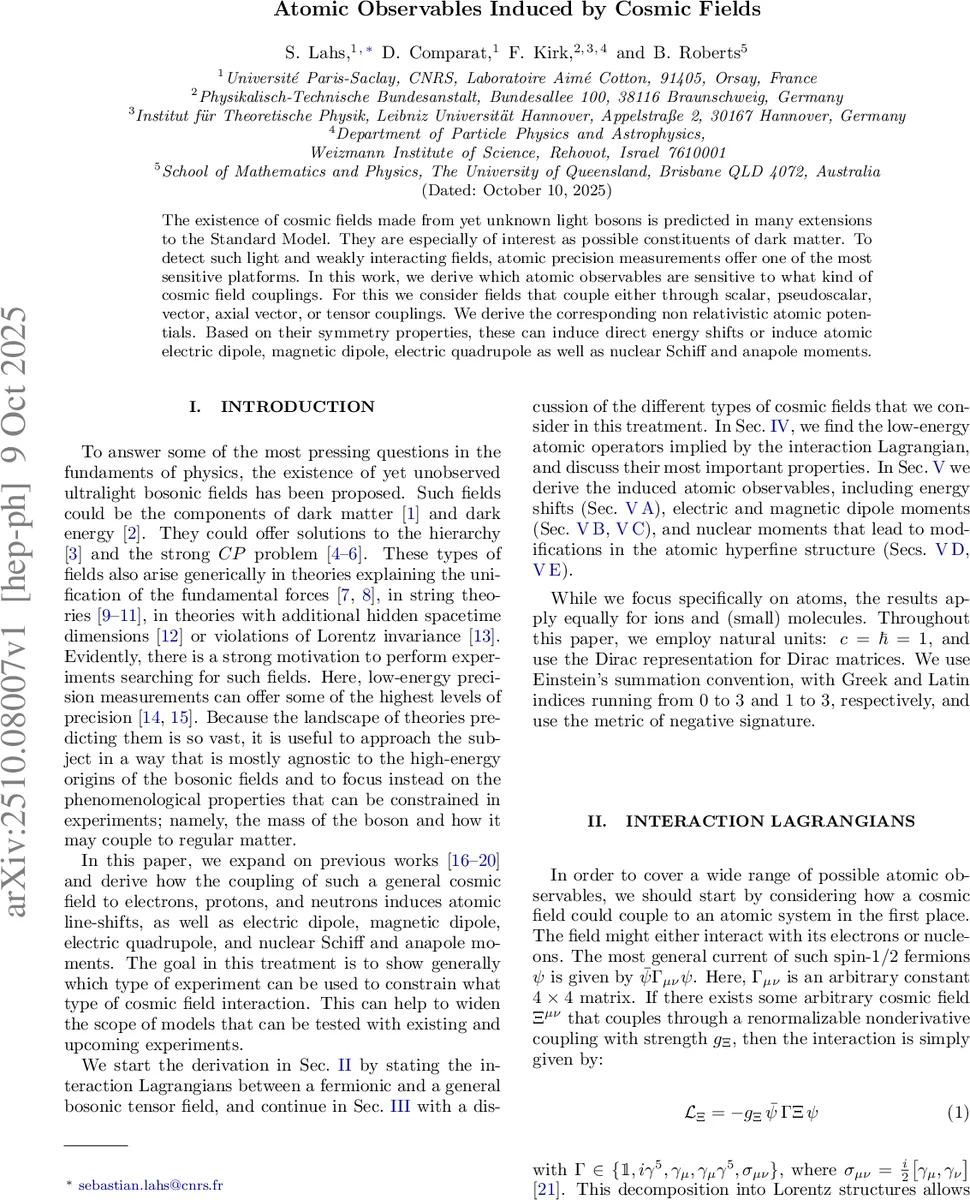
The existence of cosmic fields made from yet unknown light bosons is predicted in many extensions to the Standard Model. They are especially of interest as possible constituents of dark matter. To detect such light and weakly interacting fields, atomic precision measurements offer one of the most sensitive platforms. In this work, we derive which atomic observables are sensitive to what kind of cosmic field couplings. For this we consider fields that couple either through scalar, pseudoscalar, vector, axial vector, or tensor couplings. We derive the corresponding non relativistic atomic potentials. Based on their symmetry properties, these can induce direct energy shifts or induce atomic electric dipole, magnetic dipole, electric quadrupole as well as nuclear Schiff and anapole moments.
💡 Research Summary
The paper “Atomic Observables Induced by Cosmic Fields” provides a comprehensive, model‑independent framework for connecting a broad class of hypothetical light bosonic fields—scalar, pseudoscalar, vector, axial‑vector, and rank‑2 tensor—to measurable atomic‑scale effects. The authors begin by writing the most general renormalizable interaction between a spin‑½ fermion (electron, proton or neutron) and an external bosonic field (\Xi_{\mu\nu}) as (\mathcal L_{\Xi}= - g_{\Xi},\bar\psi \Gamma_{\Xi}\psi), where (\Gamma_{\Xi}) runs over the five Lorentz structures ({1,i\gamma_5,\gamma_\mu,\gamma_\mu\gamma_5,\sigma_{\mu\nu}}). This yields five distinct Lagrangians for a scalar (\phi), a pseudoscalar (a), a vector (A’\mu), an axial‑vector (Z’\mu) and a tensor (\Theta_{\mu\nu}), each with its own coupling constant.
The authors then classify cosmic fields into three phenomenological types. Type I are static, homogeneous backgrounds (e.g., SME Lorentz‑violation coefficients). Type II are coherent oscillations of a light bosonic dark‑matter condensate, described by plane‑wave solutions (\propto \exp
Comments & Academic Discussion
Loading comments...
Leave a Comment