Spin Seebeck Effect of Triangular-lattice Spin Supersolid
Using thermal tensor-network approach, we investigate the spin Seebeck effect (SSE) of the triangular-lattice quantum antiferromagnet hosting spin supersolid phase. We focus on the low-temperature scaling behaviors of the normalized spin current across the interface. For the 1D Heisenberg chain, we find a negative spinon spin in the bulk current with algebraic temperature scaling; at low fields, boundary effects induce a second sign reversal at lower temperatures. These benchmark results are consistent with field-theoretical analysis. On the triangular lattice, spin frustration dramatically enhances the low-temperature SSE, with distinct spin-current signatures – particularly the sign reversal and characteristic temperature dependence – distinguishing different spin states. Remarkably, we discover a persistent, negative spin current in the spin supersolid phase, which saturates to a non-zero value in the low-temperature limit and can be ascribed to the Goldstone-mode-mediated spin supercurrents. Moreover, a universal scaling $T^{d/z}$ is found at the U(1)-symmetric polarization quantum critical points. These distinct quantum spin transport traits provide sensitive spin current probes for spin supersolid states in quantum magnets such as Na$_2$BaCo(PO$_4$)$_2$. Furthermore, our results also establish spin supersolids as a tunable quantum platform for spin caloritronics in the ultralow-temperature regime.
💡 Research Summary
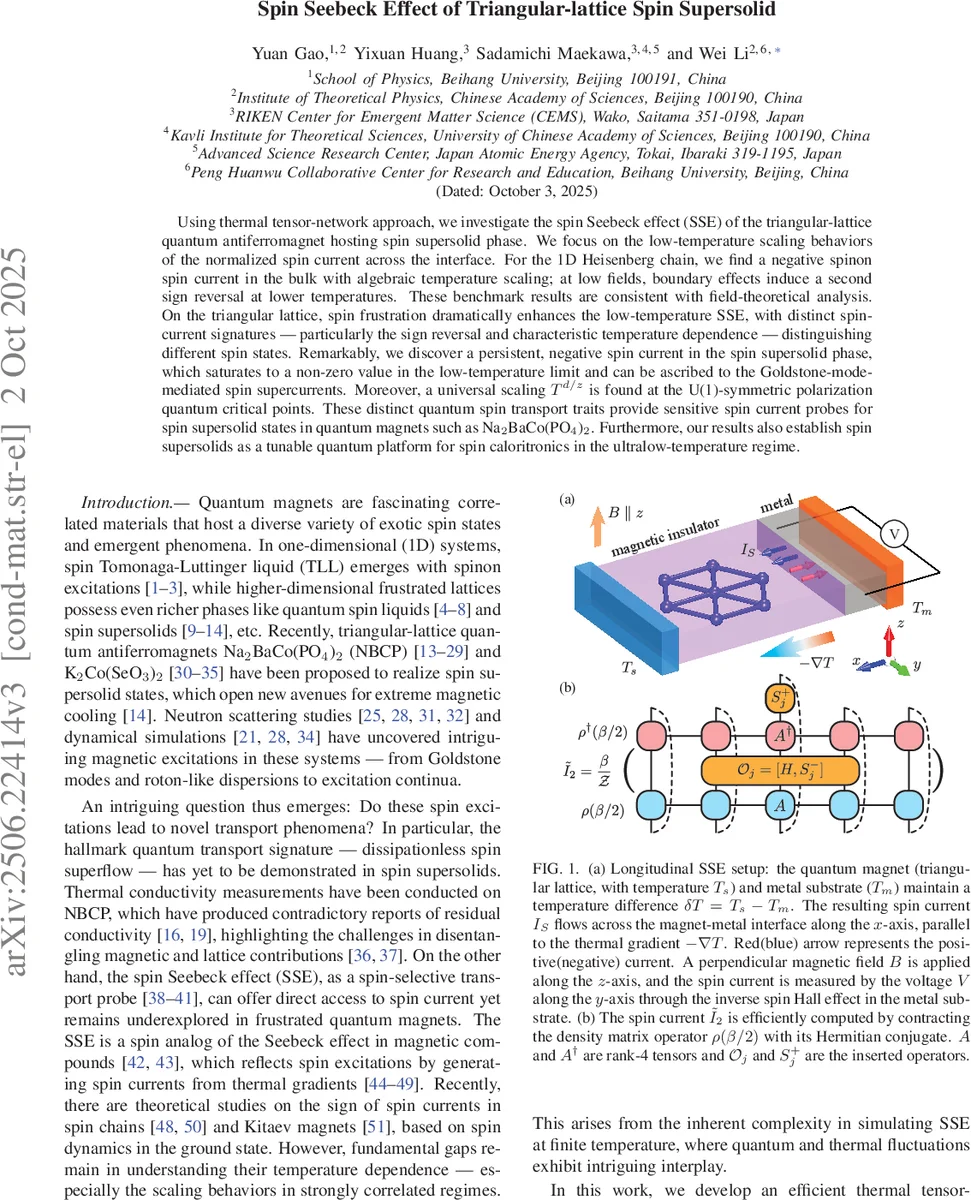
In this work the authors develop a thermal‑tensor‑network (tanTRG) framework for computing the spin Seebeck effect (SSE) in quantum magnets, focusing on the low‑temperature scaling of the normalized spin current that flows across a magnet–metal interface under a temperature gradient. Starting from the non‑equilibrium Green’s‑function expression
(I_S = -A,\tilde I_S,\delta T) with
(\tilde I_S = Z\int_{-\infty}^{\infty} d\omega,k^2(\beta\omega),\mathrm{Im},\chi^{-+}{\rm loc}(\omega)),
the authors emphasize that the kernel (k(x)=x/\sinh(x/2)) weights low‑frequency spin dynamics and that the temperature dependence of the local dynamical susceptibility (\chi^{-+}{\rm loc}) must be treated explicitly. By expanding (\mathrm{Im},\chi^{-+}{\rm loc}(\omega)=\sum{n\ge1} f_n \omega^n/n!) and noting that the even‑parity kernel selects the (f_2) term, they obtain the leading low‑temperature behavior (\tilde I_S\sim f_2/\beta^3), i.e. a linear‑in‑(T) scaling when (\omega) is small compared with temperature.
The method is first benchmarked on the isotropic 1D Heisenberg chain ((J_{xy}=J_z=1)). For a magnetic field (B=1) (Tomonaga‑Luttinger‑liquid phase) the spin current follows (|\tilde I|\propto T^{\alpha}) with (\alpha\simeq1), reflecting the gapless spinon excitations. At the polarization quantum critical point (QCP) (B_c=2) the authors recover the universal scaling (\tilde I\propto\sqrt{T}), consistent with the expected (T^{d/z}) law for (d=1) and dynamical exponent (z=2). Moreover, for very small fields ((B\ll J)) a second sign reversal appears at lower temperatures, originating from boundary contributions that dominate over bulk spinon currents—an effect previously predicted by field‑theoretical analyses.
The main focus then shifts to a frustrated triangular‑lattice antiferromagnet (TLAF) that hosts a spin‑supersolid phase. Using experimentally motivated parameters for Na(2)BaCo(PO(4))(2) (NBCP), namely (J{xy}=0.88) K and (J_z=1.48) K, the authors map out four distinct magnetic phases: supersolid‑Y (SSY), up‑up‑down (UUD) plateau, supersolid‑V (SSV), and a fully polarized (PL) regime, separated by three quantum critical fields (B{c1}\approx0.35) T, (B{c2}\approx1.15) T and (B_{c3}\approx1.69) T. The computed normalized spin current (\tilde I_2) displays characteristic sign patterns: both supersolid phases exhibit a negative current that, upon cooling, saturates to a finite non‑zero value; the UUD plateau shows an exponential suppression of the current at low (T) due to its gap; the PL phase retains a positive current across the whole temperature range.
To understand the sign reversal in the supersolid, the authors decompose the local operator driving the current, (O_j=
Comments & Academic Discussion
Loading comments...
Leave a Comment