Frequency Switching for Simultaneous Wireless Information and Power Transfer
A new frequency switching receiver structure is proposed for simultaneous wireless information and power transfer in multi-carrier communication systems. Each subcarrier is switched to either the energy harvesting unit or the information decoding uni…
Authors: Dogay Altinel, Gunes Karabulut Kurt
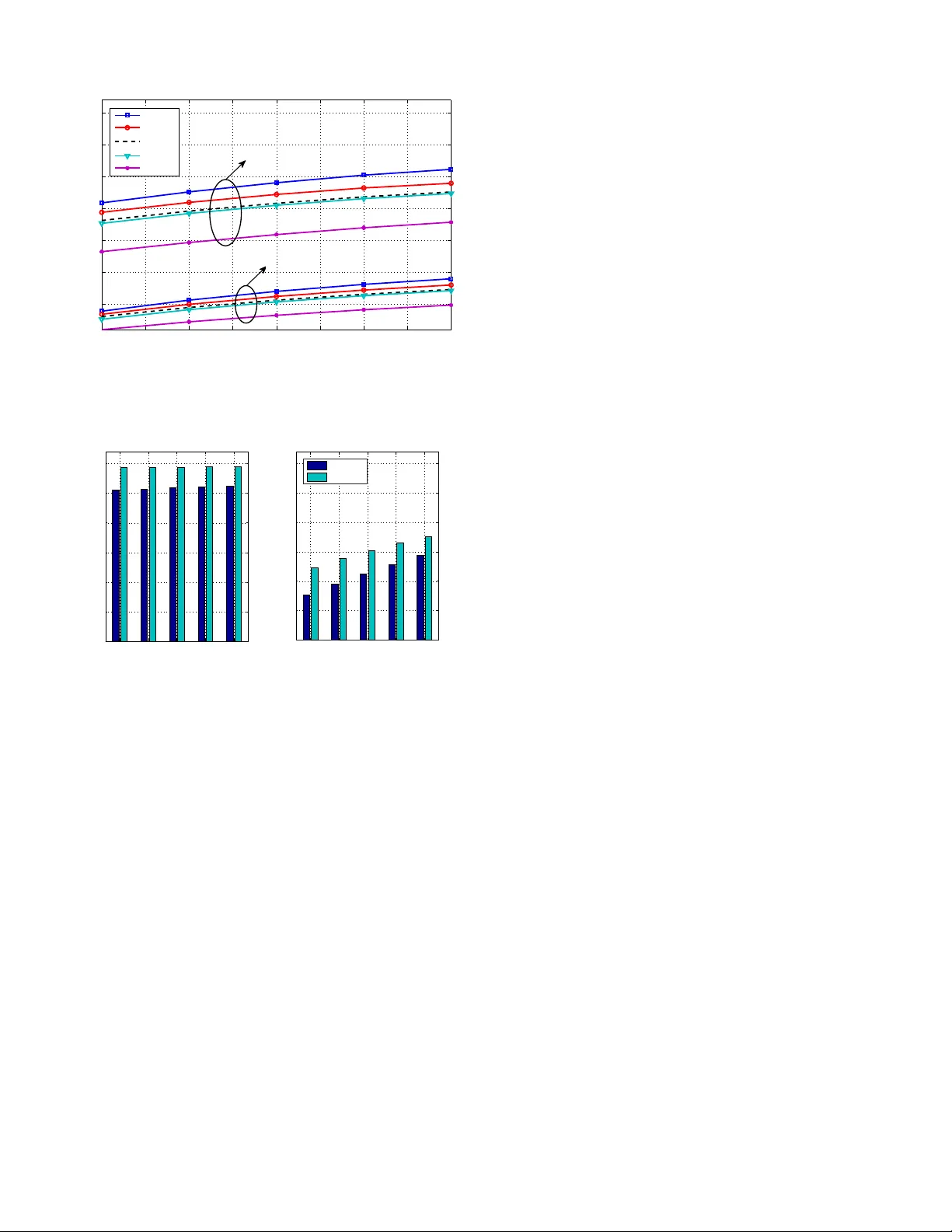
Frequenc y Switching for Simultaneous W ireless Information and Po wer T ransfer Dogay Altinel ∗ ∗∗ , Gunes Karabulut Kurt ∗ ∗ Department of Electronics and Communication Engineering, Istanbul T echnical Univ ersity , T urkey ∗∗ Department of Electrical and Electronics Engineering, Istanbul Medeniyet Uni versity , T urkey dogay .altinel@medeniyet.edu.tr , { altineld, gkurt } @itu.edu.tr Abstract —A new frequency switching receiver structure is proposed for simultaneous wireless information and power trans- fer in multi-carrier communication systems. Each subcarrier is switched to either the energy harv esting unit or the information decoding unit, according to the optimal subcarrier allocation. T o implement the system, one-bit feedback is required f or each subcarrier . T wo optimization pr oblems are defined, con verted to binary knapsack problems, and solved using dynamic program- ming approaches. Upper bounds are obtained using continuous relaxations. P ower allocation is integrated to further increase the performance. Numerical studies sho w that the proposed frequency switching based model is better than existing models in a wide range of parameters. Index T erms —RF energy harvesting, simultaneous wireless information and power transfer (SWIPT), frequency switching, multi-carrier , OFDM. I . I N T R O D U C T I O N Simultaneous wireless information and po wer transfer (SWIPT) concept, which is recently developed in the liter- ature, integrates wireless power transfer to communication technologies [1]. The main goal of SWIPT is to provide energy to the receiv er by means of radio frequency (RF) signals captured from the transmitter , while transmitting information. Actually , the process of decoding information and harvesting energy from the same RF signal simultaneously is not possible for practical circuits. In [2], time switching (TS) and power splitting (PS) based practical receiver designs are proposed for the co-located receivers. In TS designs, the receiver antenna switches between the energy harvester and the information decoder according to a time schedule. On the other hand, in PS designs, the receiv ed radio signal is divided into two signals with desired powers for the energy harvester and the information decoder . In [3], dynamic PS operation scheme is proposed for separated and integrated receiver architectures. In multi-carrier communication (MCC), the av ailable band- width is divided into a number of narrowband subcarriers to obtain flat channels and high data rate. Based on nar- rowband subcarrier structure, MCC is an appropriate tech- nique for SWIPT systems. In this context, in [4], a dual- antenna mobile architecture and a framework are presented for realizing SWIPT in broadband wireless systems. In [5], an algorithm is proposed to optimize TS and power allocation jointly for multi-carrier relay network. While these works exploit frequency div ersity in multi-carrier based approaches Fig. 1. System model for simultaneous wireless information and power transfer with FS receiver . to improve the efficienc y , they use PS or TS techniques to share the received signal between the information decoder and the energy harvester . In [6], in order to exploit frequency div ersity , the subcarrier seperation scheme is proposed in a multiuser OFDM system. Although the transfer of information and power on different subcarriers is adopted in [6], the structure and implementation model of receiv er is not given. Additionally , the maximization of total harvested po wer under the channel capacity constraint is not considered. In this paper, we propose a new receiv er structure making use of frequency switch (FS) to improve the performance of SWIPT in MCC systems, using one-bit feedback per subcarrier . W e define two different optimization problems, based on the power and channel capacity requirements of the system, and con vert them to binary knapsack problems that can be addressed using dynamic programming approaches. W e also provide upper bounds for the achiev able information and power transfer limits. W e then optimize transmit power lev els to further improve the performance. Numerical results are provided and compared with TS and PS based receivers. I I . S Y S T E M M O D E L A N D R E C E I V E R S T RU C T U R E The considered MCC system consists of a transmitter and a receiv er , as illustrated in Fig. 1. The transmitter sends both information and power in the same multi-carrier symbol to the receiv er that is equipped with both an information decoder and an energy harvester . Assuming K subcarriers that are non- Fig. 2. Internal structure of the proposed frequency switch. Band pass filter for each subcarrier is denoted by BPF k , k = 1 , 2 , . . . , K . Here, SA, ID, and EH represent subcarrier allocation, information decoder, and energy harvester , respectiv ely . ov erlapping in the frequency spectrum, the receiv ed symbol on the k th subcarrier can be modeled as Y k = p P t,k H k X k + Z k , k = 1 , 2 , . . . , K. (1) Here, X k represents the transmitted symbol on the k th subcar- rier . Z k is the complex additi ve white Gaussian noise (A WGN) with zero mean and σ 2 z variance. H k is the channel coefficient affecting the transmitted symbol between the transmitter and the receiv er . W e denote the av erage transmit power on each subcarrier by P t,k , and assume that E [ | X k | 2 ] = 1 , ∀ k . E [ · ] represents the expectation operator . In the proposed FS recei ver , we target to utilize each subcarrier for either information or power transfer . The internal structure of an examplary frequency switch is shown in Fig.2. This can be realized as a filterbank [7], [8]. Since it is proven that energy harvesting is possible in baseband [3], [9], the frequency switch first performs baseband con version, then, after band pass filtering it performs switching of subcarriers to the information decoder or the energy harvester dynam- ically , depending on the subcarrier allocation (SA) scheme. The proposed receiv er can be used in filterbank multi-carrier communication (FBMC) and orthogonal frequency division multiplexing (OFDM) systems. In order to optimally allocate subcarriers to information and power transfer functionalities, we need to consider the channel capacity and the harvested power . T o identify the subcarrier set to be used for information transfer , the channel capacity ( C k ) of the k th subcarrier can be obtained as C k = B log 2 (1 + | H k | 2 γ k ) , (2) where B is the subcarrier bandwidth and γ k represents the av erage signal to noise ratio, expressed as γ k = P t,k /σ 2 z . The channel capacity is proportional to the square of channel coefficient, C k ∝ | H k | 2 γ k , in dB scale. On the other hand, to determine the subcarrier set that will be used for power transfer , we can consider the relationship between the channel coef ficient and the harvested power from k th subcarrier ( Q k ) expressed as [3] Q k = η k | H k | 2 P t,k , (3) where η k is the con version ef ficiency of RF signal to direct current signal for each subcarrier channel. The value of η k mainly depends on the design of the energy harvester , which can be around 0.5 in commercial applications [10]. It can be seen that the harvested power is also proportional to the square of channel coefficient, Q k ∝ | H k | 2 γ k , in linear scale. In the proposed system, it is assumed that the channel coefficients are av ailable at the recei ver . On the receiver side, we define an optimization problem and run a SA algorithm. The outcome of the algorithm, indicating the functionality of each subcarrier , is fed to both the frequency switch and to the transmitter using a feedback channel, requiring one- bit information for each subcarrier . Let S represents the set of subcarriers to be used for information transfer . Then, S c = { 1 , 2 , . . . , K } \ S becomes the subcarrier set to be used for power transfer . The corresponding total channel capacity ( C T ) becomes C T = X k ∈S B log 2 (1 + | H k | 2 γ k ) , (4) and the total harvested power ( Q T ) can be calculated as Q T = X k ∈S c η k | H k | 2 P t,k . (5) There is a clear tradeof f in the selection of S and S c in terms of the total channel capacity versus the total harv ested po wer . The channel coefficients and the transmit po wers have an important role on both quantities. Based on these two parameters, it can be concluded that the performance of the SWIPT system can be increased in terms of either the channel capacity or the harvested power , as will be inv estigated next. I I I . S U B C A R R I E R A L L O C AT I O N The SA problem, i.e., selection of S (or equiv alently S c ), can significantly affect the performance of the SWIPT system and can be formulated as an optimization problem. Here, it is assumed that the transmit powers are equal, P t,k = P t,e , ∀ k . W e concentrate on two optimization problems: maximizing the total channel capacity while harvesting a desired amount of power ( P1 ), and maximizing the total harvested power while satisfying a minimum channel capacity ( P2 ). Let s k ∈ { 0 , 1 } be an indicator function, ∀ k . s k = 1 indicates that the subcarrier is allocated for the transmission of information. Otherwise, i.e. s k = 0 , the subcarrier is used for power transmission. s c k , an indicator function for the subcarrier to be harvested, can be obtained as s c k = 1 − s k . W e can define vectors of these indicator fuctions as s = [ s 1 , s 2 , . . . , s K ] and s c = [ s c 1 , s c 2 , . . . , s c K ] . Note that s c = 1 − s , where 1 is a vector of ones of length K . The indices of ones in s ( s c ) consitute S ( S c ), respectiv ely . The first optimization problem, ( P1 ), maximizing the total channel capacity ( C T ) while harvesting a minimum power ( Q min ) can now be stated as ( P1 ) : max s K X k =1 s k C k s.t. K X k =1 s c k Q k ≥ Q min , s k , s c k ∈ { 0 , 1 } , s c k = 1 − s k . (6) The second optimization problem, ( P2 ), maximizing the total harvested power ( Q T ) while guaranteeing a mi nimum capacity ( C min ) can be formulated as ( P2 ) : max s c K X k =1 s c k Q k s.t. K X k =1 s k C k ≥ C min , s k , s c k ∈ { 0 , 1 } , s c k = 1 − s k . (7) A. Dynamic Pro gramming for Optimal Solutions Dynamic programming breaks the problem down into smaller problems, and reuses the solution of small problems stored in the memory to find the optimal solution of the main optimization problem [11]. In case of SA problems in ( P1 ) and ( P2 ) dynamic programming can be used to obtain solutions. Let the parameters of Q th = P K k =1 Q k − Q min and C th = P K k =1 C k − C min respectiv ely denote the channel capacity threshold and the harvested power threshold. ( P1 ) can be con verted to ( P1 ) : max s K X k =1 s k C k s.t. K X k =1 s k Q k ≤ Q th , s k ∈ { 0 , 1 } , (8) and ( P2 ) can be written as ( P2 ) : max s c K X k =1 s c k Q k s.t. K X k =1 s c k C k ≤ C th , s c k ∈ { 0 , 1 } . (9) W e can clearly observe that (8) and (9) become a type of the binary knapsack problem, a well-known discrete programming problem [12]. Note that in the binary knapsack problem, Q k , C k , Q th , and C th are positive integers. Howe ver , in our case, although positive, they may not always be integers. T o overcome this limitation, we scale all v alues with a proper factor . W e also assume that the threshold values in (8) and (9) are set as Q k ≤ Q th and C k ≤ C th , ∀ k . Now , the exact solution of ( P1 ) and ( P2 ) can be obtained using algorithms based on dynamic programming and branch-and- bound approach [13]. T o determine the optimal solution with dynamic programming, smaller problems can be formulated using iterations, and a recursiv e formulation for the C T ( Q T ) can be obtained [14]. Finding the optimum solutions is also possible with the brute-force approach at the expense of high computational complexity . There are 2 K possible subsets of carriers, so the complexity becomes O (2 K ) , where O ( · ) is complexity notation. Howe ver , the complexity is reduced to O ( K Q th ) (for integer values of Q th ) in ( P1 ) with dynamic programming. B. P erformance Bounds Although a closed form expression is not av ailable for (8) or (9), we can obtain an upper bound ( C up or Q up ) that ensures C T ≤ C up or Q T ≤ Q up by utilizing continuous relaxation of the binary knapsack problem [15]. For ( P1 ), the ratios of the channel capacity to the harvested power can be ordered in a decreasing manner as C l 1 Q l 1 ≥ C l 2 Q l 2 ≥ · · · ≥ C l K Q l K , (10) where l i ∈ { 1 , . . . , K } . Then, starting with subcarrier index corresponding to the largest ratio ( l 1 ) , the subcarrier channels are chosen for the transmission of information, until the critical subcarrier ( l d 1 ) . The critical subcarrier is determined as the first subcarrier that exceeds the harvested power threshold, and its index is formally stated as d 1 = min ( d : d X i =1 Q l i > Q th ) , (11) where d ∈ { 1 , . . . , K } . In case of continuous relaxation, the optimal solution for s l i ( ˆ s l i ) can be expressed as ˆ s l i = 1 , i = 1 , . . . , d 1 − 1 1 Q l d 1 K P i = d 1 Q l i − Q min , i = d 1 0 , i = d 1 + 1 , . . . , K. (12) Hence, the upper bound of the total channel capacity becomes C up = d 1 − 1 X i =1 C l i + C l d 1 Q l d 1 K X i = d 1 Q l i − Q min ! . (13) Note that the optimal solution of the continuous knapsack problem is considered as the upper bound for the optimization problem ( P1 ), where the integer constraint for s l i is relaxed. Applying the same procedure for ( P2 ), by relaxing the integer constraint for s c l i , the upper bound of the total harv ested power can be obtained as Q up = K X i = d 2 +1 Q l i + Q l d 2 C l d 2 d 2 X i =1 C l i − C min ! (14) for d 2 = min ( d : K X i = d C l i > C th ) , (15) where d 2 is the index of the critical subcarrier l d 2 for ( P2 ) according to the order in (10). I V . P O W E R A L L O C AT I O N In addition to the SA, it is possible to further increase the performance of the system model with power allocation (P A). W e optimize each P t,k value for giv en subcarrier sets according to the defined optimization problems. This scheme is referred to as subcarrier and power allocation (SP A). For ( P1 ) and ( P2 ), the optimization problems are expressed as ( P3 ) : max P t,c C T s.t. X k ∈S P t,k ≤ P c (16) according to the channel capacity and ( P4 ) : max P t,q Q T s.t. X k ∈S c P t,k ≤ P q (17) according to the harvested po wer . Here, P t,c and P t,q are the sets of transmit power values for k ∈ S and k ∈ S c , respec- tiv ely . P c and P q represent the total transmit po wer allocated to information transfer subcarriers and power transfer subcarriers, respectiv ely , P c = P t,e P K k =1 s k and P q = P t,e P K k =1 s c k . Both of ( P3 ) and ( P4 ) are conv ex optimization problems. In order to solve ( P3 ), we define the Lagrange function as L ( P t , λ ) = C T + λ ( P c − X k ∈S P t,k ) (18) where λ is the Lagrange multiplier . By differentiating the Lagrange function with respect to P t,k , we obtain P t,k = B λ ln 2 − σ 2 z | H k | 2 + , (19) where ( x ) + = max(0 , x ) , and B λ ln 2 is the water level. The solution of the optimization problem ( P4 ) is to allocate all transmit power to the subcarrier that ensures the maximum of η k | H k | 2 value. It is expressed as P t,k = ( P q , k = arg max k ( η k | H k | 2 ) 0 , otherwise (20) In case of limited transmit power value ( P t,max ) for each individual subchannel, a new constraint needs to be added to ( P4 ) as P t,k ≤ P t,max , ∀ k . ( P4 ) becomes ( P5 ) : max P t,q Q T s.t. X k ∈S c P t,k ≤ P q , P t,k ≤ P t,max , ∀ k . (21) 0 0.5 1 1.5 2 2.5 3 3.5 4 400 500 600 700 800 900 1000 1100 1200 1300 1/ σ z 2 [dB] (a) C [kb/s] P T =64 mW P T =128 mW FS−SPA PS C up − SA FS−SA TS Fig. 3. Optimal values of channel capacity for TS, PS, FS-SA, FS-SP A and C up for SA ( C up -SA) are plotted vs. 1 /σ 2 z based on the optimization problems (P1) and (P3) . P T = 64 and 128 mW . In that case, ( P5 ) is a linear programming problem and solved by the interior point method. The subcarrier powers allocated according to the P A prob- lems can be used in the SA problems. Moreover , the values of decision variables calculated as the solutions of SA and P A problems can be recursiv ely used for both optimization problems, to obtain a performance closer to the optimal so- lution. Alternativ ely , the joint subcarrier and power allocation can be considered as a future work, although it is possible to encounter higher computational complexity . V . N U M E R I C A L R E S U LT S Numerical studies are conducted to demonstrate the per- formance of the proposed SWIPT system. The results of optimization approaches are compared with TS and PS based receiv ers [2]. Monte Carlo simulations are run for 10 6 multi- carrier symbols with K = 32 subcarriers. The parameters are selected as B = 15 kHz and η k = 0 . 5 , ∀ k . The total transmit powers are P T = K × P t,e = 64 and 128 mW . The channel coefficients are Rayleigh distributed, path loss is not included. Firstly , we examine the results of ( P1 ) and ( P3 ). The minimum required power value is taken as Q min = 12 mW . For ( P1 ), the transmit power for each subcarrier is constant, P t,k = P t,e = 2 and 4 mW , ∀ k . The obtained subcarriers are used for ( P3 ). The optimal values are calculated for SA of FS (FS-SA) and SP A of FS (FS-SP A) as well as both TS and PS based recei vers. The channel capacity values versus the in verse of noise variance are shown in Fig. 3. The total channel capacity increases, in line with the upper bound in (13). From the results, it can be seen that at higher (lower) noise lev els FS-SP A(PS) provides superior performance. Considering ( P2 ) with constant transmit po wer and ( P5 ) with P t,max = 2 . 4 , 4 . 8 mW and C min = 400 kb / s, the harvested power values shown in Fig. 4 are obtained. The harvested power increases with the increase of transmit power . FS-SP A outperforms all other considered techniques. 0 0.5 1 1.5 2 2.5 3 3.5 4 20 30 40 50 60 70 80 1/ σ z 2 [dB] (b) Q [mW] P T =64 mW P T =128 mW FS−SPA PS Q up − SA FS−SA TS Fig. 4. Optimal values of harvested power for TS, PS, FS-SA, FS-SP A and Q up for SA ( Q up -SA) are plotted vs. 1 /σ 2 z based on the optimization problems (P2) and (P5) . P T = 64 and 128 mW . 0 1 2 3 4 0 5 10 15 20 25 30 1/ σ z 2 [dB] (a) average # of subcarriers for information 0 1 2 3 4 0 5 10 15 20 25 30 1/ σ z 2 [dB] (b) average # of subcarriers for power P T = 64 mW P T = 128mW Fig. 5. A verage numbers of subcarriers allocated for information transfer and power transfer are plotted vs. 1 /σ 2 z for the optimization problems (P1) in (a) and (P2) in (b), respectiv ely . P T = 64 and 128 mW . The average numbers of subcarriers allocated to information transfer and po wer transfer are shown in Fig. 5 (a) and (b), respectiv ely . For ( P1 ), the av erage number of subcarriers allocated to information transfer increases slightly with the decrease of noise variance. For ( P2 ), the av erage number of subcarriers allocated to po wer transfer rises noticeably with the reduced noise variance, as expected. V I . C O N C L U S I O N In this paper, a ne w recei ver structure is proposed to improv e the performance of SWIPT in MCC systems. The frequency switch in the recei ver forwards subcarriers to either the information decoder or the energy harvester . The optimal subcarrier selection approaches are developed to maximize the capacity or the harvested power using dynamic programming. In addition, the transmit power is optimized to increase the system performance. For the channel capacity , the proposed system model performs better than TS and PS based models particularly at high noise conditions. For the harvested power , the proposed model outperforms the existing approaches. R E F E R E N C E S [1] L. V arshney , “T ransporting information and energy simultaneously , ” in IEEE ISIT , July 2008, pp. 1612–1616. [2] R. Zhang and C. K. Ho, “MIMO broadcasting for simultaneous wire- less information and power transfer, ” IEEE Tr ansactions on W ireless Communications , vol. 12, no. 5, pp. 1989–2001, May 2013. [3] X. Zhou, R. Zhang, and C. K. Ho, “Wireless information and power transfer: Architecture design and rate-energy tradeoff, ” IEEE T ransac- tions on Communications , vol. 61, no. 11, pp. 4754–4767, Nov . 2013. [4] K. Huang and E. Larsson, “Simultaneous information and power transfer for broadband wireless systems, ” IEEE T ransactions on Signal Process- ing , vol. 61, no. 23, pp. 5972–5986, Dec. 2013. [5] G. Huang, Q. Zhang, and J. Qin, “Joint time switching and power alloca- tion for multicarrier decode-and-forward relay networks with SWIPT, ” Signal Pr ocessing Letters, IEEE , vol. 22, no. 12, pp. 2284–8, Dec 2015. [6] S. Y in and Z. Qu, “Resource allocation in multiuser OFDM systems with wireless information and power transfer , ” IEEE Communications Letters , vol. 20, no. 3, pp. 594–597, Mar. 2016. [7] P . Siohan, C. Siclet, and N. Lacaille, “ Analysis and design of OFDM/OQAM systems based on filterbank theory , ” IEEE Tr ansactions on Signal Processing , vol. 50, no. 5, pp. 1170–1183, May 2002. [8] B. Farhang-Boroujeny , “OFDM versus filter bank multicarrier, ” IEEE Signal Processing Magazine , vol. 28, no. 3, pp. 92–112, May 2011. [9] R. G. Cid-Fuentes, M. Y . Naderi, S. Basagni, K. R. Chowdhury , A. Cabellos-Aparicio, and E. Alarcon, “ An all-digital receiver for low power , low bit-rate applications using simultaneous wireless information and power transmission, ” in Proceedings of IEEE ISCAS , May 2016. [10] Powercast Corporation, http://www .powercastco.com, 2016. [11] R. Bellman, Dynamic Progr amming , 1st ed. Princeton Un. Press, 1957. [12] S. Martello and P . T oth, Knapsack pr oblems: algorithms and computer implementations . John Wiley & Sons, Inc., 1990. [13] E. Horowitz and S. Sahni, “Computing partitions with applications to the knapsack problem, ” JA CM , vol. 21, no. 2, pp. 277–292, 1974. [14] G. L. Nemhauser and Z. Ullmann, “Discrete dynamic programming and capital allocation, ” Management Sc. , vol. 15, no. 9, pp. 494–505, 1969. [15] G. B. Dantzig, “Discrete-variable extremum problems, ” Operations r esearc h , vol. 5, no. 2, pp. 266–288, 1957.
Original Paper
Loading high-quality paper...
Comments & Academic Discussion
Loading comments...
Leave a Comment