Optical selection rules of topological excitons in flat bands
Topological excitons are superpositions of electron-hole pair states, characterized by an envelope function with finite vorticity in momentum space. This vorticity is determined by the underlying topology of the electronic bands. We derive the optical selection rules for topological excitons in flat bands, considering different topological two-band models: a family of Hamiltonians with skyrmion pseudo-spin textures, the flattened BHZ model for a single spin and the flattened Haldane model. We derive the selection rules for these three models accounting for short-range interactions. We also consider the non-hydrogenic spectrum of excitons in the single-spin flattened BHZ model with Coulomb interactions. We show that for the case of two flat bands with skyrmion pseudo-spin textures, all excitons are bright, and the handedness of the light that couples to them is fixed by the vorticity of the pseudo-spin texture. For the single-spin flattened BHZ model, we show that bright excitons couple to circularly polarized light, regardless of the range of the interactions. In the flattened Haldane model, topological excitons couple to elliptically polarized light. We obtain the phase diagram for the polarization of light in this model as a function of microscopic parameters of the Hamiltonian. Our results demonstrate how band topology affects exciton properties, offering a framework for predicting light-matter interactions in topological materials with flat bands.
💡 Research Summary
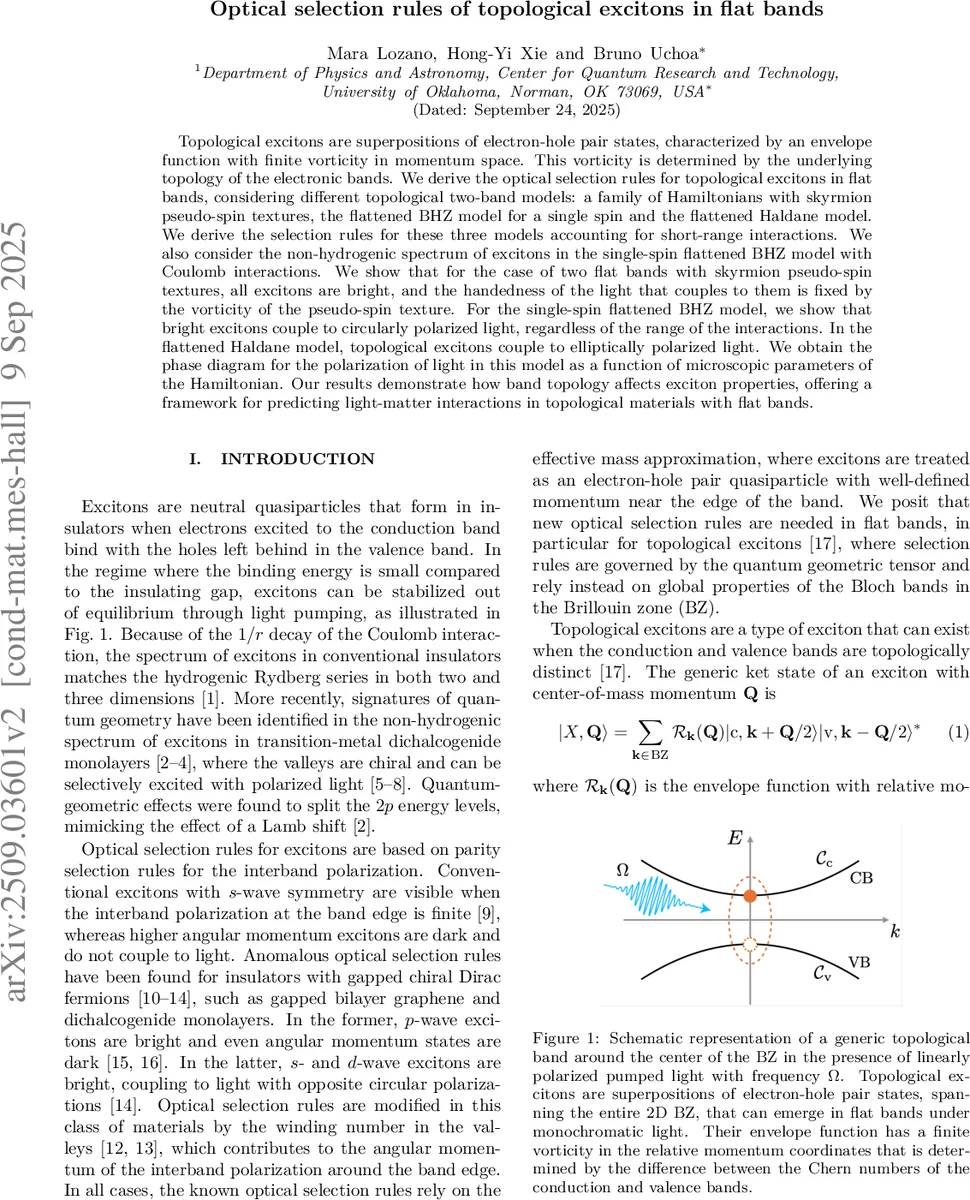
This paper presents a comprehensive theoretical study of optical selection rules for topological excitons in flat‑band systems. Topological excitons are electron‑hole bound states whose envelope functions carry a finite vorticity (winding number) ζ = C_c − C_v, set by the difference of Chern numbers of the conduction and valence bands. Because the envelope extends over the entire Brillouin zone, conventional effective‑mass approximations (which focus on states near a band edge) are inapplicable; instead, global quantum‑geometric quantities such as the interband Berry connection A_cv(k) dictate light‑matter coupling.
The authors first derive a general expression for the electric polarization induced by a monochromatic field in a two‑band flat‑band insulator. The polarization consists of a geometric term proportional to A_cv(k) and an excitonic term proportional to the envelope function R_ν(k). Their product defines an effective exciton dipole moment ℓ_ν = (eΔ/Ω) ∑_k R*_ν(k) A_cv(k). The magnitude and complex direction of ℓ_ν determine whether an exciton mode ν is bright (|ℓ_ν| ≠ 0) or dark (ℓ_ν = 0) and which polarization of light couples to it. By diagonalising the susceptibility tensor, the authors show that the bright eigenmode corresponds to the eigenvector ξ_ν,+ ∝ (ℓ*_x, ℓ*_y), while the orthogonal eigenmode is dark.
Three concrete flat‑band models are examined:
-
Skyrmion pseudo‑spin texture (NLσM minimal‑energy configuration). Here the pseudo‑spin vector d(k) winds ζ times over the Brillouin zone. The resulting ℓ_ν aligns with the winding direction, guaranteeing that all exciton bound states are bright. The handedness of the coupled circularly polarized light is fixed by the sign of ζ (i.e., the Chern number of the valence band).
-
Flattened BHZ model (single spin). This two‑band model has C_c = ±1, C_v = ∓1, giving ζ = 2. With short‑range (contact) interactions, three bound excitons appear: two bright and one dark. The bright states possess ℓ_ν ∝ (1, ± i), meaning they couple exclusively to right‑ or left‑handed circularly polarized light, with the handedness dictated by the sign of the valence‑band Chern number. The dark state has ℓ_ν = 0.
-
Flattened Haldane model. Also characterized by ζ = 2, but because the Berry curvature distribution is anisotropic, ℓ_ν becomes a generic complex vector (ℓ_x ≠ ± i ℓ_y). Consequently, bright excitons couple to elliptically polarized light. By parametrising the model with hopping amplitude t₂, phase φ, and mass term M, the authors map a phase diagram showing how the ellipticity (axis ratio and orientation) varies across parameter space, using Jones vectors to represent the polarization.
The paper then extends the analysis of the BHZ model to include long‑range Coulomb interactions. Solving the Bethe‑Salpeter (Wannier) equation with a 1/r potential yields an infinite ladder of bound exciton states, all sharing the same vorticity ζ = 2. The effective dipole moments |ℓ_ν| decay exponentially with the principal quantum number ν, so higher‑lying excitons are progressively dimmer. Importantly, no dark excitons appear in this non‑hydrogenic spectrum; every state couples to circularly polarized light, with the polarization handedness set by the band topology.
Overall, the work demonstrates that in flat‑band topological materials, optical selection rules are governed by global band topology rather than local band‑edge properties. The effective dipole moment ℓ_ν, which encodes the overlap of the exciton envelope with the interband Berry connection, serves as the decisive quantity. These findings provide a predictive framework for designing optoelectronic devices—such as polarization‑selective emitters, detectors, and switches—in systems ranging from moiré superlattices and quantum spin Hall insulators to engineered photonic lattices where flat Chern bands can be realized.
Comments & Academic Discussion
Loading comments...
Leave a Comment