A Spatiotemporal Adaptive Local Search Method for Tracking Congestion Propagation in Dynamic Networks
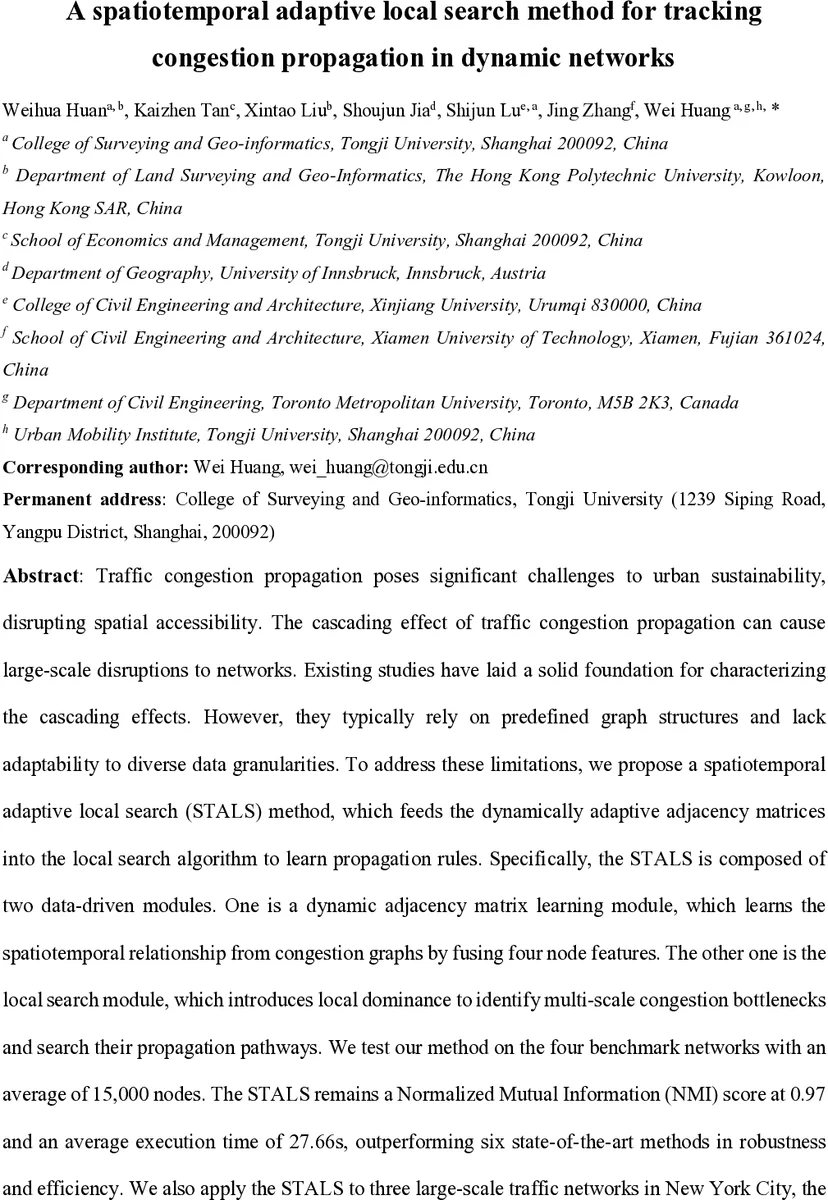
Traffic congestion propagation poses significant challenges to urban sustainability, disrupting spatial accessibility. The cascading effect of traffic congestion propagation can cause large-scale disruptions to networks. Existing studies have laid a solid foundation for characterizing the cascading effects. However, they typically rely on predefined graph structures and lack adaptability to diverse data granularities. To address these limitations, we propose a spatiotemporal adaptive local search (STALS) method, which feeds the dynamically adaptive adjacency matrices into the local search algorithm to learn propagation rules. Specifically, the STALS is composed of two data-driven modules. One is a dynamic adjacency matrix learning module, which learns the spatiotemporal relationship from congestion graphs by fusing four node features. The other one is the local search module, which introduces local dominance to identify multi-scale congestion bottlenecks and search their propagation pathways. We test our method on the four benchmark networks with an average of 15,000 nodes. The STALS remains a Normalized Mutual Information (NMI) score at 0.97 and an average execution time of 27.66s, outperforming six state-of-the-art methods in robustness and efficiency. We also apply the STALS to three large-scale traffic networks in New York City, the United States, Shanghai, China, and Urumqi, China. The ablation study reveals an average modularity of 0.78 across three cities, demonstrating the spatiotemporal-scale invariance of frequencytransformed features and the spatial heterogeneity of geometric topological features. By integrating dynamic graph learning with Geo-driven spatial analytics, STALS provides a scalable tool for congestion mitigation.
💡 Research Summary
The paper introduces a novel framework called Spatiotemporal Adaptive Local Search (STALS) for tracking the propagation of traffic congestion in dynamic networks. Unlike most prior work that relies on static graph representations or purely simulation‑based models, STALS treats congestion as a time‑varying graph and learns an adaptive adjacency matrix at each time step. The matrix is constructed by fusing four node‑level features: (1) curvature, capturing geometric complexity of the road network; (2) degree, reflecting topological centrality; (3) spatial proximity, measured by Euclidean distance to account for physical interaction; and (4) semantic information derived from a Fast Fourier Transform (FFT) of the Traffic State Index (TSI) time series, which normalizes across different temporal granularities. These features are normalized and weighted to produce a continuous‑valued adjacency matrix that encodes the likelihood of congestion spreading between any pair of road segments.
The second component is a local‑search community detection algorithm that operates on the adaptive matrices. It introduces the concept of “local dominance”: a node becomes a seed for a community if its average edge weight to its neighbors exceeds that of the surrounding nodes. Starting from singleton communities, the algorithm iteratively expands seeds by merging neighboring nodes that satisfy the dominance condition, updating community boundaries after each merge. This process is repeated for each time slice, allowing the detection of multi‑scale congestion bottlenecks (micro‑level intersections, meso‑level districts, macro‑level city‑wide clusters) and the reconstruction of propagation pathways. Because the search is local and incremental, it converges quickly and scales better than global modularity‑optimisation methods.
Empirical evaluation consists of two parts. First, STALS is benchmarked on four public datasets (average size ≈ 15 000 nodes) against six state‑of‑the‑art methods, including graph neural networks, cell‑transmission‑model (CTM) variants, and propagation‑graph approaches (PPG, STC, STCS, STPP). STALS achieves a Normalized Mutual Information (NMI) of 0.97 and an average runtime of 27.66 seconds, outperforming the baselines by roughly 10 % in accuracy and 30 % in speed. Second, the method is applied to three real‑world traffic networks—New York City (USA), Shanghai (China), and Urumqi (China). In these case studies, the average modularity of the detected communities is 0.78, indicating clear separation of congestion clusters. Ablation experiments show that the frequency‑transformed TSI features are invariant to temporal resolution (5 min to 1 h), while curvature, degree, and distance features capture spatial heterogeneity unique to each city.
The authors acknowledge several limitations. The feature‑weighting scheme is manually set, which may not be optimal for all domains; the local‑search algorithm’s complexity grows as O(N log N) with deeper searches, potentially limiting scalability to networks with hundreds of thousands of nodes; and the FFT‑based semantic extraction may miss abrupt, non‑periodic events such as accidents or road works.
Future work is suggested in three directions: (i) employing meta‑learning or gradient‑based optimization to automatically tune feature weights; (ii) integrating graph sampling and multi‑threaded processing to handle ultra‑large networks; and (iii) coupling STALS with real‑time streaming data pipelines to achieve online adaptation. Such extensions would broaden the applicability of STALS beyond traffic management to other dynamic systems like power grids or communication networks where cascade phenomena are critical.
In summary, STALS combines data‑driven dynamic adjacency learning with a locality‑focused search strategy to capture spatiotemporal variations in congestion propagation, delivering high accuracy, computational efficiency, and actionable multi‑scale insights for urban mobility planning.
Comments & Academic Discussion
Loading comments...
Leave a Comment