Limits of asymptotically Fuchsian surfaces in a closed hyperbolic 3-manifold
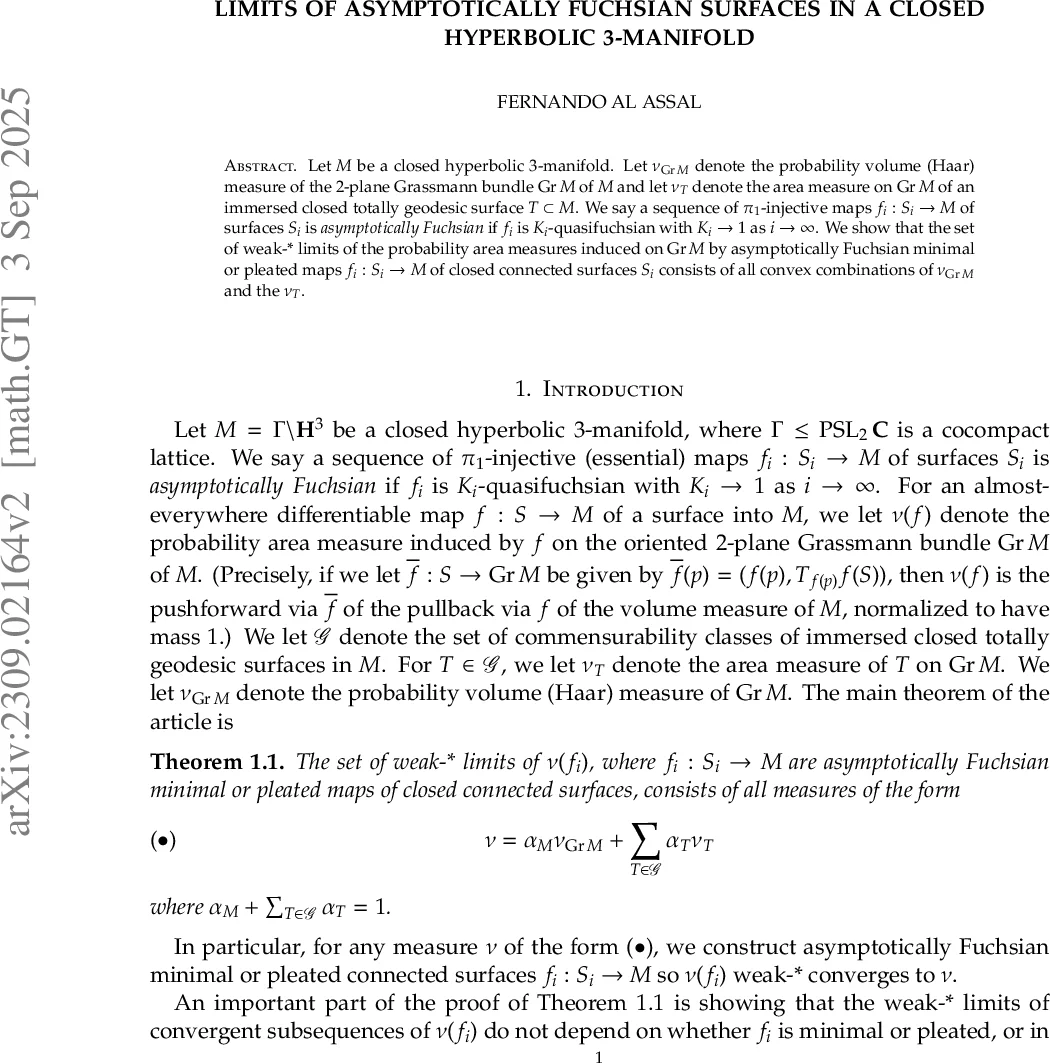
Let $M$ be a closed hyperbolic 3-manifold. Let $ν_{Gr(M)}$ denote the probability volume (Haar) measure of the 2-plane Grassmann bundle $Gr(M)$ of $M$ and let $ν_T$ denote the area measure on $Gr(M)$ of an immersed closed totally geodesic surface $T\subset M$. We say a sequence of $π_1$-injective maps $f_i:S_i\to M$ of surfaces $S_i$ is asymptotically Fuchsian if $f_i$ is $K_i$-quasifuchsian with $K_i\to 1$ as $i\to \infty$. We show that the set of weak-* limits of the probability area measures induced on $Gr(M)$ by asymptotically Fuchsian minimal or pleated maps $f_i:S_i\to M$ of closed connected surfaces $S_i$ consists of all convex combinations of $ν_{Gr(M)}$ and the $ν_T$.
💡 Research Summary
The paper investigates the limiting behavior of area measures induced on the oriented 2‑plane Grassmann bundle Gr(M) of a closed hyperbolic 3‑manifold M by sequences of π₁‑injective surface maps that become increasingly Fuchsian. A sequence {f_i : S_i → M} is called asymptotically Fuchsian if each f_i is K_i‑quasifuchsian with K_i → 1. For each map one obtains a probability area measure ν(f_i) on Gr(M) by pushing forward the normalized surface area.
The first major result (Theorem 1.2) shows that the weak‑* limits of these measures are independent of whether the surfaces are realized as minimal immersions or as pleated (bent) surfaces. The proof uses normal flow from the universal covers of the minimal or pleated surfaces into a fixed component H⁺_i of the convex core of the associated quasifuchsian group. In the minimal case, Seppi’s theorem guarantees that principal curvatures tend to zero as K_i → 1, giving uniformly small area distortion under the flow. In the pleated case, one avoids the bending lamination by flowing a definite distance η away from it; letting η → 0 yields the same limit.
Having identified a common limit for minimal and pleated realizations, the authors invoke a theorem of Lowe which asserts that the lifted measures on the frame bundle Fr(M) are invariant under the right action of PSL(2,ℝ). Ratner’s measure classification then forces any weak‑* limit to be a convex combination of the Haar probability measure ν_{Gr(M)} on the whole Grassmann bundle and the area measures ν_T supported on immersed totally geodesic surfaces T ⊂ M. Thus every limit has the form
ν = α ν_{Gr(M)} + Σ_{T∈𝔾} α_T ν_T, with α,α_T ≥ 0 and α + Σ α_T = 1,
where 𝔾 denotes a set of representatives of commensurability classes of closed totally geodesic surfaces in M. This establishes one direction of the main theorem (Theorem 1.1).
The second, constructive, direction proves that every such convex combination actually arises as a limit of asymptotically Fuchsian surfaces. The construction builds on the Kahn–Marković surface subgroup theorem and its refinement by Kahn–Wright. The basic building blocks are (ε,R)‑good pants: maps of a pair of pants whose three cuffs are sent to closed geodesics whose complex length is 2ε‑close to 2R. A crucial ingredient is the equidistribution of the “feet” of these pants in the unit normal bundle N₁(√γ) of each cuff γ (Theorem 1.3). This equidistribution is quantified by an exponential error term e^{−qR} and holds uniformly over all good cuffs.
Using one representative from each equivalence class of good pants, one first assembles a possibly disconnected surface S(ε,R). To obtain a connected surface that still uses each good pant exactly once, the authors apply the Liu–Marković gluing technique: they take N(ε,R) copies of S(ε,R) and reglue them along carefully chosen cuffs so that the resulting surface \hat S(ε,R) is connected, essential, and still asymptotically Fuchsian.
Next, the authors endow \hat S(ε,R) with a pleated structure in which each good pant is split into two ideal hyperbolic triangles. They prove that the barycenters of these triangles become equidistributed in the frame bundle Fr(M) as ε → 0 and R(ε) → ∞. This uses a generalized version of the foot‑equidistribution theorem where a continuous test function g on N₁(√γ) replaces the indicator of a set, together with Lalley’s result that cuff directions themselves equidistribute in the unit tangent bundle T¹M. Consequently, the probability area measures ν(\hat S(ε,R)) converge to the Haar measure ν_{Gr(M)}.
Finally, to realize limits that place positive weight on a specific totally geodesic surface T, the authors construct “hybrid” surfaces. They take high‑degree covers of T (which, by the work of Kahn–Marković on the Ehrenpreis conjecture, can be built from good pants) and glue them to the equidistributing surfaces \hat S(ε,R). By adjusting the proportion of the cover versus the equidistributing part, one obtains a sequence of asymptotically Fuchsian surfaces whose induced measures converge to any prescribed convex combination α ν_{Gr(M)} + Σ α_T ν_T.
In summary, the paper establishes a complete classification of weak‑* limits of area measures coming from asymptotically Fuchsian surfaces in a closed hyperbolic 3‑manifold: the limits are exactly the convex hull of the Haar measure on Gr(M) and the measures supported on totally geodesic surfaces. Moreover, it provides explicit geometric constructions—via good pants, equidistribution of feet, and hybrid gluing—that realize every point in this convex set. The work blends deep tools from hyperbolic geometry, ergodic theory (Ratner’s theorem), and recent advances in surface subgroup constructions, offering a comprehensive picture of how “nearly Fuchsian” surfaces distribute in the ambient 3‑manifold.
Comments & Academic Discussion
Loading comments...
Leave a Comment