Multi-Fidelity Space Mission Planning and Infrastructure Design Framework for Space Resource Logistics
To build a sustainable and affordable space transportation system for human space exploration, the design and deployment of space infrastructures are critical; one attractive and promising infrastructure system is the in-situ resource utilization (IS…
Authors: Hao Chen, Tristan Sarton du Jonchay, Linyi Hou
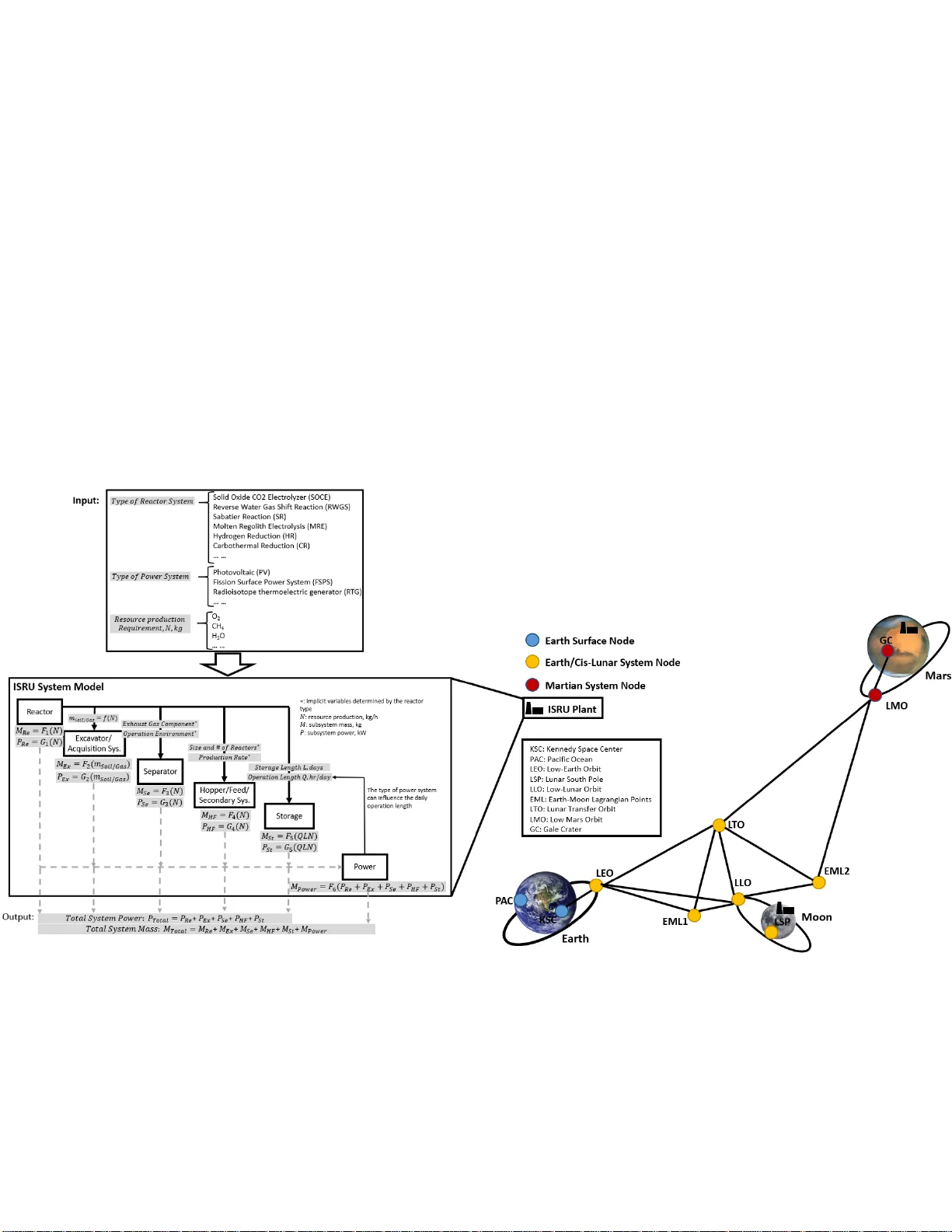
1 Multifidelity Space Mission Planning and Infrastructure Design Framework for Space Resour ce Logistics 1 Hao Chen, 2 and Tr istan Sarton du Jonchay, 3 Georgia Institute of Technology, Atlanta, GA, 30332 Linyi Hou, 4 University of Illinois at U rbana -Champa ign, Urbana, IL, 61801 and Koki Ho 5 Georgia Institute of Technology, Atlan ta, GA, 30332 To build a sustainable space transporta tion system for hum an space exploration, the design an d de ployment of space infrastructure , suc h as i n-situ resource utilization plants, in- orbit propellant depots, and on-orbit servicing platforms, are critical . T he design analysis and trade studies for t hese space infrastructure systems req uire the co nsideration of not o nly the design of the infrastruct ure elements themselves, but also their sup porting systems (e.g., storage, power) and lo gistics tra nsportation while ex ploring various architect ure options (e.g., location, technology). This paper proposes a system-level space infrastruct ure a nd logistics design optimization fra mework to perfor m architecture trade studies. A new space - infrastructure logistics optimiza tion problem formulation is proposed that considers the internal intera ctions of infrastructur e subs ystems an d their external synergistic effect s wit h space logistics simultaneously. Because th e full-size version of this proposed problem formulation can be co mputationally prohibitive, a n ew multifidelity optimization form ulation is developed by varying the g ranularity of t he commodity -t ype definition over the space logistics netwo rk; this multifidelity fo rmulation can find a n approximate solutio n to t he full- size problem computationally eff iciently w ith little sacrifice in the s olution qualit y . The 1 This p aper is a revised version of the paper AIAA 20 19 -4134 presented at the AIAA Pr opulsion and Energy 2019 Forum, Indianapolis, IN, Au gust 19 -22, 201 9. 2 Ph.D. Student, Aerosp ace Engineering, AIAA Student Member . 3 Ph.D. Student, Aerosp ace Engineering, AIAA Student Member . 4 Undergraduate Student, Aerospace E ngineering, AIAA Stu d ent Member. 5 Assistant Professor, Aerospace Engineering, AI AA Se nior Me mber. 2 proposed pro blem fo rmulation a nd method are applied to the design of in situ r esource utilization systems in a multimission lunar exploration campaign to demonstrate their values. Nomenclature A = coefficient matrix for linear pr ogramming = set of arcs = constraint vector for linear programming = continuous co mmodity set = discrete commodity set = spacecraft pa yload capacity = cost coefficient = mission demand, k g = commodity transfor mation matrix = agg r egation matri x = standard gravity, m/s 2 = concurrency constraint matrix = specific impulse , s = optimization objective = set of nodes = infrastructure po wer demand, kW = s pacecraft prop ellant capacity, kg = power system output po wer, kW = in frastructure operating len gth per so lar day , h = po wer system working time per solar day , h = commodity packi ng index sub sets = number of different t ypes of commodities = commodity index partition sub sets = spacecraft structure mass, kg 3 = set of time steps = set of spacecraft = set of time windows = variable vector for linear progra mming = commodity variable = reactor productivity, kg/h/k g plant = consumption rate , kg/h/kg plant = energy storage e fficiency = the speci fic mass of energy st orage systems = time of flight, day = change of velocit y, km/s = commodity packi ng index set = propellant mass fraction Subscripts = node index = node index = time step index = spacecraft index I. Introduction S interest gro ws in space exp loration and space econo my develop ment, the design a nd d eployment o f space infrastructure syste ms become cr itical to supp ort space resource utilization, o n-orbit servici ng, and interplanetar y space transportation . P ast space infrastructure design liter ature h as anal yzed t he s ystem perfor mance o f in -situ resource utilization ( ISRU) syste ms, pr opellant depots, o n-or bit servicing platfor ms, etc. For exa mple, the technical and economic feasibility of co mmercial propellant production b y ISRU systems has b een examined and demonstrated by industry, g overnment, and academic experts [1]. Multiple studies h ave focus ed on the chemical processes of ISRU reactor and system p roductivity, such as the hy drogen reduction reaction testbeds by NASA [2] and Lockheed Martin [3], the integrated carbothermic regolith reduction s ystem by Orbitec Inc. and Kenned y Space Center [ 4], the A 4 integrated molten regolit h electrolysis (M RE) reactor modeling method b y Schreiner [ 5 ], and the Mars ox ygen ISRU experiment by Me yen [6] . Besides I SRU , on -orbit servicin g technologies have also been develop ed in recent years [7 ,8 ] , its commercial po tentials an d operations have bee n analyzed in the literature [9-11]. Ho wever, all these referenced st udies mainly a nal yzed the feasibilit y and per formance of the space infrastructure elements , and did not take into account the co mplex logistics to deplo y and support those infrastruct ure systems. On the other ha nd, m ultiple st udies focused on space transportatio n analysis and considered space infrastructure design, such as ISRU s ystems, together with space transpo rtation system desig n. United Launch Alliance p roposed the Cislunar- 1000 proj ect to bu ild a sustai nable space eco no my b y taki ng advan ta ge of lunar water ISRU plants to produce oxygen and h ydrogen [ 12]. A series of network-bas ed space logistics opti mization methods were proposed by Ishimatsu [ 13 ], Ho [ 14 ] , and Chen [ 15 ] to solve mission planning, space i nfrastructure design, a nd spacecra ft design problems conc urrently. T heir results showed the long -ter m benefits of ISRU syste ms and propellant depots to space exploration campaigns. However, in these traditional space logistics optimization methods, referred to as th e prefixed space infrastr ucture o ptimization for mulation in this paper , the space infrastruc ture w as considered as a black bo x, and the subsystem interactions and m a ss ratios were determined before taking into account space logistics optimization [ 13 - 17 ]. They ignored the interactio n between i nfrastructure subs ystems and space tran sportation mission plan ning. Due to the i nadequate trade stu d ies between space inf rastructure design and space transportation p lanning , conventional prefixed space mission plan ning and infrastructure design ha ve only explored a limited trade space. For example, con sidering the ISRU s ystem as a b lack bo x model w o uld m iss the tradeoff between the f req uency of logistics m issio ns and its i mpact on ISRU storage system size. Namely, freq uent transp ortation missions require smaller storage subsystems b ut higher operatio n cost and complexity; whereas infrequent transportation missions require larger storage s ubsystems, which can al so lead to higher in frastructure deplo yment cost. T he con sider ation of this tradeo ff requires the modeling of ISRU infrastr ucture subsystems and its coupling with the logistics planning. Furthermore , prefixing the sp ace infrastructure design for architect ure d esign can also miss the synergistic ef fect of space infrastruct ure technolog ies and the combination o f subsystems to achieve a hybrid system desig n , particularly when different infrastruc ture technologies have common su pporting subsystems . An example is a n ISRU plant b ased on the reverse water gas shift rea ction (RWGS) and Sab atier reaction (SR). T he RWGS proce ss can be used concurrently w ith SR to pro duce sufficient oxygen so that th e generated and can be used together as propellants optimally . (The oxygen/methane bipro pellant h as been widely co nsid ered as a p ropellant option to s upport 5 future robo tic and human missions in co njunction with ISRU s ystems [ 1 8 ,1 9 ]. ) Because of the similar reactants and reaction environment, the RWGS process and the SR p rocess can share the sa me acqui sition s ubsystem ( for ), liquefication & storage sub syste m (for ), and power s ubsystem. Thus, t he SR ISRU and the RWGS ISRU need to be designed to gether for op timal performance , a nd this d esign sol ution depends o n the mission sce narios and the logistics planning (e.g., launch frequency, vehicle ty p e/size, available resources from the ground or other sources ). To resolve this challe nge e ffectivel y, a general design opti mization framework and its methods need to be develop ed to handle the synergistic ef fect of sp ace infrastructure subsyste ms and the logistics s ystem. To effectivel y e valuate the impacts of the space infrastructure design to space missions with higher fidelit y ( i.e., considering both system -level and subsystem -level tradeo ffs), we propose an interdiscipl inary space infrastructure optimization frame work and its optimization methods, leveraging n etwork-based sp ace logistics modeling . The proposed frame work enables an integrated architecture tr ade study for f uture space infrastructure , considering the coupling bet ween the subsystems desi gn a nd corresponding lo gistics planning . Our proposed fram e work ha s fo ur technical innovations. First, we propose an in ter disciplinary space infrastructure optimization formulation that considers infrastruct ure s ubsystems’ internal interactions a nd their ex ternal synergistic effects with space logistics transpor tation simultaneously . This is a new proble m in space logistics for high -fidelity space infrastructure trade studies. Second, since the full -size version of this propo sed problem for mulation can be computationally prohibitive for large -scale space infrastructure design proble ms, we develop a ne w multi-fideli ty optimization for mulation that can pr ovide an app roximat e solutio n to the f ull-size for mulation at a significantl y reduced computational cost with little sacrifice in the solution quality. The idea behind this multi -fidelity formulation is to vary the granularity of t he co mmodity type definition over the net work grap h; thi s technique is referred to as commodity packing based on its ph ysical meaning. Third, in ord er to identify where and when t o pack the co mmodities for the multi -fidelity optimization for mulation, we d evelop a prepro cessing algorith m for commodity packing. This method enables an auto mated implementation o f the multi -fidelit y formulation in the context of dyna mic generalized multicommodity network flow. Fourth, we establi sh the rel ationship b etween the solu tion s of the multi -fidelity, f ull- size, and traditional prefixed for mulation s. T his relationship enables us to find the app roximate solution o f the computationally prohibitive full-size for mulation with the k nowledge about the worst possible approximation error. Our method will enable a unique tradeoff that co uld not be p erformed with tr aditional methods. T he proposed framework can perfor m space infrastructure tech nology sele ction and system sizing for each subs ystem con sider ing 6 their interactions and logistics mission planni ng. For exa mple, we can consider the tradeo ff between the frequenc y of logistics missions a nd its impact on ISRU storage system size. Exploring t his trad eoff considering both I SRU a nd logistics m i ssion d esign concurrently ca n lead to an efficient system desi gn compared with the traditional method s considering t hese t wo separat ely. In additio n , our method can co nsider the opti mal desig n of a h ybrid infrastructure system with multiple technologies . For exa mple, for ISRU infrastructure s ystems that have co mmon reactants, reaction environments, or final p roducts like t he aforementioned SR/RWGS exa mple , the prop osed framework can co mbine multiple technolo gies into a n o ptimally integrated I SRU arc hitecture with shared subsystems. B y enablin g these new capabilities in space logistics optimization, the developed f ra mework provides an important s tep f o rward in integrated space infrastructure design and trade studies for future large-scale human space exploration. The proposed optimization f ramework can also be used as an evaluation too l to anal yze t he lo ng -term performance of spacecraft and space architectures. The remainder of this pap er is organized as follo ws. Sect ion II first in tr oduces the traditiona l prefix ed optimization formulation for space i nfrastructure design , where spac e i nfrastructure is con sidered as a black box. T hen, Sec. I II discusses the full-size versio n of the proposed space infrastruct ure optimization pro blem for mulation, taking into account spac e infrastructure subs ystems trad eoffs together with space mission plannin g co ncurrently. In Sec. IV, we propose a multi-fidelit y opti mization for mulation and its methods to re solve the computati onal challenge inherent i n the full-size for mulation . Section V demonstrates the prop osed op timization formulations through a multi-missio n human lunar exploratio n camp aign ca se study. Finally, Sec. VI summarizes t he conclusion of this paper and discusses future work. II. Traditiona l Method: Pref ixed Space Infra structure Opt i mization Formulat i on The n etwork-based space logistics optimization formulation considers space missions as co mmodity network flow problems [ 13 - 15 ], where nod es represent planets or orbits and arcs rep resent trajectories. Vehicles, p ayloads, infrastructure, and cre wmembers are all co nsidered as commodities. An example of the Earth -Moon -Mars transportation ne twork model is shown i n Fig. 1. The inputs of this infrastr ucture op timization for mulation ar e space mission dema nds and corresponding available infrastr ucture s ystems to be implemented (i.e., mainly represe nting ISRU syste ms a nd their s uppo rting structures i n this p aper). Based on the mission de mands and time window constraints, this for mulation outputs selected infrastr ucture systems to be deplo yed, including system sizing, plant 7 deployment strate gy, syste m oper ating mecha nisms, and furth er resource logistics processes if missio n de mands occur at a location different from the infrastruct ure deplo yment spot. Fig. 1 An e xample of the Earth-Moo n-Mars transpor tation netwo rk model. [ 17 ] In this space infrastructure optimization proble m, space logistics mission planning is the main goal for optimization. Fig . 1 shows an example of t he Earth-Moon-Mar s tran sportation network model. Space lo gistics optimization includes space tr ansportation scheduling and space infrastructure deployment strategy optimization . The space inf rastructure subsystem interactions are deter mined in advance b efore s pace logistics optimization. The optimizer of this for mulation o nly find s the optimal total mass of the space infrastructure, where the mass ratios between subsystems ar e fixed. Let us first define a time-exp anded network graph b y a set of arcs, , where is a set of nodes (index: , ), and is a set of time steps (index: ). We also need a set of ava ilable spacecraft ( index: ) as transportation ve hicles d uring spac e missions. There are t wo types of ar cs i n the network: 1) transportation arcs to connect different nodes at d ifferent time steps rep resenting sp aceflights in space transpo rtation; 2) holdover arcs to connect the same nodes at d ifferent time steps representing operation activities after inf r astr ucture deployment. Then, we define a commodity flow variab le vector , representing the co mmodity flow from node to node at time using spacecraft . Note that t his represents the mass right aft er departing node , and thus it is o ften mentioned as an o utflow in the liter ature. Each ele ment of t he commod ity flow variable vector corresponds to one t ype o f 8 commodity, and it can b e either continuous or d iscrete (i.e., integer) dep ending on the corr esponding co mmodity; the former commodity set (i.e., co ntinuous co mm odity set) is defined as , and the latter commodity set (i.e., discrete commodity set) is defined as . For exam ple, the number of spac ecraft and cre w member s are integers while the mass of p ropellant and p ayload are continuous. De fine a demand p arameter , which is deter mined b y mission scenarios. Mission de mands are negative and mission supplies ar e posi tive. We also need to define a cost coefficie nt, , for each co mmodity to measure the space mission co st. I f th ere are types o f co mmodities in the space mis sion, , , and are all vectors. Aside from the notations de fined above, we also need to define the follo wing parameters: 1) = Time of flight along arc to . 2) = Commodity transfor mation matrix. 3) = Concurrency constrain t matrix. 4) = Time windows o f spaceflight along arc to . Then, the formulation of the p refixed space i nfrastructure opti mization for mulation can be written as follows. Minimize: Subject to: A. Objectiv e Function Equation (1a) is the ob jective function that minimizes the total m i ssion co st t hroughout th e w h ole s pace cam paign. Different types of missio n objectives can be implemented dep ending on the mi ssion performance me tric. B. Mass Balan ce Constraint 9 Equation (1b) is the mass b alance constrai nt that guarantees mission de mands are always satisfied at node . T his constraint contains an inequa lity rather than eq uality to allo w the po ssibility of d umping co mmodities out of the logistics system. In this constraint, the second term represents the outcome of t he co mmodity transfor mation pr ocess from node to node during spaceflights or mission operatio ns. T he transformation includ es propellant burning that consumes prop ellant d uring sp aceflights, cre w consumptions that include food , water, and oxygen, and resource productions (e. g., pro pellant) by space infra struct ure s ystem s. T he matrix is the transfor mation matrix. After the transformation proce ss, the commodities flo w into node as c ommodity inflows. To illustrate the settings of the transf o rmation matrix , tw o examples are shown in the f ollowing. One example is about propellant burning and another one is about space infrastructure resource productions. First, define a commodity inflow variab le as, For propellant burning pr ocess, define the co mmodity flow variab les as, Then, we can express the i mpulsive propellant cons umption as follo ws: In Eq. (2), is the spacec raft st ructure mass ; note that, is in the unit o f the number of spacecraft and needs to be converted into t he mass in kilo grams. The pro pellant mass fraction is defined from the r ocket equation, , where is the cha nge of veloci ty for the spaceflight, is the sp ecific impulse, and is the stan dard gravity. For space infrastructure reso urce pro ductions, we use lu nar water IS RU as an exa mple. The water ISRU will first extract water from lunar r egol ith and then electrol yze water to generate and . Define the commodit y flow variables as 10 Then, we can express the IS RU pr oduction process for o ne hour for and as follows: In Eq. (3 ), there are three constraints. The first two constraints rep resent the ISRU prod uction for and for one hour, where is the ISRU plant productivit y, representing the amount o f reso urce generation per hour per unit mass of the ISRU plan t. T he last constraint means the ISRU p lant system mass does not cha nge during the production process. C. Concurrency Constraint Equation ( 1c) is the concurrenc y co nstr aint d enoting co mmod ity flow b ounds . In this constraint, is the number of concurrency co nstraints to be considered . To illustrate the settings o f the concurrency co nstraint m atrix , two examples are sho wn a s follows. O ne example is the co nstraints from sp acecraft propellant and pa yload ca pacities . Another exa mple is the non-negati vity of co mmodity variab les. For spacecraft pr opellant and p ayload cap acities, we define the commodit y flow variables as, Then, we can express the spac ecraft pa yload and propellant cap acities as follows, where and are the pa yload an d pr opellant cap acities of spac ecraft , respectivel y. Note that , both and are spacecraft design para meters that also can be considered as design variables in the op timization, which will make the problem an in tegrated space mission planni ng and spacecraft design prob lem. In this scenario, the co ncurrency constraint has quadratic terms and the spacecraft desi gn model may also be nonlinear. T his nonlinear problem can be solved effectively using a pi ecewise- linear approximation method as sho wn in Ref. [ 15 ] . For this research, t he 11 spacecraft design is not co nsider ed as part of the optimizatio n. T hus, the values of and are both constants in the formulation. For the non-negativity of co mmodity inflow variables, we have, which is equivalent to, In this constraint, the concurrency co nstraint matrix corresponds to the ne gative of the tr ansformatio n constraint matrix , . It guara ntees the feasibility o f com modity transfor mations during sp aceflights o r surface system operation. D. Time Window Constraint Equation (1d) is the time windo w constrai nt on rocket launch and spaceflig ht. Onl y when the time windows ar e open, are sp aceflights and mission op erations per mitted. Oth erwise, the commodit y flow variable is set to be zero . E. Lim itations of the Tradition al Fo rmulation In this traditional space infrastructure opti mization formulation, the i nfrastructure subsystem d esigns are determined in ad vance. Space logistics op timization only identifies the optimal total size o f the space infrastructu re in space missions and ca nnot optimize the mass ratio b etween subsystems. It ignores the interaction bet ween spac e infrastructure subsystems a nd space logistics tran sportation planning. T his formulation is not able to per form sufficient trade studies for i nfrastructure technology selection s and identify technolog y gaps. III. Full-Size Spac e I nfrastru cture Optimizat ion Formulation To increase the space infrastructure design fidelit y and ta ke into ac count the detailed inter actions bet ween sp ace infrastructure subsystems and space lo gistics transportation, this section introduce s a newly developed full-size space infrastructure o ptimization formulation t hat con siders all infrastructure subsystems separatel y throughout the space campaign. As shown in Fig. 2, there are tw o main co mponents to be optimized in the full-siz e space infrastructure optimization formulation. The first component is the sa me as the prefixed space infrastructure optimization formulation, a s s hown o n th e right side of Fi g. 2. It considers space transportation mission plannin g, space 12 infrastructure dep loyment strategy, and reso urce lo gistics after pr oduction. The seco nd component is the sp ace infrastructure trade studies, as sho wn in the left side of Fig. 2. It considers the internal tradeoffs a mong space infrastructure subsystems and their external interactions with space transportation to pr ovide infrastructure su bsyste m sizing and tech nology selections. In this paper, we use ISRU system s as an exa mple o f multi-subsyste m space infrastructure op timization, although the proposed method can b e generall y implemented in d ifferent t ypes of space infrastructure design trade studies. There are six subsystem s co nsidered in t he I SRU infrastructure model: reactor, excavator ( for soil) or acquis ition system ( for Martian at mosphere), separato r, hopper/feed/secondary subsystem, storage system, and po wer syste m. T here can be multiple d ifferent reacto rs, excavators, etc . depending o n t he ISRU technologies. T hese subsystems are all considered as different co mmodities in space lo gistics t o enab le effective analysis of subsyste m interactions. Fig. 2 An e xample of the full-size space infrastructure opti mization for mulation. The formulation of the full-size space infrastructure optimizatio n for mulation is the same as the prefixed optimization formulation, as s hown in Eqs. (1 a) -(1d). However, the co nstraints ar e interpreted and implemented in a different way because each infrastr ucture subsystem is considered separately. In the follo wing parts, we show the 13 additional relations hips to be co nsidered to enable system- level space i nfrastructure trade studies toget her with space logistics optimization. A. Objectiv e Function The obj ective function (i.e., Eq . (1a)) is exactly the same as it is in the prefixed optimization f ormulation . The only point to note is that a higher fi delity mission perfor mance m easurement model is needed in this for mulation because each subs ystem is con sidered independently. For exa mple, if a cost model is implemented in the o bjective function, then the cost model in the ful l-size optimization formulation should include the detailed cost information for each subsystem and each tec hnology. B. Mass Balance Constraint In the mass balance constraint (i.e., Eq . (1b)), we need to take into account the IS RU r esource pr oduction process from t he subsystem-level. T he same lunar water ISRU example is used to ill ustrate the differences in the settin g o f the tran sformation matrix . T here are multiple technology op tions to b uild a lunar water ISRU. In t his e xample, we a ssume that t he lunar w a ter ISRU plant is mainly m ad e up of tw o react or s: the soil/water extraction (SWE) reactor and the direct w ater electrolysis (DWE) reactor. The SWE re ac tor, , extracts w ater from lunar or Martian soil. T he DW E reacto r, , elect rolyzes water produced by the SWE reactor to generate and . We can define the com modity flow variables as, Then, we can express the IS RU pr oduction process for o ne hour for , , and as follows: In Eq. (5), there are five constraints in total. T he first two constraints represent and generations by the DWE reactor for one hour, where is the reactor pro ductivity. The third constraint illustrates consumption by the DWE reactor and production by the SWE pro cess for one ho ur, w here denotes t he cons umption rate. Bo th and are 14 nonnegative values. Note that b ecause o f the mass balance of chemical r eaction s, we have . The last t wo co nstraints show that t he masses of t he DW E reactor and the SWE reactor do not chan ge d uring the resource prod uction processes. C. Concurrency Constraint In the conc urrency constraint (i.e. , Eq. (1c)), besid es the spa cecraft pa yload a nd prop ellant cap acities considered during space transpo rtation, the resource storage capacitie s for infra structure s torage s ystems, the po wer suppl y capacities for po wer generation systems, and the ener gy storage capacities f or energy storage s ystems also need to be considered. Among t hese, the co nstraint format of re source storage cap acities is t he s ame as the co nstraints for spacecraft payload and p ropellant capacities, whic h are shown in Eq. (4 ). In t he following, we show t wo exa mples of the concurrency constraint i n the full -size op timization for mulation . One ex ample is ab out space inf rastructure power supply cap acities and another is about energy s torage capacities. For space infrastructure po wer supp ly capacities, we define the commodity flo w variables as Then, we can express the p ower suppl y capacit y constraint for infrastructure syste m design as follo ws, where is the infrastruc ture power demand of system (in kW/ kg) ; is the in frastructure operating length p er solar day, in the unit of ho urs; is the p ower generation system o utput p ower per unit mass (in kW/kg) ; is the power system working ti me per solar day. If the po wer system i s a fission surface po wer system (FSPS) or a radioisotope thermoelectric generator (RT G) , it works continuously during the space mission, which means is equal to the len gth of a solar day . If the power s yste m is a photovoltaic ( PV ) s ystem, it only works d uring the daytime, which means is equal to the daytime le ngth of a solar day at the destination. If the infrastructure system operating time is longer than the po wer system working time per solar day, which means , a n energy storage system (e.g., b attery or fuel cell) is necessar y to suppo rt the infrastructure systems. T here is an energy loss 15 during the po wer storage p rocess in batter y charging/discha rging. T herefore, we define an energy storage efficiency parameter , . To i d entify the size of the ener gy storage s ystem, a co ncurrenc y co nstraint for energy storage capacities is needed. Define the commodity flo w variables as Then, we can express the ener gy storage capac ity constraint as follo w s where is the speci fic m as s of the energy storage system, in the unit of kWh/kg. It s hows th e abilit y of energy storage per unit mass. D. Time Window Constraint The time window constraint (i.e. , Eq. (1d)) is the same as i n the prefixed opti mization for mulation. T ypically, the time windows for different space infrastructure subsystems are the same. E. Relationship with the Prefixed F ormulation It is easy to show that the solutio n from the prefixed formulation is an upper bound of that fro m the full- size formulation . This is becau se the on ly differ ence between the two f ormulations is that t he prefixed formulation fixes the m as s ratios of the infrastructure subsyste ms, whereas the f ull -size formulation allows the variation of those m ass ratios. Thus, the prefixed formulation has an equal or smaller feasible d esign space than the full -size formulation, and thus p rovide an equal or larger solution. F. Li mitations of the Full -Size Fo rmulation 16 The full-size space infrastructure op timization formulation considers all infrastruct ure subsystems as separated commodities during the en tire s pace cam paign, and this significantly increase s t he n umber of co mmodities in lo gistics optimization. Ge nerally, as a mixed-integer linear programming formulation, which is an NP -hard problem, the computational time cost incre ases exponentially as t he pro blem size increases. Studies sho wed that even for a short lunar e xploration campaign (i.e., including three lunar missions) , the concurrent op timization of spac e mission planning, spacecraft design, and spac e infrastructure design can make the network-based space logistics optimization formulation co mputationally prohibitive [ 15 ]. This caveat can m ake the full-size formulation co mputationall y intractable for long-term space m ission p lanning. I n the next section, we will propose a new approximate op timization formulation that can achie ve a significant co mputational cost savin g with little sacrifice in the solution qualit y. IV. Multi-Fidelity Spa ce Infrastructur e Optimiz ation Formulation In response to the co mputational challen ge of the full -size space infrastructure op timization for mulation, we propose a new app roximate o ptimization problem formulatio n. Our idea is to note t he f act that t he i nfrastructure subsystem d esign tr ade studies only exist at the desti nation nodes, where these subsystem s ar e deployed ; there may exist red undant commodity var iables and co nstraints in transportation arcs that can be reduced. With this idea, we develop a m echa nism to combine the inf rastructure subsystem variables into fe wer commod ity variab les during space transportation (“packing” p rocess) and separ ate these packed commodities after deliver y to the destinatio n nodes (“unpacking” pr ocess) . Namely, we vary the granularity of the co mmodity type definition over the network graph, resulting in a multi-fidelit y sp ace infrastructure optimization formulation. This for mulation can significantly r educe the number of co mmodity var iables and cor responding constraints in space logistics during space tran sportation and improve computational e fficiency. The multi-fidelity space infra structure opti mization levera ges the t heory of constraint a nd variable aggregations for a general mixed -integer linear pro gramming for mulation. For large and complex engineering pro blems, we often need to balance the accuracy of the m o del with the cost of computation. Constr aint and variable aggregation m e thods have been explicit ly or implicitly used in realistic problems, which are typically large and complex, to find surrogate models of the origi nal formulations. Zipkin [ 20,2 1] performed thor ough analys es on so lution bo unds for linear programming through con straint aggregatio n and variable aggregation, respectively , under ce rtain assumptions about the problem, although their assu mptions limit their methods’ applicabilit y to our problem . In the multico mmodity network flow context, Evans [2 2 ,2 3] developed the commodity aggregation for multico mmodity capacitated 17 transportation prob lems to find the lower b ound. More r ecently, Ho [ 24 ] also develop ed a for mulation based o n constraint ag gregation a nd va riable agg regation to enable an e fficient w ay to red uce the s ize of the time-expanded network for the generalize d multicommodit y network flow. In this section, we first discus s the general constraint and variable aggregations in linear p rogramming. T hen, we show how to perfor m a partial constraint and commodity aggr egations, referred to as com modity packing based on its physical meaning, over par ticular space transportatio n ar cs to enable a multi - fidelity optimization. We show that th e solution of this multi-fidelit y optimization for mulation pro vides a lower b ound o f that of the full -size o ptimization formulation . Furthermore, a commodity pac king pr eprocessing algorithm is also developed to enable an automatic decision on where and when to pac k the commodities . A. Constraint Aggregat ion and Variable Pack ing The commodit y variable packing is processed in t wo steps: constraint a ggregation and vari able packing. The first step, constraint aggregation, a ggregates the constraints with designated packable commodi ties into shared constraints through an aggregatio n m atrix. Then, the seco nd step, variable packing, aggregates t he packable co mmodities into shared package co mmodities. The transportation, trans formation, and flow b ounds of these co mm odities are considered together t hrough the package co mmodities. 1. Constraint Aggrega tion Consider a general (full-size) l inear progra mming formulation sho wed as follows . Formulation F1 ( Full-Size) Minimize: Subject to: where W e define an “aggregation matrix” and multiply b oth sides of the constraint Eq. (8b) by G . Then, we ca n obtain a new formulation as follo ws, 18 Formulation F2 ( Constraint Ag gregation) Minimize: Subject to: where the aggregation matrix has a size , where is th e numb er of rows in th e matrix a nd is the num b er of constraints after aggrega tion ( ), and satisfies the follo wing two conditions: Condition 1: The aggregation matrix has e xactly one nonzer o entr y per column, and that entry is positive . Condition 2: The aggregation matrix has at lea st one nonzer o entr y per row, and those e ntries ar e all positive. For these formulatio ns, w e sho w that a lo wer bound of the optimal objec tive of F1 can b e found by solvin g F2 if both problems are feasible and bounded. We first rewrite the constrai nt ( 9b ) as, The column i ndices of the po sitive e ntries in each ro w of the aggregatio n matrix define a partition of the corresponding constraints {1 ,…, m } into sets. Denote t he par tition as , where is t he set of constraint indices in the -th set. Define , which is the n umber of constraint indices in the -th set. T he partition satisfies Define , where each row of the aggregation matrix is a weighting vector, , that satisfies To aggregate and relax the constraints, we replace each subset of constrai nts by a single constraint thro ugh weighting vectors. As a result, we can write the k -th constraint after aggre gation for F1 as, 19 This constraint aggregates number of constraints in F1 w ith indices . Because all non-zero en tries in the weighting vectors are p ositive, these constraints are also r elaxed. By applying the weighing vectors to F1 , we can get a relaxed for mulation, Minimize: Subject to: By solving the for mulation ( 10 a)-( 10 b), which is equivalent to F2 , we can get a lo wer bound of F1 ’s solutio n . 2. Variable Packin g After the constraint aggre gation , we can perform variable packing to further improve computational efficienc y by reducing the number of variables. T he purpose o f this step is to find a formulation eq uivalent to F2 , but with fewer variables; this step co rresponds to packing the co mmodities . Note that, in the following d iscussion, we only co nsider the aggregation of the conti nuous co mmodity flow variables for si mplicity. Consider a variable vector as fo llows, Assume that there exists a set of ind ex set , where each set includes the packable co mmodity variable indices to be packed into one package com modity . This ind ex set satis fies The variable packing operation is defined as replacing the original variables into new variables following the conversion . In the follo wing, we show that we can find an equivalent formulation a fter perfor ming variable packing i f coefficients in F2 satis fy the follo wing t wo conditions: Condition 3 : For each index set , t here exists a constant such that for all ; 20 Condition 4 : For each index set , there exists a constant vector such that for all and for all . First, without loss o f generalit y, we con sider a case where the last variables are to be pac ked into one package co mmodity. T his corresponds to the case where and . T hus, t he e xpected variab le vector after packing is where the package co mmodity variab le . In the objective function of F2 (i.e., Eq. (9a) ), we have, From the first condition, we know that for all . Therefore, we can get Similarly, in the constrai nt of F2 (i.e., Eq. (9b )), we have From the seco nd condition, we have such that for all and for all . Therefore, we can get 21 By repeating this pr ocess, we can pack commodities into multiple package co mmodities . As a re sult, w e achieve a new formulation. Formulation F3 ( Variable Packing) Minimize: Subject to: According to the abo ve analysis, the formulation F3 is eq uivalent to F2 . In summary, we have shown how to find a lo wer-bound formulation t hrough co nstraint aggregation a nd variab le packing for general linear p rogramming pro blems. It is nec essary to first f ind the aggr egation matrix that satisfies the t wo defining properties ( i.e., conditions 1 and 2 ). T hen, w e need to identify the v ariables whose coefficients satisfy the t wo variable packing conditions (i.e., conditions 3 and 4). T his sequence can be generalize d to the commodity packing in the space logistics for mulation and for mulation F3 can be generalized to the multi-fidelity for mulation. Thus, together with the prefixed formulation disc ussed before, we have the following relatio nship: Bounding the co mputationally prohibitive full -size formulation f rom both the upper an d low er sides enables us to f ind the app roximation sol ution of the computationally p rohibitive full-size formulation with the kno wledge about the worst possible appro ximation error . B. Preprocessing Algorith m for Auto matic Co mmodity Packing in Space Logistic s A lthough the previous subsect ion showed an efficient way to pack th e co mmodities in space logistics formulation under certain co nditions, we still need a method to identify what co mmodities are able to be packed in each arc and then find the aggregation matrix to aggregate corresponding constraints so that all conditio ns are satisfied. T herefore, this su b section proposes a p reprocessing algorithm to co mpile a multi-fidelity optimization formulation a utomatically for the f ull-size space infrastructure opti mization problem. The consequent for mulation perfor ms constraint and variable ag gregations i n a subset o f net work arcs, which ac hieves a lo wer bound approxi mation of the original full- size optimization for mulation. Considering a full-size space infra structure optimization prob lem a s s hown in t he formulation (1a)- (1 d) , w e can identify the packable commodities leveraging the special structure of this formulation. In the mass balance constraints 22 (i.e., Eq. (1b )), each constraint is d esignated to gu arantee the mass balance of one ty pe of commodity. The comm o dity transformation matrix d efines the interactio ns betwee n co mmodities. To make t he co mmodities packable, they should ha ve the same transfor mation co efficients with respe ct to all other co mmodities. The concurrency constraints (i.e., Eq. ( 1c )) provide the commodity flo w upper bound b y co nsidering the to tal weights of d ifferent commodities. For exa mple, the total mass of crew, consu mables, i nstruments, a nd infrastr ucture ele ment s must be smaller or equal to the spacec raft total p ayload ca pacity; this con straint has a set of packable co mmodity weights. Therefore, the packable commodities s hould have the same weight co efficients in all concurrenc y co nstraints. After ident ifying the packable commodities, they ca n be packed directly in the concurrency constraints without an aggregation matrix. The time window co nstraints (i.e., Eq. (1d )) are also defined specifically for each type of commodity. Ho wever, b y definition, the ti me window is always the sa me for different commodities in one spec ific arc. In summary, a ccording to co nditions 3 a nd 4 in Sec . I V.A.2 , to pack the p ackable co mm odities i n space tran sportation , the associated coefficients must sati sfy the follo wing three co mmodity packing co nditions: 1) For the objective function, Eq. ( 1 a), the cost coefficients of p ackable commodities need to b e equal; 2) For the mass balance constrai nt, Eq. (1 b), the transfor mation coefficients of pac kable co mmodities with respect to all other commodities need to be equal; 3) For all concurrency constraint s, Eq. (1 c), the weight coefficients of p ackable co mmodities need to be equal. Based o n the preced ing commodity packin g conditions, w e can pro pose a preprocessing algorithm to automaticall y identify the packable commodities and aggregation matrices in the original full-size space infra structure opti mization problem. T he pseudo code o f the prepro cessing is shown a s follo ws. We assume there ar e types of commoditie s in the system. Note that, i n this pseudo code, there is a sorting pro cess after identifying packab le commodity index set s . The reason f o r this step is to enable flexible packing decision ; if the users prefer to generate fewer package commodities than the numbe r of packable co mm odity index set s for an arc (i.e., only N package commodities, where ) , they can generate the N m ost impactful package co mmodities in the sorted list , where “most impactful” mean s it contains t he m ost packable commoditie s . Fewer package commodities , w hich means fewer commodities are packed, leads to a tighter lower -bound o f the optimization. To generate th e aggregatio n matrix for the mass balance co nstraint and time w indo w constraint, we first need to identify the packable commodit y index set, denoted b y as shown in the preprocessing pseudo code. If we assume that we would like to ge nerate package commodities, then . Each subset i n represents the corr esponding 23 packable co mm odities that will be packed into one packag e commodity. Suppose that types of co mmodities are packed into package co mmodities, then . Therefore, before the co mmodity pac king, t he number of variables over each arc is , wh ere each variable r epresents one type of commodity. After the co mmodity p acking, the number of variables is , where the first variables rep resent the packa ge commodities, they contain the i nformation of types of commodities that are packed; the re maining variables rep resent commodities that are not packed. Note that the mass bala nce constraints and the t ime windo w constraints are defi ned for each co mmodity i ndependently. Therefore, b efore the co mmodity pac king, the number of mass balance co nstraints or the time windo w constraint s over eac h arc is also ; after t he commodity p acking, t he number of t hese constraints becomes . Algorithm 1 . Preproce ssing for co mmodity packing pseudo code For : Step 1. For the cost matrix in the objective function, : Let be a partition of the comm odity indices {1,…, R } an d define . The partition satisfi es Step 2. For t he trans f ormation matrix in m ass balance constrai nt, : L et be a partiti on of the com modity indices {1,…, R } an d define . The partition satisf ies Step 3. For the concurrenc y matrix in concurrency const raint, : Let be a partiti on of the comm odity indices {1,…, R } and d efine . The part ition satisfies Step 4. Find all intersect ion sets Step 5. Identify the packable co mm odities If : Step 5.1. Ther e are no pac kable commodi ties in thi s arc. Screen t he next ar c : Go to Step 1. 24 Else : Step 5.2. Def ine the cardinal ity . Step 5.3. Perform sorting in a descending order based on the cardinality for and get a new set . Step 5.4. Based on the predefined preference, define the num ber of package com modities as ( ), the packable com modity index set as . Step 6. Find t he aggregatio n matrix for t he mass bal ance const raint and time w indow constraint: Step 6.1. Get the number of comm odities that will be packed: . Step 6.2. Get the number of v ariables aft er co mmodity packing: . Step 6.3. For this arc, define , where each row of the aggregation matrix is a weighting vect or , , that sa tisfies For (the first variabl es are package com modities ): For (the rem ain ing vari ables are for com modities t hat are not packed ): Step 7. Scr een the next ar c: Go to Step 1. V. Case Study and Analy sis This section eval uates the performances of th e p roposed space infrastructure optimization fo rmulations w ith a case study on a multi-mission hum an lun ar exploration campaign, considering ISRU system designs . The mission scen ario, including mission demand, spacecraft design, and ISRU architecture models, is first intro d uced in Sec. V.A, and then Sec. V.B evaluates the per formance o f the formulations. N ote that although th is paper intro duce s the for mulations i n the order of the prefi xed, full-size , multi-fidelity formulations, t he later a nalysis consider s the full -size op timization formulation as the b aseline and compares the other two formulations aga inst it; this is because the full -size optimization is th e most accurate and computationally costly one, and we are interested i n the solution quality and the computational cost o f t he pref ixed formulation (i.e., the upp er -bound for mulation) a nd the multi-fidelit y for mulation (i.e., the lower-bound for mulation). A. M ission Scenario A simple scenario is consider ed as a case study where all formulations (including the full -size formulation) can complete its computation wit hin a reasonable time. We c onsider a cis-lunar transportation system with Earth, lo w- Earth orb it (LEO), geosynchro nous equator ial orb it (GEO), Earth -Moo n Lagran gian po int 1 (EML1), and the Moon. 25 The five- node tr ansportation network model and the spac eflight values are shown i n Fi g. 3. Note that we do not consider the pr opellant cost fr om Eart h to LEO (i.e., the is considered as zero) ; instead, Earth is ass umed as the main supply node and the arc from Earth to LEO is co nvenient to calculate the space mission cost. Every year, 5 astronauts fly to the Moon with habitat and equip ment. T hese demands are consid ered as one type of general payload together with a crew cabin. The total mass of the cre w cabin and lunar eq uipment is assu med as 30,000 kg, which is estimated based on the Apollo mission [ 25]. The astronauts stay on the lun ar surface f o r 120 days and then come back with l unar samples and m a terials. The total m a ss of cre w cabin and lunar samples i s assumed as 5,0 00 kg and they ar e delivered back to the Earth at the end of the mission. Fo r this mission d esign , t he optimizer needs to d ecide whether it requires ISRU syste ms to suppor t the transportation, whether the s ystem needs a pr opellant depot, and where w e should deploy the dep ot (i.e., LEO, GEO, or EML1) if need ed. W e assume that a spac ecraft can serve a s a pro pellant depot if it stays at a node durin g the m i ssion [ 12 ]. T he m i ssion demands and supplies are su m marized in T able 1. Note that, t he mission d emands and supplies are defined at t he same ti me step for ea ch flight to minimize the n umber o f time steps assigned for the tra nsportation. Fig. 3 Cis-luna r transportat ion network model. Table 1 Lunar e xploration demands and sup plies Payload T y pe Node T ime, day Supply Go to the Moon ISRU, propel lant & food, kg Earth All the tim e +∞ Crew cabin & e quipment, kg Earth 240 +30,000 [2 5] Crew cabin & e quipment, kg Moon 240 -30,000 [2 5] Back to Earth Crew cabin & l unar sam ple, kg Moon 360 +5,000 Crew cabin & l unar sam ple, kg Earth 360 -5,000 We need spacecr aft to deliver p ayloads from Earth to the Mo on. T o simplify the analysis, the spacecraft desi gn is not co nsidered as part of the trade space in spac e logistics optimization. Instead, two types of spacecraft with fixed 26 design parameters are considered for space tran sportation. Spacecraft 1 is modeled based on the Advanced Cryogenic Evolved Stage (ACES) fro m United Launch Alliance [ 1 2]. I t uses liquid hydrogen and liquid oxygen (LH2/LOX) as the prop ellant. T he spacec raft structure mass is 5, 917 kg and the pro pellant tank capac ity i s 68, 040 kg [ 12]. Because of the implementation o f long -duration storage technolo gies in ACES pr opellant t anks, the LH2/LOX p ropellant boiloff rate is co nsidered as zero during space transportation. Spacecraft 2 is modeled b ased on the lunar surface ac cess module (LSAM) desce nt stage pressure-fed design fro m t he green p ropellants study. The design par ameters are found in the SpaceNet d atabase [ 26]. It uses liquid m et hane and liq uid oxygen (LCH4 /LOX) as the propellant. T he spacecraft design assum ptions are lis ted in T able 2. For simplicity, w e assume that bo th spacecraft can b e us ed for all trajectories in the tra nsportation net work, includi ng lunar landing a nd ascendin g. Also, t hey are considered as single -stage transportation vehicles, but the y can be combined to for m a larger transportation vehicle . Table 2 Spacecraf t design para meters. Parameter Assumed value Spacecra ft 1 Propellant ty pe LH2/L O X Propellant capaci ty , kg 68,040 [12] Structure m ass, kg 5,917 [12] Propellant , s 420 Propellant com ponent mass rat io =5.5:1 Spacecra ft 2 Propellant ty pe LCH4/L O X Propellant capaci ty , kg 40,737 [26] Structure m ass, kg 6,560 [26] Propellant , s 350 Propellant com ponent mass rati o =3.5:1 The ISRU in frastr ucture design model is another essential part of the space in frastr ucture optimization case study. For the lunar e xploration campaign considered i n t his p aper, the IS RU archi tecture design models are listed in T able 3. T hese m odels are extrapo lated from historical ISRU infrastructure design concept literature and prototypes by Chen et al. [27 ] . In T able 3, the reference pro duct is used to size the I SRU subsystems. For reactors and ex ca vators, the specific power and speci fic mass mean the po wer demand and the system ma ss needed to reach 1 kg/hr pr oductivity of the reference product. For stor age systems and power systems, the specific po wer and specific mass mean the necessar y system size to store 1 kg resou rce , 1 kWh energ y or to supply 1 kW powe r. T he soil/ water extraction process a nd the excavator are classified based on different soil types, soil @3% and soil @8% . Note that the regolith water 27 concentration values as sumed here are extrap olated from the literature relating to Martian surface soil [27 ]. They are used as exam ple values only here. Bec ause of the difference in lun ar regolit h co mposition, the hydrogen reduction process also has different productivity in d ifferent regions. Moreover, acco rding to the ISRU i nfrastructure desig n prototype, we ass ume that rigid solar concentrators provide thermal e nergy to the HR a nd CR rea ctors [4 ]. They are considered as par t of the reactor s. Therefore, the nominal p ower demand s o f the HR and CR rea ctors are zero. In this case, we o nly co nsider ISRU systems for and generation during t he mission. It is up to the op timizer’s c hoice whether to us e Spac ecraft 1 and leverage ISRU s ystems or to us e Spacecraft 2 and deliver all necessar y p ropellant from Earth. Besides the IS RU i nfrastructure sizing models, missio n oper ation management is also cr itical to be considered in space logistics optimization. I t includes rocket launch frequency, ISRU system mainte nance [14 -15], power s ystem working environment, d egradation, and energy st orage ef ficiencies [28 - 32] . T he mission op eration assumptions are listed in Table 4. T he rocket launch interval determines the freq uency of mission operati on. We define that the m i ssion operation time windo ws are open for a few time steps a fter each rocket launch oppo rtunity. W hen t he mission operation tim e windows are closed, space flights are not permitted. The ISRU maintenanc e rate means that every year, the mass of maintena nce spare demand is equivale nt to 10% of the IS RU system total mas s [ 14 - 15 ]. Table 3 ISRU infra structure design models. [ 27 ] System Chemistry r eactions Refer ence product Specific po wer , kW Specific m ass, kg Reactor Soil/W ater extr action (SWE) , kg/hr @3% : 13.7 @8% : 7 @3% : 357 @8% : 195 Direct water electroly sis (DWE) , kg/hr 5.83 83.3 Molten regoli th electroly sis (MRE) , kg/hr 26.94 197.58 Hydrogen r eduction ( HR) , kg/hr 0 @equator: 22 8 @pole: 482 Carbotherm al reduction ( CR) , kg/hr 0 520.5 Soil extraction sys tem Excavator for soil @3% — — Soil, kg/hr 0.004 0.38 Excavator for soil @8% — — Soil, kg/hr 0.027 23 Storage syst em storage — — , kg 0.0088 5.15 storage — — , kg 0.0267 3.33 storage — — , kg 0 40 storage — — , kg 0.0073 1.67 Power system Photovolt aic (PV) power sy stem — — Power , kW — — 6.8 (@ 1 AU) 28 Ener gy st orage s ystem : battery — — Ener gy , kWh — — 4 Ener gy st orage s ystem : fuel cell — — Ener gy , kWh — — 2 Fissi on surface power sy stem (FSPS) — — Power , kW — — 150 Radioisotope power system ( RPS) — — Power , kW — — 124 Table 4 M ission operatio n parameters and assu mptions. Parameter Assumed value Rocket launch i nterval, day 120 ISRU m aintenance, sy stem mass/yr 10% [14-15] Solar irradi ance (@ 1 AU), kW/m 2 1.36 [28] PV radi ation degr adation, /s ol 0.014% [ 29 ] Battery char ging effici ency 95% [30] Fuel cel l ener g y ef ficiency 60% [31] RPS degrad ation rate, / yr 1.9% [32] The p roblem is solved usi ng the Gurob i 8. 1 solver through P ython on an i 9- 9900k , 3.6 GHz platform with 32 GB RAM. T he detailed anal ysis and discussion of this human lunar e xploration campaign case st udy are shown in the next section. B. Comparison of Opti mization For mulations Th is section compares the solution and computational cost o f the prefixed infrastructure optimization for mulation (i.e., the upper-bound formulation), t he full-size infrastructure optimization formulation (i.e., the baseline formulation), and the proposed multi-fidelity optimization formulation (i.e., the lower -bound formulation). We consider a lunar exploratio n ca mpaign with multiple consec utive l unar missio ns, with a mission oper ation frequenc y of 120 days. The lunar landing area is in the equatorial region with lunar regolith @3% . The initial mass in low- Earth o rbit (IMLEO) is used as the mission co st metric. It is a widely used mission cost measurement i n p ast spac e logistics op timization literat ure [ 13 - 15 ]. As a baseline mission scenario, the FSPS is selec ted as the stat ionary po wer supply system o n the lunar surface. The PV pow er syste m and energy storage system a re considered as candidate power sources in space. By fixing t he nu mber of hum an lunar missions to three and changing other mission scenar io par ameters, we can evaluate the performance of three optimization for mulations under d ifferent settings. T he ISRU infrastr ucture d esign models shown i n Tab le 3 are relatively co nservative mod els. With the de velopment o f tec hnology an d material science, ISRU systems can have higher productivity and lower system structure mass. T able 5 compares the infrastructure optimization formulation p erformances w ith respect to ISRU prod uctivity. It shows the r esults wh en the 29 ISRU p roductivities are 10 0%, 1 25%, and 150% of the o riginal design models. The mission cost er rors illustrate the mission cost difference of sol utions with respect to the res ults of the basel ine full -size optimizatio n formulation. In Table 5 , we can find that multi -fidelity opti mization can provide a ver y accurate appr oximatio n of the full-size formulation at a significa nt co mputational co st reduction. The computation time reduction was more than 60 %, whereas the perfor mance lo ss is within 2 .5%. T his is ena bled by packing co mmodity variables and eliminati ng infrastructure subsystem tradeoffs during space flights. The (sm all) solution difference between the multi -fidelity and full-size formulations is caused by t he inability of t he multi -fidelity formulation to distinguish different commodity types when they are packed together; for example, when two commodities are packed and then unpacked later on, we lose the information about the origin al mass ratio between these tw o co mmodities, wh ic h can lead to an o veroptimistic solution. On the ot her hand, the upper -bound solutions p rovided b y t he prefixed opti mization formulation is mu ch larger than opti mal solu tions. The phy sical meaning of the pref i xed infrastructure optimization is that it ignores the infrastructure subsystem trade studie s and their interactions with space mission planning. It considers t he infrastructure as an integrated system. We can still size the infrastruct ure; however, the mass ratios bet ween infrastructure subsystems are fixed in advan ce before cons idering space lo gistics. Therefore, it can provide an upper -bo und, feasible solution, w hich is significantly larger than the op timal so lution. I t is also the f astest method a mong three infrastructure optimization for mulations because it has the least variables and co nstraints and explores th e smallest design spac e . Table 5 Co mparison of for mulation performances wit h respect to ISRU productiv ity. ISRU producti vity index Optim ization formulation Mission cost (IMLEO), k g Mission cost err ors Computation time, s Computation time r eduction 100% (default) Prefixed (Upper Bound) 565,622.9 33.7% 1 10.9 -89.6% Full-size (Baseline) 422,930.7 — — 1,062.3 — — Multi-fi delit y (Lower Bound) 414,393.7 -2.0% 92.5 -91.3% 125% Prefixed (Upper Bound) 528,563.7 33.6% 91.1 -92.0% Full-size (Baseline) 395,422.6 — — 1,135.7 — — Multi-fi delit y (Lower Bound) 394,302.7 -0.3% 301.9 -73.4% 150% Prefixed (Upper Bound) 513,612.6 37.1% 25.7 -95.7% 30 Full-size (Baseline) 374,732.9 — — 592.2 — — Multi-fi delit y (Lower Bound) 366,229.3 -2.3% 246.8 -58.3% We can var y t he problem co mplexity by changin g the number of h uman lunar missio ns or the rocket la unch frequency. If we fix t he ISRU productivity a s normal a nd increa se the nu mber of human lunar missions fro m 3 to 4 and 5, the mission pla nning r esults are shown in Table 6. It shows that the mission cost errors of the multi -fidelity optimization with respect to t he full-size o ptimization are within 2%. Bo th the multi-fidelity optimization and the prefixed op timization formul ations are significantl y faster than the full -size optimizatio n formulation ( i.e., >9 0% computation time red uction). Table 6 Opti mization for mulation performance co mparison. Number of human lunar missions Optim ization formulation Mission cost (IMLEO), k g Mission cost err ors Computation time, s Computation time r eduction 3 (default) Prefixed (Upper Bound) 565,622.9 33.7% 1 10.9 -89.6% Full- size (Baseline) 422,930.7 — — 1,062.3 — — Multi-f idelity (Lower Bound) 414,393.7 -2.0% 92.5 -91.3% 4 Prefixed (Upper Bound) 671,716.3 31.3% 321.3 -96.7% Full- size (Baseline) 51 1,476.6 — — 9,607.4 — — Multi-f idelity (Lower Bound) 509,792.9 -0.3% 439.8 -95.4% 5 Prefixed (Upper Bound) 774,626.1 29.7% 693.8 -98.4% Full- size (Baseline) 597,300.8 — — 42,675.8 — — Multi-f idelity (Lower Bound) 596,347.8 -0.2% 2,074. 1 -95.1% We can also fix t he nu mber of human lunar missions to three and the ISRU p roductivity as normal, then change the lau nch frequency to evaluate its i mpact on I SRU infrastructure design, especially the storage system design. As there is a 120-da y lon g huma n lu nar exploratio n at the end of each year , the human lunar mission b egins o n da y 240 in each y ea r. By var ying th e rocket lau nch frequency i nterval to 60, 120 (default), or 240 days, th er e are 3 , 1 or 0 extra cargo mission o pportunities before each human l unar mission. The for mulation perfor mance c omparison under different launch freq uencies is sho wn in Table 7. 31 Table 7 sh o ws that the performance of the multi -fidelity op timization for mulation i s stable. The m is sion cost errors are always within 2% compared with the optimal solutions from the full -size optimization formulation . If we observe the computation times in Table 6 and Table 7 , w e can analyze a general trend in the computational time saving by the multi-fidelity for mulation . In T able 6 , as the number of human lunar missions increa ses, the co mputation time reduction of the multi- fidelity formulation i ncrease s slightl y from 91% to 9 5%. In Table 7, as the rocket la unch opportunity interval dec reases (i.e. , from 240 to 60), the time steps con sidered in the opti mization increa se significantly, a nd the co mputation ti me r eduction of t he multi-fidelity formulation increases fro m 7 0% to more than 95%. These observations show that the prop osed multi-fidelit y optimization formulation achieves a large computational time sa ving compared with the full -size formulation for co mplex space mission design proble ms. Table 7 Co mparison of fo rmulation perfo rmances with respect to the launch frequen cy. La unch frequ ency , day Optim ization formulation Mission cost (IMLEO), k g Mission cost err ors Computation time, s Computation time r eduction 240 Prefixed (Upper Bound) 697,800.9 65.0% 7.1 -94.8% Full-size (Baseline) 422,930.7 — — 135.9 — — Multi-fi delit y (Lower Bound) 414,393.7 -2.0% 39.9 -70.6% 120 (default) Prefixed (Upper Bound) 565,622.9 33.7% 1 10.9 -89.6% Full-size (Baseline) 422,930.7 — — 1,062.3 — — Multi-fi delit y (Lower Bound) 414,393.7 -2.0% 92.5 -91.3% 60 Prefixed (Upper Bound) 480,705.3 13.7% 604.9 -98.2% Full-size (Baseline) 422,926.5 — — 33,383.0 — — Multi-fi delit y (Lower Bound) 414,388.1 -2.0% 1,581.9 -95.3% Moreover, the results also sho w that the launch frequency and the sizing of infrastructure sto rage systems need to be considered c oncurrently to find the optimal in frastructure design. With a higher launch frequency, a smaller storage system is needed because resources produced by the infra structure can be deliver ed to other destinations through spacecraft when mission time windows are open. Keeping this i ntuition in mind, the storage syste m d esign in the prefixed optimization formulation is pre -set to be able to sto re the exact amount of reso urces produced between t wo mission time windows. For example, if the launch frequency is 24 0 days, then the storage system in the prefixed optimization for mulation is exactly able to store the resources produced in 240 days. In Tab le 7, the m i ssion cost 32 results b y the full-size a nd the multi-fidelit y optimizatio n formulations show that t he la unch frequency has limited influence on mission co sts for this mission scenario. Ho wever, the mission cost from the prefixed o ptimization formulation decreases si gnificantly as the launch freq uency i ncreases, which leads to a dec rease in infrastructure storage system size. T his result shows t hat this missio n scenar io may prefer small infrastru cture storage syste ms. To confirm this hypothesis, we conduct a sensitivity anal ysis on the ISRU storage s ystem sizing under the default launch freque ncy (i.e. , 120 days). T he results are sho wn in Table 8. We find that as we decrea se the storage syste m size, the mission costs obtained through the prefixed optimization for mulation decrease dramatically until the storage system is too small to m ake the mission feasible. Note that o ur full - size formulation’s sol ution is s till mu ch better than any o f the prefixed formulatio ns tested here. This resu lt shows that our proposed interdisciplinary spac e infrastructure optimization methods can o pti mize the ISRU sto rage size as well as an y other ISRU subs ystems by conc urrently capturing the detailed i nteractions between eac h infrastr ucture subs ystem and space transp ortation mission planning in an opti mal way . The optimal sub system designs can not be achieved by considering space infrastructure design independently in adva nce and treat ing it as a black b ox in space logistics. Table 8 Sensitivity analysis of ISRU storage sy stem siz ing . Optim ization formulation ISRU storage system size Mission cost (IMLEO), k g Mission cost err ors Computation time, s Computation time r eduction Prefixed (Upper Bound) 100% 565,622.9 33.7% 1 10.9 -89.6% 80% 524,412.9 24.0% 41.5 -96.1% 60% 494,243.2 16.9% 37.2 -96.5% 40% 467,241.3 10.5% 59.4 -94.4% 20% 444,414.1 5.1% 151.2 -85.8% 0% infeasible — — — — — — Full- size (Baseline) — — 422,930.7 — — 1,062.3 — — Multi-f idelity (Lower Bound) — — 414,393.7 -2.0% 92.5 -91.3% VI. Conclusion This paper propo ses a system-level space inf r astructure and lo gistics mission design optimizatio n framework to perform architecture trade studies. A n ew space infrastructure logistics optimization problem formulation is proposed that considers infrastructure sub systems ’ internal interactions and their external s ynergistic ef fect s w it h space lo gistics simultaneously. A natural imple mentation of this formulation is referr ed to as the full-size for mulation, which explores a larger trad e space and thus provides the sa me or a better (i.e., lo wer-cost) solution than the trad itional p refixed 33 formulation. However, the inherent limitation of this full-size formulation is its prohibitive co mputatio nal co st for complex s ystems. In response to this challe nge, anot her new multi-fidelity o ptimization for mulation is develop ed by varying the gran ularity of th e commodity t ype definition over the network graph . The developed multi-fidelity formulation can f i nd an appr oximation lo wer-bound solution to the full-size problem computationally ef ficiently with little sacrifice in the so lution quality. A m ulti-mission human lunar exploration campaign case study shows the consistent i mprovement of the multi -fidelity opti mization for mulation in co mputational efficiency. For the tested cases, the multi-fidelit y opti mization for mulation found so lutions that are withi n 2 -3% of those o f the full-size optimization for mulation with a significant co mputational ti me reduction (> 90 % for the majority of the tested cases). The sensitivit y analysis o f launch frequency demonstrates t he value o f the prop osed interd isciplinary infrastructure optimization method. Future research can include the co nsideration o f uncert ainties in sp ace mission planning to evaluate t he performance and technology reliabilit y under sto chastic mission scenarios. F urther implementations can also be explored to consider technolo gy trade studies for life suppo rt systems or scientific in struments i n space logistics optimization. Funding Sources This m aterial is partially based upon work supported by the fun ding from the NASA NextSTEP program (80NSSC18P3 418) awarded to the University of Illinois, where the original ver sion of th is work was initiated. Any opinions, findings, and conclusions or reco mmendations expressed in this material are those of th e authors and do not necessarily reflect the vie ws of the National Aerona utics and Spac e Administration. References [1] Kornuta, D. , Abbud-Madrid, A., Atkinson , J., Barr, J., Barnhard, G., Bienhoff, D., Blair, B., Clark, V ., Cyrus, J., DeWitt, B., Dreyer, C., F inger, B., Goff, J., Ho , K., Kelsey, L., et. al, “ Commercial Lunar P ropellant Architecture: A Collaborative Study of Lunar Propellant Production ,” REACH - Reviews in Human Space Exploration , Vol . 13 , Mar.2019 , 100026. doi: 10.1016/j.reach.2019.100026 [2] Lee, K. A., Oryshchyn, L., Paz, A., Reddington, M., and S imon, T. M. , “The ROxygen P roject: Outpost -scale Lunar Oxygen Production System Develo pment at Johnson Space Center,” Journal of Aerospace En gineering , Vol. 26, No. 1, 2013 , pp. 6 7 - 73. 34 doi: 10.1061/(ASCE)AS.1943-5525.0000230 [3] Clark, D. L., Keller, B. W., and Kirkland , J. A., “Field Test Results of the PILOT Hydrogen Reduction Reactor,” AIAA S pace 2009 Conference and Exposition , AIAA 2009-6475, Pasadena, CA, Sep. 2009. doi: 10.2514/6.2009-6475 [4] Gustafson, R. J., White, B. C., and Fidler, M. J., “2010 Field Demonstration of the Solar Carbothermal Regolith Reduction Process to P roduce Oxygen,” 49th AIAA Aerospace Sciences Meeting in cluding the New Horizons Fo rum and Aero space Exposition , Aerospace Sciences Meetings, AIAA 2011-434, Orlando, FL, Jan. 2011. doi: 10.2514/6.2011-434 [5] Schreiner, S. S., "Molten Regolith Electrolysis Reactor M odeling and Optimization o f In -Situ Resource Utilization Systems," M.S. Thesis, Aeronautics and Astronautics Dept., MIT , Cambridge, MA, 2015. [6] Meyen, F. E., “System modeling, design, and control of the M ars Oxygen In -Situ Resource Utilization Experiment (MOXIE) and implications for atmospheric ISR U p rocessing plants,” Ph.D. dissertation, Aeronautics and Astronautics Dept. , MIT, Cambridge, MA, 2017. [7 ] Parrish, J., “Robotic servicing o f geosynchronous satellites (RSGS).” DARPA, URL: http://www.darpa.mil/program/robotic- servicing- of - geosynchronou s-satellites. [cited 15 January 2020]. [8 ] NASA, “In - sp ace robotic manufacturing and assem bly (IRM A),” 2016. URL: https://www.nasa.gov/sites/default/files/atoms/files/nac_tkortes_irma_nov2016_tagged.pdf. [cited 15 January 2020]. [9 ] Verstraete, A. W., Anderson , D., S t. Louis, N. M ., and Hudson, J., “Geosynchronou s Ea rth orbit robotic servicer mission design,” Journal of Spacecraft and Rockets , Vol. 55, No. 6, Nov. 2018, pp. 1444-1452. doi: 10.2514/1.A33945 [1 0 ] Verstraete, A., St. Louis, N., Ko losa, D., and Hudson, J., “GEO robotic servicer trajectory optimization,” AIAA Space 2016 Conference & Exposition , AIAA 2016-5242, Long Beach, CA, Sep. 2016. doi: 10.2514/6.2016-5242 [1 1 ] Sarton du Jonchay, T. and Ho, K., “ Quantification of the Responsive ness of On -Orbit Servicing Infra structure for Modularized Earth-Orbiting Pla tforms,” Acta Astronautica , Vol. 132, Mar. 2017, pp. 192-203. doi: 10.1016/j.actaastro.2016.12.021 [12] Kutter, B. F., “Cislunar -1000: Transportation Supporting a Self- Sustaining Space Eco nomy,” AIAA Space 2016 Conference & Exposition , AIAA 2016-5491, Long Beach, CA, Sep. 2016. doi: 10.2514/6.2016-5491 [13] Ish imatsu, T., de Weck , O. L., Ho ffman, J. A., Oh kam i, Y., an d Shishko, R., "Ge neralized M ulticommodity Network Flow Model for the Earth-Moon – Mars Logistics System ," Jou rnal of Spacecraft and Rocket , Vol. 53, No. 1, Jan. 2016, pp. 25-38. 35 doi: 10.2514/1.A3323 5 [14] Ho , K., de Weck, O. L., Hoffman, J. A., and Shishko, R., “Dy namic Mod eling and Optimiza tion for Sp ace Logistics Using Time- Expanded Networks,” Acta Astronautica , Vol. 105, No. 2, Dec. 2014 , pp. 428-443. doi: 10.1016/j.actaastro.2014.10.026 [15] C h en, H., and Ho, K., “Integrated Space Logistics Mission Plan ning and Sp acecraf t Design with Mixed -Integer Nonlinear Programming,” Journal of Spacecraft and Rockets , Vol. 55, No. 2, Apr. 2018, pp. 3 65 -381. doi: 10.2514/1.A33905 [16] Ho, K., de Weck, O. L., H o ffman, J. A ., and Shishko, R., “Campaign -level Dynamic Network Mod elling for Spaceflight Logistics for the Flexible Path Concept,” Acta Astronautica , Vol. 123, Jun. 2016, pp. 51-61. doi: 10.1016/j.actaastro.2016.03.006 [17] Chen, H. , Lee, H., and Ho, K., “Spac e Transportation System and Mission P lanning for Regular I nterplanetary Missions,” Journal of Spacecraft and Rockets , Vol. 56, No. 1, Jan. 2019, pp. 12-20. doi: 10.2514/1.A34168 [1 8 ] Sanders, G. B., “Comparison of Lun ar and Mars In - Situ Resource Utilization for Future Robotic and Human Missions,” 49 th AIAA Aerospace Sciences Meetin g including the Ne w Horizons Forum and Aer ospace Exposition , AIAA 2011 -120, Orlando, FL, Jan. 2011. doi: 10.2514/6.2011-120 [1 9 ] A rne y, D. C., Jones, C. A., Klovstad, J., Kom ar, D.R., Earle, K., Moses, R., Bushnell, D., and Shy face, H., “Sustaining Hum an Presence on Mars Using ISRU and a Reusable Lander,” AIAA SPACE 2015 Conference and Exposition , AIAA 2015-4479, Pasadena, CA, 31 Aug.-02 Sep. 2015. doi: 10.2514/6.2015-4479 [20 ] Zipkin, P. H., “Bounds on the Effect of Aggregating V ariables in Linear P rograms,” Operations Research , Vo l. 28, No. 2 , Mar.-Apr. 1980, pp. 403-418. [21 ] Zipkin, P. H., “Bounds for Row - Aggregation in Linear Programming,” Operation s Research , Vol. 28, No. 4, Jul.-Aug. 1980, pp. 903-916. [22 ] Rogers, D. F ., Plante, R. D., Won g, R. T., and Evans, J. R., “Aggregation and Disaggregation Techniqu es and Methodology in Optimization,” Operations Research , Vol. 39, No. 4, Jul.-Aug. 1991, pp. 553-582. [23 ] Evans, J. R., "Model Simplification in Multicommodity Distribution Systems Through Aggregation,” Annual Meeting o f the American Institute for Decision Sciences , 11th, Vol. 2, New Orleans, LA, Nov. 1979. [24 ] Ho, K., “Dynamic Network Modeling for Sp aceflight Logistics with Time - E xpanded Networks,” Ph.D. Dissertation, Aeronautics and Astronautics Dept., MIT, Cambridge, MA , 2015. 36 [25 ] Mission Evaluation Team, “Apollo 17 Mission Report,” Lyndon B. Johnson Space Center, JSC-0 7904, Houston, TX, March 1973. [26 ] Anon., "S paceNet," URL: http://strategic.mit.edu/spacelogistics/space_net.php. [retrieved 08 June 2019]. [ 27 ] Chen, H., Sarton du Jonchay, T., Hou , L., an d Ho, K. “ Integrated In-Situ Resource Utilization System Design and Logistics for Mars Exploration ,” Acta Astronautica , (In Press) Jan. 20 20 . doi: 10.1016/j.actaastro.2020.01.031 [ 28 ] Surampudi, R., Carpenter, B., EI-Genk, M., Herrera, L., Mason, L., Mondt, J., Nesmith, B., Rapp, D., and Wiley, R. , “Advanced Radioisotope Power System Report,” NA SA’s Office of Sp ace Science, D -20757, March 2001. [ 29 ] La ndis, G. A., Kerslake, T. W., Sch eiman, D. and Jenkins, P., “Mars so lar p ower,” 2n d Inter n ational Energy Conversion Engineering Conference , AIAA 2004-5555, Providence, Rhode Island, Aug. 2004. doi: 10.2514/6.2004-5555 [30 ] Toman, M., Cipin, R., Cervinka , D., Vorel, P. , and P rochazka, P., “Li - ion Battery Ch arging Efficiency,” ECS Transactions , Vol. 74, No. 1, 2016, pp. 37-43. doi: 10.1149/07401.0037ecst [31 ] “Energy S torage Te chnologies for Future Planetary Science Missions,” JPL D -101146, Jet Propulsion L aboratory, La Cañada Flintridge, CA, Dec. 2017. [32] Zakrajsek, J. F., Woerner D. F ., and Fleurial J. - P., “NASA S pecial Session: Next -Generation Radio isotope Thermoelectric Generator (RTG) Discussion,” N ASA, URL: h ttps://rps.nasa.gov/resources/69/next-generation-radioisotope-thermoelectric- generator-presentation [cited 15 November 2018].
Original Paper
Loading high-quality paper...
Comments & Academic Discussion
Loading comments...
Leave a Comment