A Relay-Chain-Powered Ciphertext-Policy Attribute-Based Encryption in Intelligent Transportation Systems
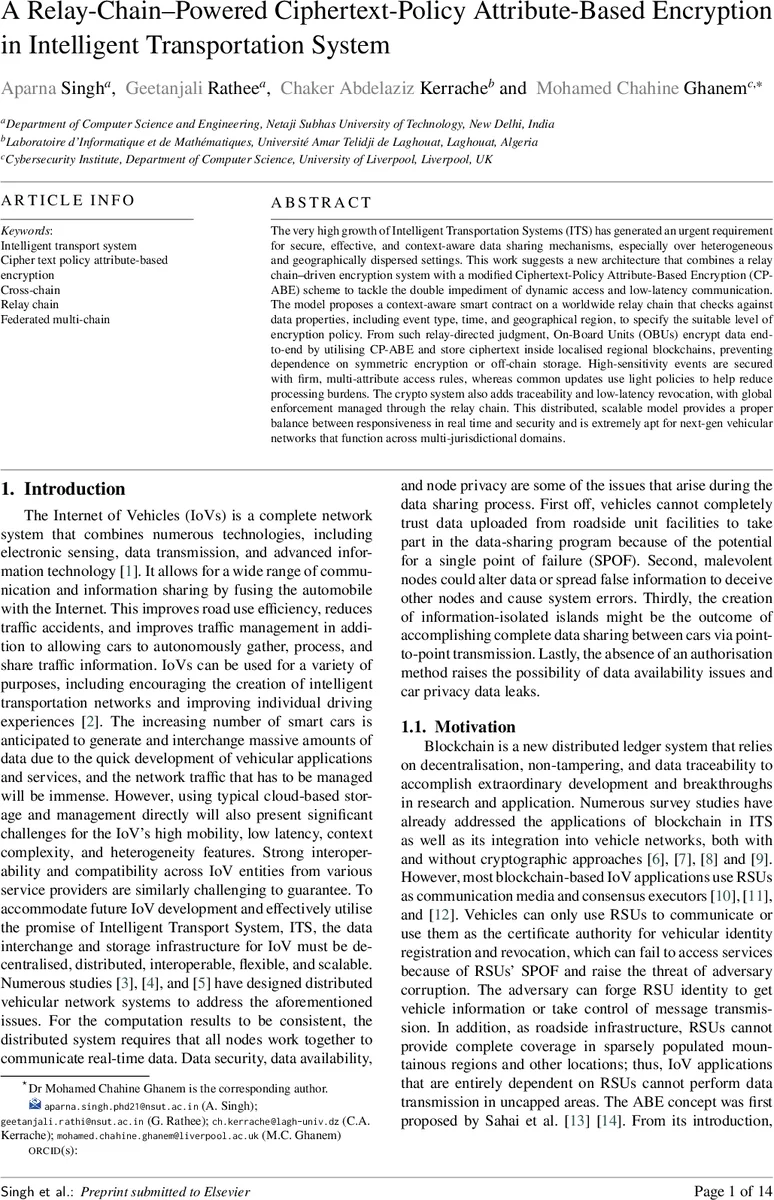
The very high growth of Intelligent Transportation Systems (ITS) has generated an urgent requirement for secure, effective, and context-aware data sharing mechanisms, especially over heterogeneous and geographically dispersed settings. This work suggests a new architecture that combines a relay chain-driven encryption system with a modified Ciphertext-Policy Attribute-Based Encryption (CP-ABE) scheme to tackle the double impediment of dynamic access and low-latency communication. The model proposes a context-aware smart contract on a worldwide relay chain that checks against data properties, including event type, time, and geographical region, to specify the suitable level of encryption policy. From such relay-directed judgment, On-Board Units (OBUs) encrypt data end-to-end by utilising CP-ABE and store ciphertext inside localised regional blockchains, preventing dependence on symmetric encryption or off-chain storage. High-sensitivity events are secured with firm, multi-attribute access rules, whereas common updates use light policies to help reduce processing burdens. The crypto system also adds traceability and low-latency revocation, with global enforcement managed through the relay chain. This distributed, scalable model provides a proper balance between responsiveness in real time and security and is extremely apt for next-gen vehicular networks that function across multi-jurisdictional domains.
💡 Research Summary
The paper proposes a novel data‑sharing framework for Intelligent Transportation Systems (ITS) that tightly integrates a globally distributed relay‑chain with a modified Ciphertext‑Policy Attribute‑Based Encryption (CP‑ABE) scheme. The core idea is to place a context‑aware smart contract on the relay‑chain that inspects incoming data attributes—such as event type (e.g., accident, congestion), timestamp, and geographic region—and dynamically determines the appropriate encryption policy. High‑sensitivity events trigger a strict multi‑attribute CP‑ABE policy, while routine updates may be encrypted with a lightweight policy or left in clear to meet low‑latency requirements.
On‑Board Units (OBUs) in each vehicle perform the encryption locally using a lightweight CP‑ABE variant that embeds the vehicle’s identity into the secret key and relies on the q‑SDH assumption for efficient revocation. The ciphertexts, together with minimal metadata, are stored directly on regional blockchains that correspond to specific geographic zones. A two‑layer blockchain architecture is employed: regional chains handle fast, local transactions and store the encrypted payloads, whereas the relay‑chain maintains global attribute definitions, revocation lists, and cross‑region indexing. This design eliminates the need for roadside units (RSUs) as trusted intermediaries, thereby removing single points of failure and reducing communication overhead.
Key contributions include: (1) a relay‑guided, context‑aware encryption switching mechanism that balances security and latency; (2) a unified ciphertext structure (CT_f) that accommodates both encrypted and plain payloads, simplifying storage and parsing across chains; (3) an OBU‑only encryption approach that demonstrates feasibility of CP‑ABE on resource‑constrained devices; and (4) a federated multi‑region blockchain architecture with direct inter‑chain communication and uniform revocation handling.
The authors position their work against prior studies that either rely heavily on RSUs, use single‑authority ABE, or focus on policy‑hiding without addressing real‑time constraints. By combining smart‑contract‑driven policy selection with a distributed ledger for attribute management, the proposed system aims to provide fine‑grained, tamper‑evident access control while preserving the responsiveness required for vehicular applications.
However, the paper has several limitations. It lacks empirical performance measurements on actual OBUs (e.g., ARM Cortex‑M or similar) to substantiate the claimed low computational overhead of the modified CP‑ABE. The impact of the relay‑chain’s consensus latency on overall end‑to‑end delay is not quantified, nor is the scalability of global attribute and revocation storage under heavy load examined. Potential issues such as policy conflicts during dynamic switching, consistency of data across regional chains, and the burden on the relay‑chain when many jurisdictions simultaneously update attributes are not fully addressed. Moreover, security analysis focuses mainly on confidentiality and revocation but does not explore resistance to adaptive chosen‑ciphertext attacks or side‑channel leakage in the OBU implementation.
In summary, the paper introduces an innovative architecture that merges context‑aware smart contracts, lightweight CP‑ABE, and a dual‑layer blockchain to meet the dual challenges of security and low latency in next‑generation vehicular networks. While the conceptual design is compelling and aligns with emerging multi‑chain ecosystems, further experimental validation, detailed performance benchmarking, and comprehensive security proofs are required before the solution can be considered ready for real‑world deployment in large‑scale ITS deployments.
Comments & Academic Discussion
Loading comments...
Leave a Comment